Why Don’t Humans Have a Mating Season? The Reason Is Surprisingly Intimate
Birth records, search patterns, and the timing of holidays uncover an intriguing pattern in human reproduction that goes beyond mere winter romance.

Human desire defies the calendar’s neat boundaries. Babies are born every month, couples form in every season, and people don’t wait for a narrow yearly window to reproduce. At first, the idea of a human mating season seems like a category mistake.
Yet, birth records reveal a rhythm. In many Western countries, September births are unusually common, pointing back to conceptions around late December. This timing raises an obvious possibility: perhaps winter’s short days, cold weather, or more time indoors influence human reproduction.
The pattern becomes harder to explain once it moves beyond hospital records. Search engines, religious calendars, holiday timing, and public mood on social media all leave clues. Taken together, they suggest that the calendar can shape sexual behavior, but not in the same way it does for seasonal animals.
Humans Don’t Wait for a Single Breeding Window
Scott Travers, an evolutionary biologist at Rutgers University, points to concealed ovulation as one reason humans don’t have a strict human mating season. In many mammals, fertility is visible through behavior, scent, swelling, or seasonal receptivity. In humans, ovulation is much less obvious.
This matters because human sex is not organized around one brief fertile window. People can be sexually active outside the days when conception is most likely. Human relationships involve pair bonding, parenting, social intimacy, and long-term cooperation, not reproduction alone.
Franklin H. Bronson made a related point in his review published in The Quarterly Review of Biology. He described humans as having year-round fertility, while noting that reproduction can still be shaped by outside conditions. His review examined factors such as nutrition, temperature, and photoperiod, the length of daylight.
The December Clue Was Not Just About Winter
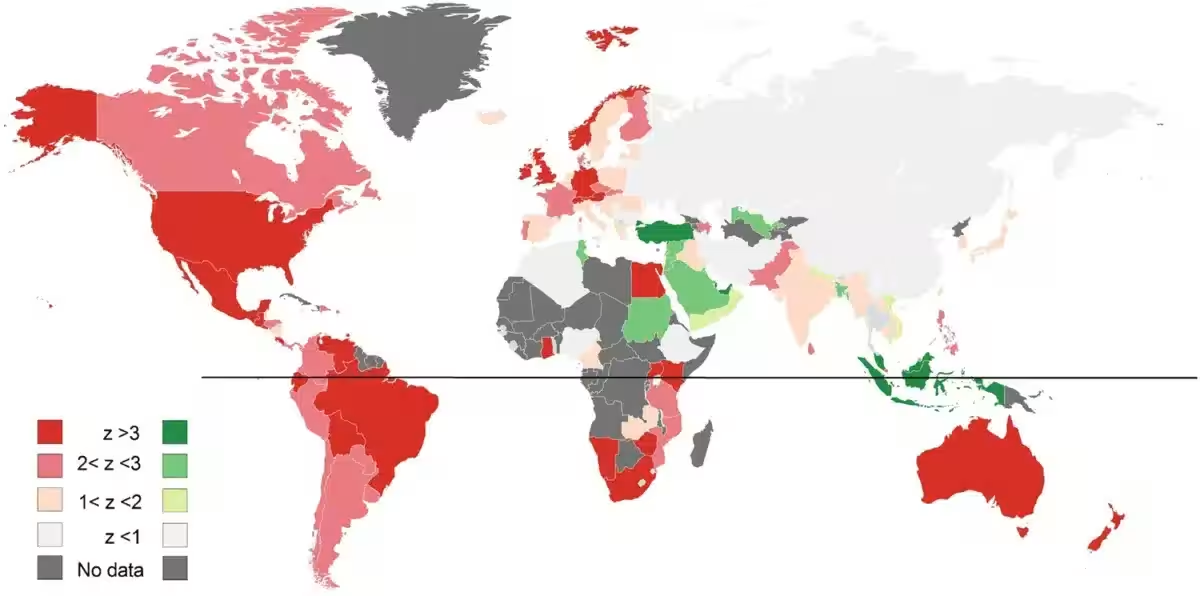
The older biological explanation had a simple test. If light, cold, or seasonal biology drives human reproduction, then countries in opposite hemispheres should show opposite patterns. A December conception peak in the Northern Hemisphere should become a June or July peak in the Southern Hemisphere.
That is where the 2017 Scientific Reports study added a sharper clue. Ian B. Wood of Indiana University and Pedro L. Varela of Instituto Gulbenkian de Ciência studied online behavior at a global scale. They used Google Trends data from 129 countries, along with birth records where those data were available.
Their result did not show that humans become seasonal breeders. Instead, searches related to sex rose around major cultural and religious celebrations. In Christian-majority countries, the clearest rise appeared around Christmas. In Muslim-majority countries, similar rises appeared around Eid-al-Fitr and Eid-al-Adha.

Holidays Left a Clearer Signal Than the Solstice
The Scientific Reports team compared biological and cultural explanations. If biology alone explained a human mating season, countries in the same hemisphere should have looked more alike. Instead, the pattern followed religion and holiday timing more closely than season.
The figures were clear. Among countries identified as Muslim, 77 percent showed a significant increase in sex searches during the week of Eid-al-Fitr. Among countries identified as Christian, 80 percent showed a significant increase during Christmas week, regardless of hemisphere. When Orthodox Christian countries that celebrate Christmas in early January were counted separately, the match rose to 91 percent.
The Muslim calendar offered another useful check. Ramadan and Eid move across the Gregorian calendar because the Islamic calendar is lunar. Even so, sex-search peaks moved with Eid rather than staying fixed to a solar season, which points toward culture rather than weather alone.
Search Peaks Lined Up With Later Births
The researchers did not rely on search data alone. They compared search peaks with birth records shifted by roughly nine months, the usual interval from conception to birth. In countries where birth data were available, the holiday search peaks lined up with later increases in births.
That does not mean every search reflected sex, pregnancy, or an attempt to conceive. Google Trends measures relative search interest, not private behavior. The study’s strength was that the pattern appeared across countries, hemispheres, religions, and moving holidays.
The team also examined Twitter data to see whether public mood changed during the same periods. They analyzed sentiment in seven countries with enough Twitter activity: Australia, Argentina, Brazil, Chile, Indonesia, Turkey, and the United States. Sex searches tended to rise when public mood was happier and less controlled, a pattern the experts linked to a holiday-related collective mood.
To measure that mood, the researchers used a method they called eigenmoods, which tracked shifts in the mix of emotions rather than simple happiness scores. Christmas and Eid-al-Fitr showed distinct mood patterns during the target weeks. That gave the study a second line of evidence beyond search traffic.
No Single Human Mating Season Appears
The best reading is not that humans secretly share one global human mating season. Bronson’s review shows that environment can influence human reproduction, while Travers’s explanation shows why strict seasonal breeding is unlikely. The Scientific Reports study adds that cultural calendars can leave a measurable mark.
So the phrase human mating season needs care. Humans can conceive throughout the year, and sexual behavior depends on relationships, opportunity, privacy, contraception, health, religion, and social life. The pattern is real, but it is not the same as heat, rut, or breeding season in other animals.
This article has been fact checked for accuracy, with information verified against reputable sources. Learn more about us and our editorial process.
Last reviewed on .
Article history
- Latest version
Reference(s)
- Bronson, F. H.. “Seasonal Variation in Human Reproduction: Environmental Factors.” The Quarterly Review of Biology, vol. 70, no. 2, June 1, 1995, pp. 141-164. University of Chicago Press, doi: 10.1086/418980. <https://www.journals.uchicago.edu/doi/10.1086/418980>.
- Wood, Ian. “Human Sexual Cycles are Driven by Culture and Match Collective Moods - Scientific Reports.”, vol. 7, no. 1, December 21, 2017, pp. 17973 Nature, doi: 10.1038/s41598-017-18262-5. <https://www.nature.com/articles/s41598-017-18262-5>.
Cite this page:
- Posted by Hassan Raza