Giant Moon Orbiting a Brown Dwarf Challenges How We Define Planets
Astronomers may have found the first exomoon beyond our solar system – a Jupiter‑mass companion orbiting a brown dwarf.
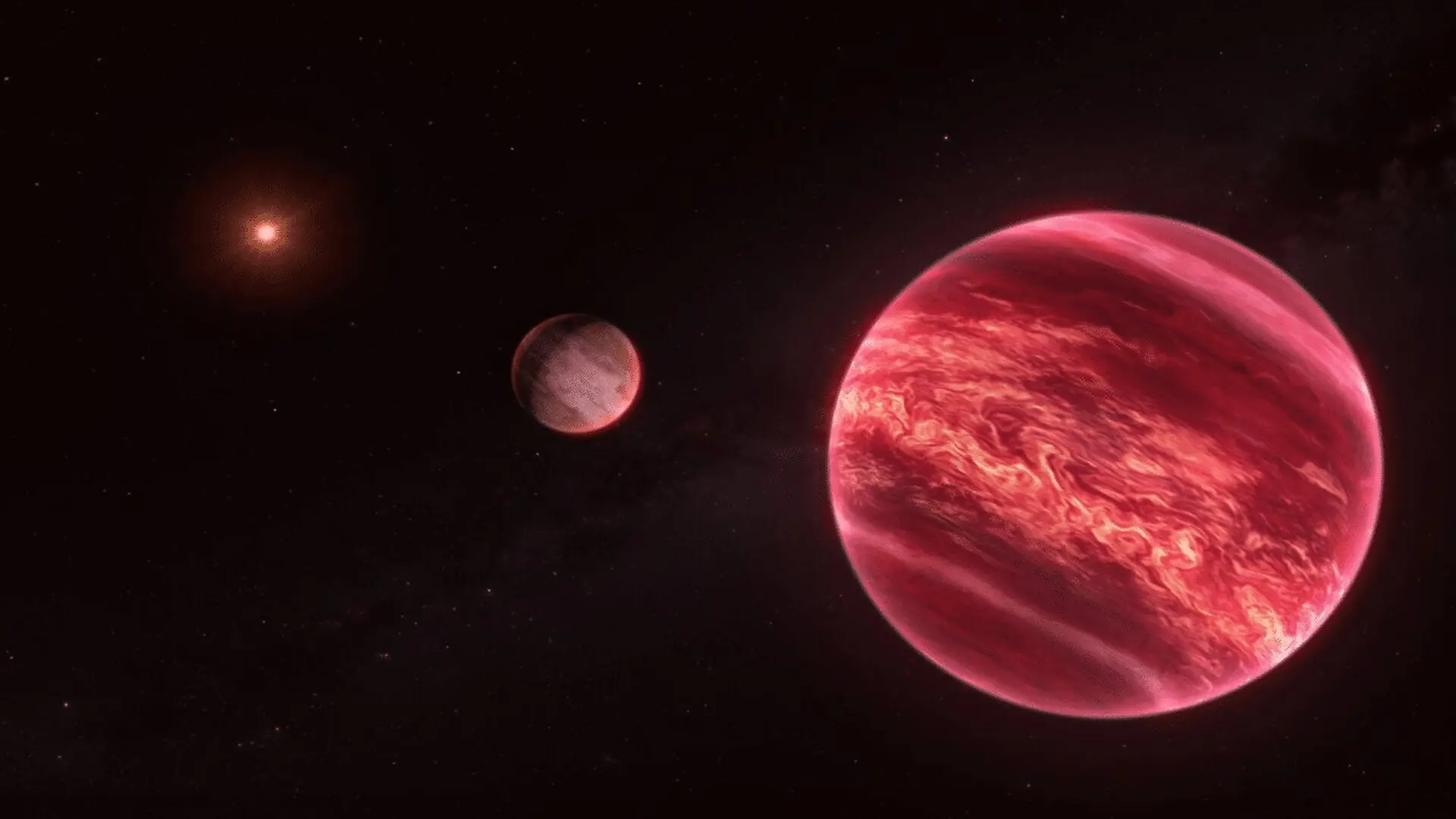
Using the European Southern Observatory’s Very Large Telescope, astronomers have identified a Jupiter‑sized body orbiting a brown dwarf in the CD‑35 2722 system. The findings, published in Nature, may constitute the first credible detection of an exomoon outside the Solar System.
A Multi‑Component System That Defies Classic Labels
The host star of the CD‑35 2722 system is about half the mass of the Sun and is accompanied by a brown dwarf weighing more than thirty times the mass of Jupiter. This substellar object, too heavy to be called a planet yet insufficiently massive for sustained nuclear fusion, in turn carries a companion whose mass rivals that of Jupiter itself.
Researchers refer to this Jupiter‑mass companion as an “exosatellite,” a term for a natural satellite found beyond our planetary neighborhood. Although it behaves like a moon by orbiting a secondary body, its size far exceeds any moon known in the Solar System.
Kevin Hoy, a student at the ESO in Chile and lead author of the study, explained the classification challenge: “The exosatellite is clearly massive enough to be a planet, but it does not orbit a star, though it orbits an object that orbits a star.” He added that its role as the “third wheel” of the system makes it tempting to label it a moon, despite its stark differences from the rocky moons familiar to us.
“The exosatellite is clearly massive enough to be a planet, but it does not orbit a star, though it orbits an object that orbits a star,” says Hoy. “Being the third wheel in this system makes us want to call it a moon, even if it is nothing like the small, rocky moons we have in our system.”
Potential First Evidence of an Exomoon
The discovery adds a new chapter to the ongoing quest for moons orbiting planets beyond the Sun. While more than 6,000 exoplanets have been catalogued, a firmly confirmed exomoon has remained elusive. The team employed the CRIRES+ spectrograph on the VLT and measured subtle radial‑velocity shifts in the brown dwarf, revealing the gravitational tug of the massive companion.
Alice Zurlo, director of the Millennium Nucleus of Young Exoplanets and their Moons (YEMS) and co‑author of the paper, described the find as “a giant gaseous body orbiting a highly massive companion, itself several times the mass of Jupiter.” She noted that the arrangement diverges sharply from the familiar Solar System hierarchy of a star, planets, and small moons.
Implications and the Road Ahead
If confirmed, this exosatellite could inaugurate a new subfield focused on satellites of objects that are not traditional planets. Studying such configurations may shed light on formation pathways for massive companions in young planetary environments.
The case also raises broader questions about whether astronomical taxonomy should remain rigid or evolve to accommodate the diverse architectures uncovered by modern surveys. Systems like CD‑35 2722 demonstrate that nature assembles bodies in ways that outstrip the categories derived from our own backyard.
Upcoming facilities, such as the 39‑meter Extremely Large Telescope, promise the sensitivity required to validate this candidate and to hunt for smaller moons around distant worlds. As observational power grows, astronomers anticipate a wave of discoveries that will further blur the lines between planets, moons, and brown dwarfs.
This article has been fact checked for accuracy, with information verified against reputable sources. Learn more about us and our editorial process.
Last reviewed on .
Article history
- Latest version
Cite this page:
- Posted by Aisha Ahmed