Slow Halo Rotation Hints Milky Way Flipped 90‑Degree In Ancient Gaia‑Sausage Merger
A new study suggests an event that may account for the unexpectedly slow rotation of a galaxy’s stellar halo.
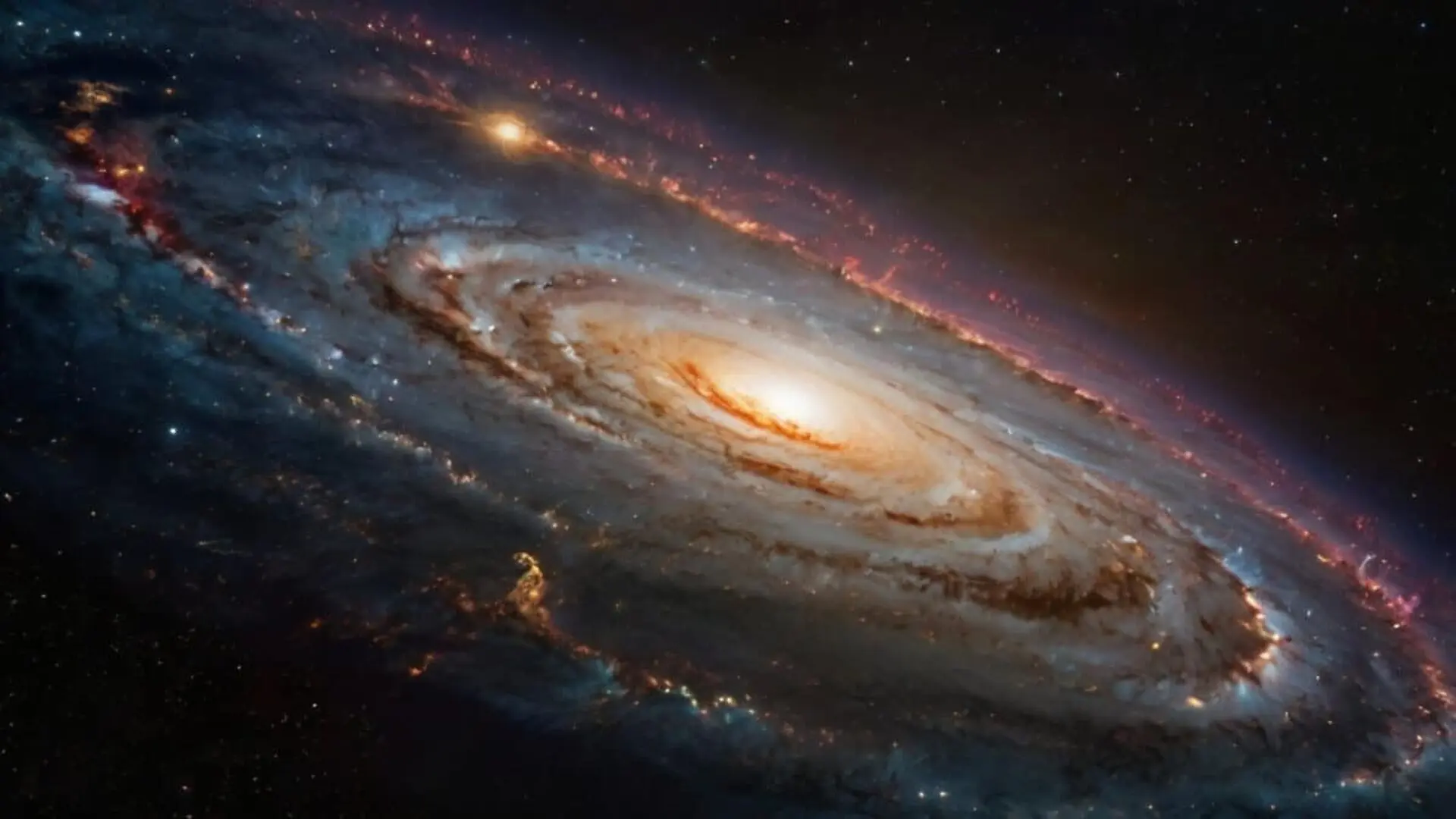
Although astronomers cannot watch events that occurred billions of years ago, the motions of ancient stars act like a fossil record of past galactic upheavals. Beyond the familiar spiral disc, the Milky Way’s stellar halo retains debris from long‑ago mergers and torn‑apart dwarf galaxies, offering clues to how our galaxy assembled.
One leading hypothesis ties the halo’s sluggish rotation to the ancient collision between the early Milky Way and a dwarf system dubbed Gaia‑Sausage‑Enceladus. Researchers suggest that this encounter may have tipped the disc’s orientation, leaving a measurable imprint in the halo’s slow spin.
Why the Milky Way’s Halo Turns So Slowly
The galactic disc races around the centre at roughly 220 km s⁻¹, while the surrounding halo drifts at only about 10–20 km s⁻¹. This discrepancy puzzles astronomers because most galaxy‑formation simulations predict more rapidly rotating haloes.
At the 2026 National Astronomy Meeting, Durham University researcher Kirill Batrakov presented a study that links the anomaly to a historic reorientation of the Milky Way. By analysing simulated galaxies that resemble the Milky Way, his team pinpointed the circumstances that produce unusually sluggish halo rotation.
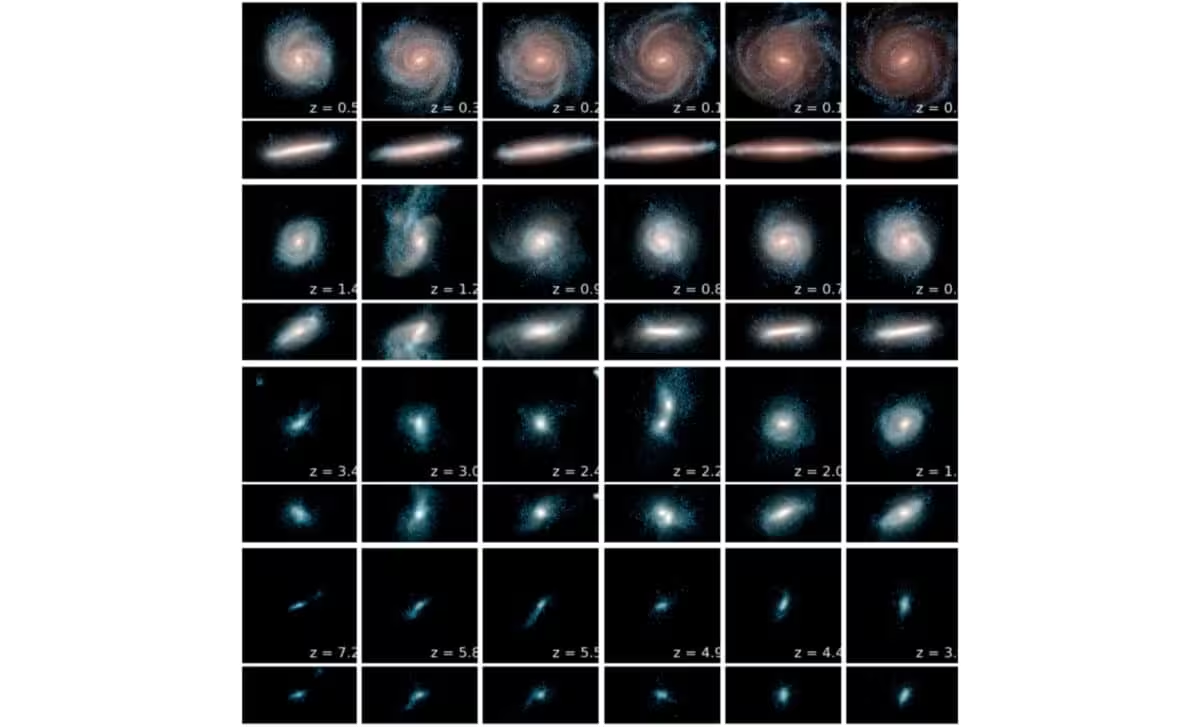
The investigation relied on the Auriga simulations, which model galaxy evolution through star formation, gas accretion, and successive mergers. Tracking halo spin over the past 11 billion years allowed the researchers to explore potential explanations for today’s observed state.
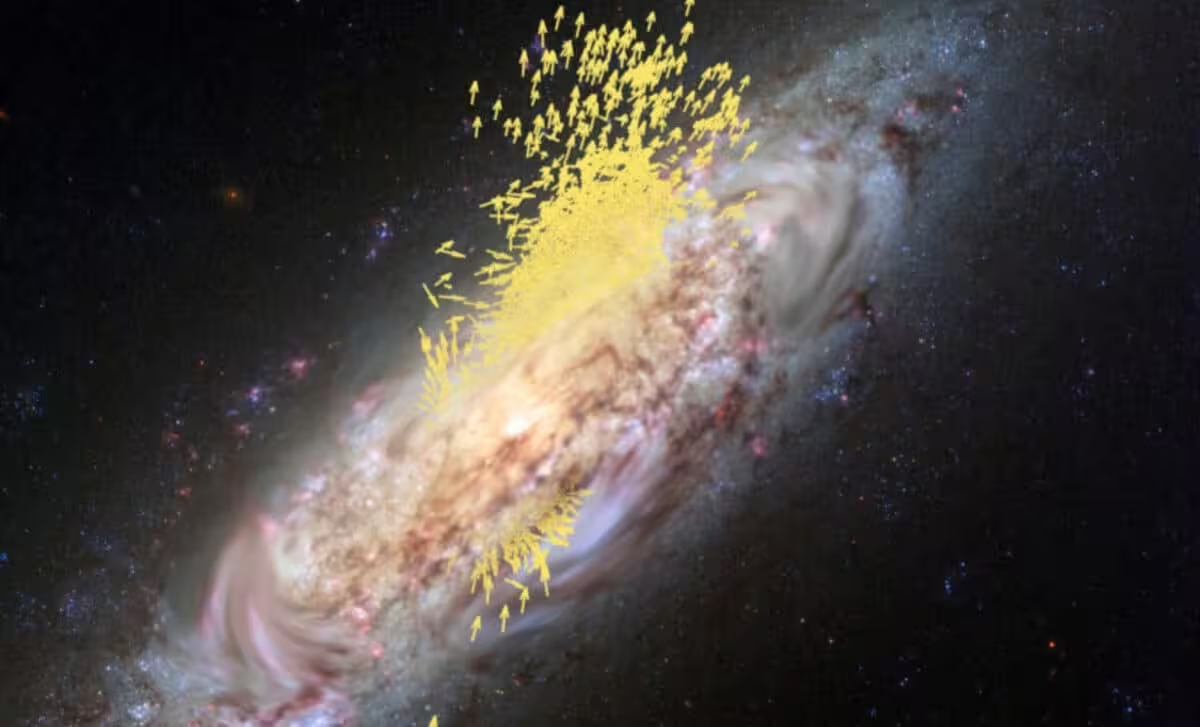
Although the halo hosts only a fraction of the galaxy’s stars, those few members retain the memory of past accretion events. Many were once part of dwarf galaxies that the Milky Way ripped apart, sending their stars onto new orbits around the larger system.
A 2017 analysis led by Alis Deason, now a co‑author on Batrakov’s paper, reported an average prograde halo rotation of about 14 km s⁻¹. That work combined early Gaia data with archival imagery from the Sloan Digital Sky Survey.
The Gaia‑Sausage‑Enceladus Encounter
The proposed scenario centers on Gaia‑Sausage‑Enceladus, the remnants of a dwarf galaxy that merged with the Milky Way roughly 8–11 billion years ago. Astronomers uncovered this ancient merger by examining the chemical fingerprints and atypical motions of halo stars.
Stars associated with the event follow highly elongated trajectories, plunging toward the galactic centre and then soaring back out. When their velocities are plotted, the distribution stretches into a shape that inspired the “Sausage” nickname.
Batrakov notes that the term “collision” can be misleading because galaxies consist mostly of empty space; direct stellar impacts are rare. Instead, gravity stretches and disrupts the smaller system, gradually dispersing its stars throughout the larger host.
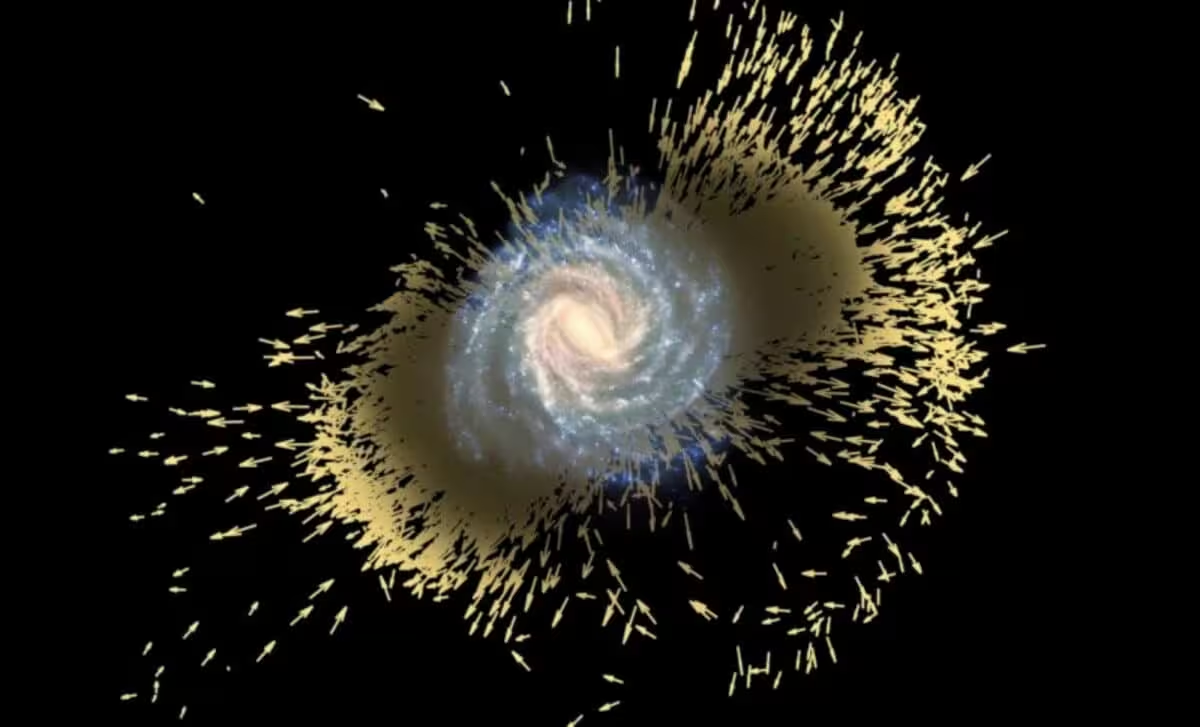
During such mergers, gas clouds can interact and the evolving gravitational field can reshape the host galaxy’s structure and tilt its disc. In Batrakov’s Auriga‑based simulations, systems that experienced Gaia‑Sausage‑like mergers frequently developed slower‑spinning stellar haloes.
While the team cannot claim 100 percent certainty that this process drove a potential flip of the Milky Way, the models suggest the merger is a plausible contributor. The analysis shows a correlation between slow halo rotation, major accretion events, and disc reorientation, without definitively proving causation.
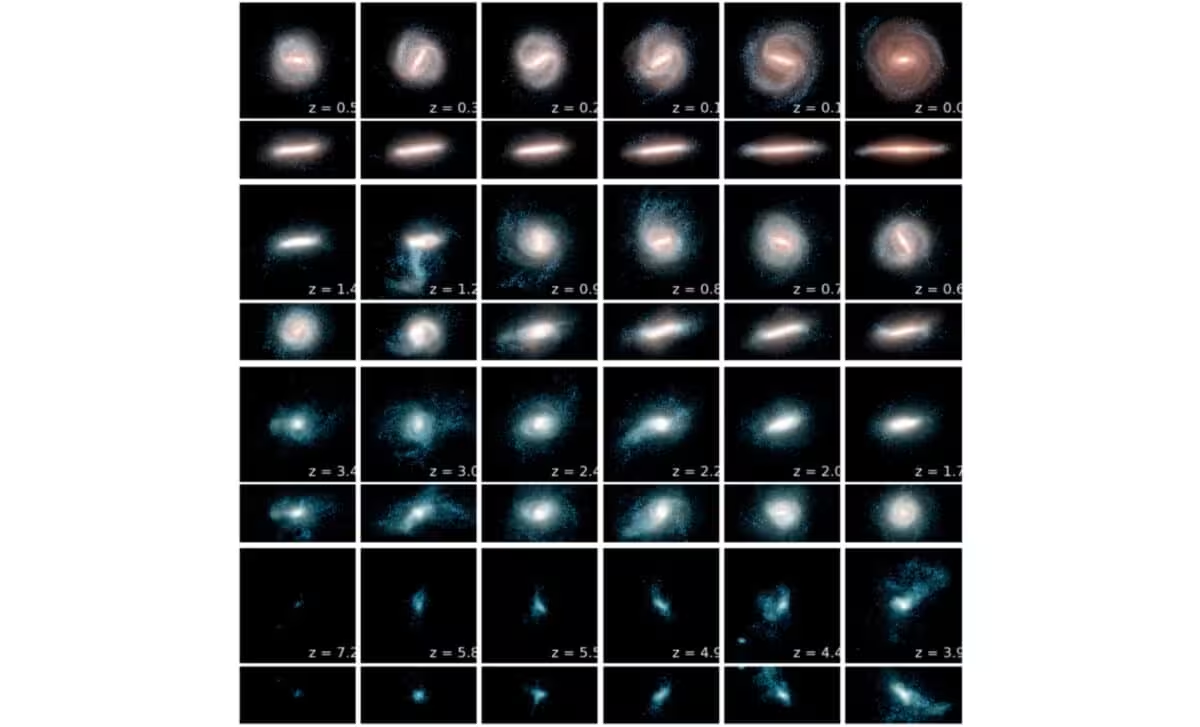
How a Galactic Reorientation Might Have Unfolded
A “flip” does not imply that the Milky Way turned over like a solid object. Because space lacks a fixed up or down, astronomers define a flip by a shift in the galaxy’s angular‑momentum vector—the imaginary line marking its rotation axis. A change exceeding 90 degrees qualifies as a flip.
The transformation would have been gradual. In the simulations, the fastest flips completed in roughly 150 million years, whereas the most prolonged events spanned 1–2 billion years.
If Earth had been present during such a transition, the change would likely have been imperceptible from the planet’s perspective. The Sun, bound to the disc, would have moved with the bulk of the Milky Way’s stellar population as the overall structure evolved.
Additional studies support the idea of a changing orientation. A 2026 investigation led by Ling Zhu examined over 600 000 giant stars observed by Gaia and the LAMOST telescope to reconstruct the galaxy’s dark‑matter halo. The authors proposed that the outer halo may be oriented nearly vertically relative to the disc, while the inner halo and disc exhibit a modest tilt.
Future work will aim to pinpoint further signatures of a possible reorientation, such as variations in halo spin with radius, stellar age, and chemical makeup, as well as mismatches between the orientations of the disc, halo, and dark matter.
For Batrakov and his collaborators, confirming which of these markers survive a major flip—and locating them in the real Milky Way—will require dedicated follow‑up investigations.
This article has been fact checked for accuracy, with information verified against reputable sources. Learn more about us and our editorial process.
Last reviewed on .
Article history
- Latest version
Reference(s)
- <https://academic.oup.com/mnras/article/467/1/179/2896681?login=false>.
- “Sloan Digital Sky Survey.” <https://classic.sdss.org/gallery/>.
- <https://academic.oup.com/mnras/article/470/2/1259/3854800>.
- “GaiaCombo Web Abstracts.” <https://cloud-1de12d.becdn.net/customfile/af0211836f81c10031bccbc7efc779bc0f94adfcac658552def131adc5ba8ebe/GaiaCombo-web-abstracts.pdf>.
Cite this page:
- Posted by Aisha Ahmed