An 8-Year-Old Boy Spotted “Seeds” in His Backyard and Accidentally Broke a 100-Year-Old Biology Rule
An 8-year-old’s backyard discovery unveiled a clever biological deception camouflaged in plain view throughout all oak woodlands globally.
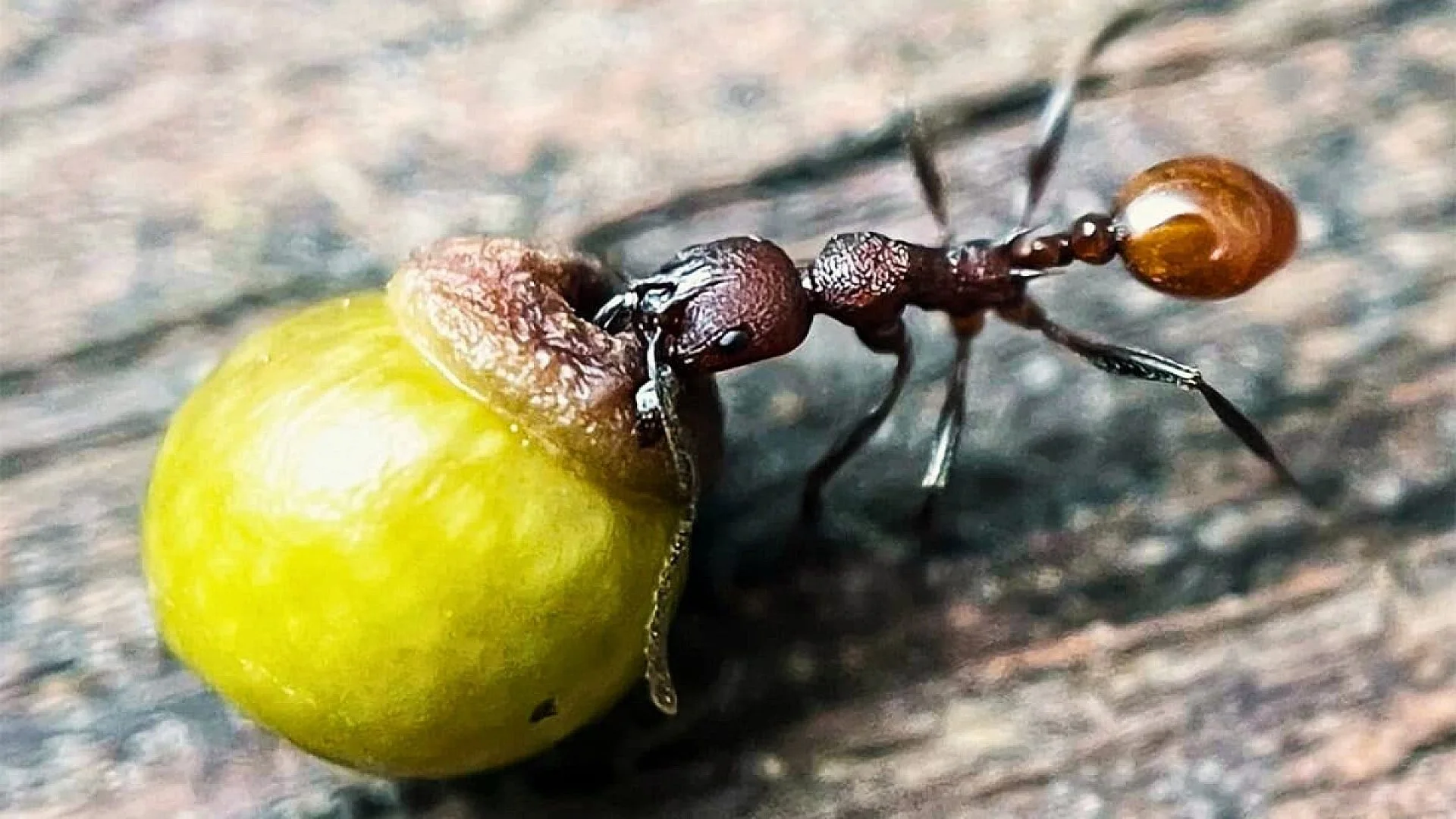
Deep in the heart of a 13-year-old’s backyard, a serendipitous discovery unfolded like a scene from a nature documentary. Hugo Deans, an 8-year-old at the time, stumbled upon an intriguing sight while exploring the fallen logs in his yard. A cluster of tiny, seed-like structures near an ant nest caught his attention, prompting him to call his father, Andrew Deans, over for a closer look. Andrew, a renowned professor of entomology at Penn State University, was about to uncover a groundbreaking secret that would rewrite the textbooks on plant-insect interactions.
Those seed-like structures, it turned out, were not seeds at all, but rather oak galls – living chambers created by the tree around wasp larvae. The ants, oblivious to the intricate relationship, were carrying these galls home like groceries, completely unaware of the complex dance unfolding before them. This phenomenon, documented in a study published in The American Naturalist, revealed that certain oak galls have evolved to hijack ant behavior using the same chemical signals plants use to disperse their seeds underground.
The Hidden Trade
For over a century, biologists have known that many plants bribe ants into moving their seeds, a phenomenon called myrmecochory. This system relies on a fatty attachment called an elaiosome fixed to the seed coat. Ants carry the seed underground, eat the elaiosome, and leave the seed in a protected, nutrient-rich spot. This mutually beneficial relationship has been a cornerstone of introductory biology, but Hugo’s discovery revealed a hidden trade that had been operating in the shadows.
“Ants get a little bit of nutrition when they eat the elaiosomes, and the plants get their seeds dispersed to an enemy-free space,” said Andrew Deans. The intricate dance between plants, ants, and wasps had been unfolding for an unknown length of time, invisible to the naked eye because no one thought to look.
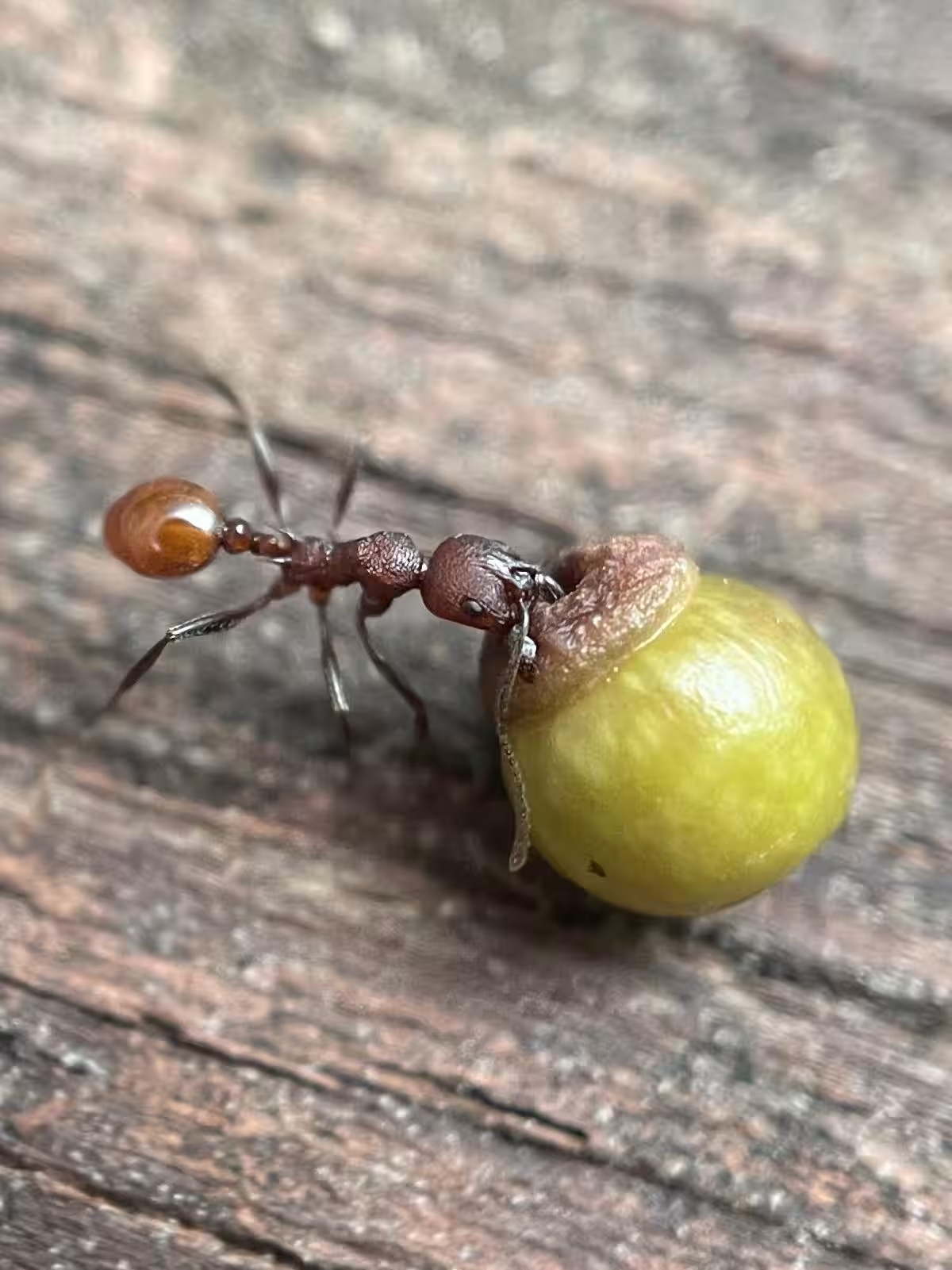
The galls, produced by two cynipid wasp species, Kokkocynips rileyi and Kokkocynips decidua, contain a pale, detachable cap called the “kapéllo,” named after the Greek word for hat. This cap is what the ants are attracted to, and it’s the key to understanding the complex relationship between the wasp, the oak tree, and the ants.
The Anatomy of Deception
Gas chromatography revealed that the kapéllos carry the same free fatty acids found in elaiosomes, including lauric, palmitic, oleic, and stearic acids. The chemical profile of a kapéllo matches an elaiosome far more closely than it matches the rest of the gall. To an ant navigating by smell, the two structures are nearly indistinguishable.
The anatomy of the gall follows the same logic. As the gall matures, the boundary between the kapéllo and the gall body stiffens and lignifies, creating a clean break point so the cap separates on contact, exactly as an elaiosome peels from a seed. The wasp does not produce this structure directly; it manipulates the oak’s own tissue growth during gall formation, essentially engineering a detachable lure out of the tree itself.
That is the part that makes this finding unusual. The wasp has no glands, no specialized organs for this. It redirects what the tree builds, creating a complex system that has been operating in the shadows for who knows how long.
Ants Responded Exactly as Predicted
Field tests in a New York forest placed bloodroot seeds and K. rileyi galls in small dishes side by side. Aphaenogaster picea, the ant species responsible for most seed dispersal in that ecosystem, cleared both dishes at nearly identical rates over roughly 90 minutes. In the lab, researchers gave ants four options at once: intact galls, galls with the kapéllo removed, isolated kapéllos, and control galls from a species that grows no kapéllo at all.
The ants ignored the stripped galls and the controls. They went straight for the kapéllo, whether it was still attached or sitting loose in the dish. The larva inside the intact gall stayed untouched throughout. The chemical signal was sufficient on its own.
What the experiment ruled out matters as much as what it confirmed. Ants were not responding to the gall’s shape, size, or color. The kapéllo’s fatty acid chemistry was doing all the work.
Why Going Underground Helps the Wasp
Adult wasps can fly, so moving a gall a few meters is not about dispersal. The researchers point to protection as the more likely payoff. Ant nests are chemically hostile environments, saturated with antimicrobial compounds the colony produces to suppress pathogens. A larva deposited inside one is shielded from the birds, rodents, and parasitic wasps that comb the forest floor, and from the mold that spreads freely through the leaf litter outside.
The researchers describe this as convergent evolution, the same solution appearing independently across unrelated organisms. Plants evolved elaiosomes. Stick insects developed fatty egg capsules that trigger identical ant behavior. Cynipid wasps appear to have arrived at the same result through a different path entirely, by borrowing the oak’s biology rather than developing their own.
Each case involves a small fatty structure that cues the same ant response. The signal is simple. The consequences compound.
What This Changes for Forest Ecology
Oak galls are not rare or subtle. They cover forest floors densely enough in late summer and fall that they were historically gathered as livestock feed. If ant-mediated gall transport operates at that scale across multiple wasp species, it represents a channel through which nutrients, microbes, and potential pathogens move through forest systems annually, a channel ecologists have not been accounting for.
“I was surprised that ants would collect galls,” said Hugo, now 13. “Why would they do that?” The answer, built from field trials, chemical analysis, and microscopic anatomy, is that the wasp gave them an extremely precise chemical reason.
The study is the first to document this interaction with evidence across all three levels. Whether other gall-forming species use the same mechanism is a question the researchers have not yet answered.
This article has been fact checked for accuracy, with information verified against reputable sources. Learn more about us and our editorial process.
Last reviewed on .
Article history
- Latest version
Reference(s)
- LaJeunesse, Sara. “Boy’s discovery reveals highly complex plant-insect interaction.”, September 1, 2022 Penn State News <https://www.psu.edu/news/research/story/boys-discovery-reveals-highly-complex-plant-insect-interaction>.
- <https://www.sciencedirect.com/topics/earth-and-planetary-sciences/myrmecochory>.
- <https://www.sciencedirect.com/topics/agricultural-and-biological-sciences/elaiosome>.
- projects, Contributors. “genus of insects.”, July 31, 2007 Wikimedia Foundation, Inc. <https://en.wikipedia.org/wiki/Aphaenogaster>.
Cite this page:
- Posted by Hassan Raza