ESA Images Reveal Hundreds of Mars Spiders Carving Webs Across Inca City
Mysterious spider-like dark spots on Mars expand as a hidden process beneath the polar ice reveals an unexpected, eerie phenomenon.
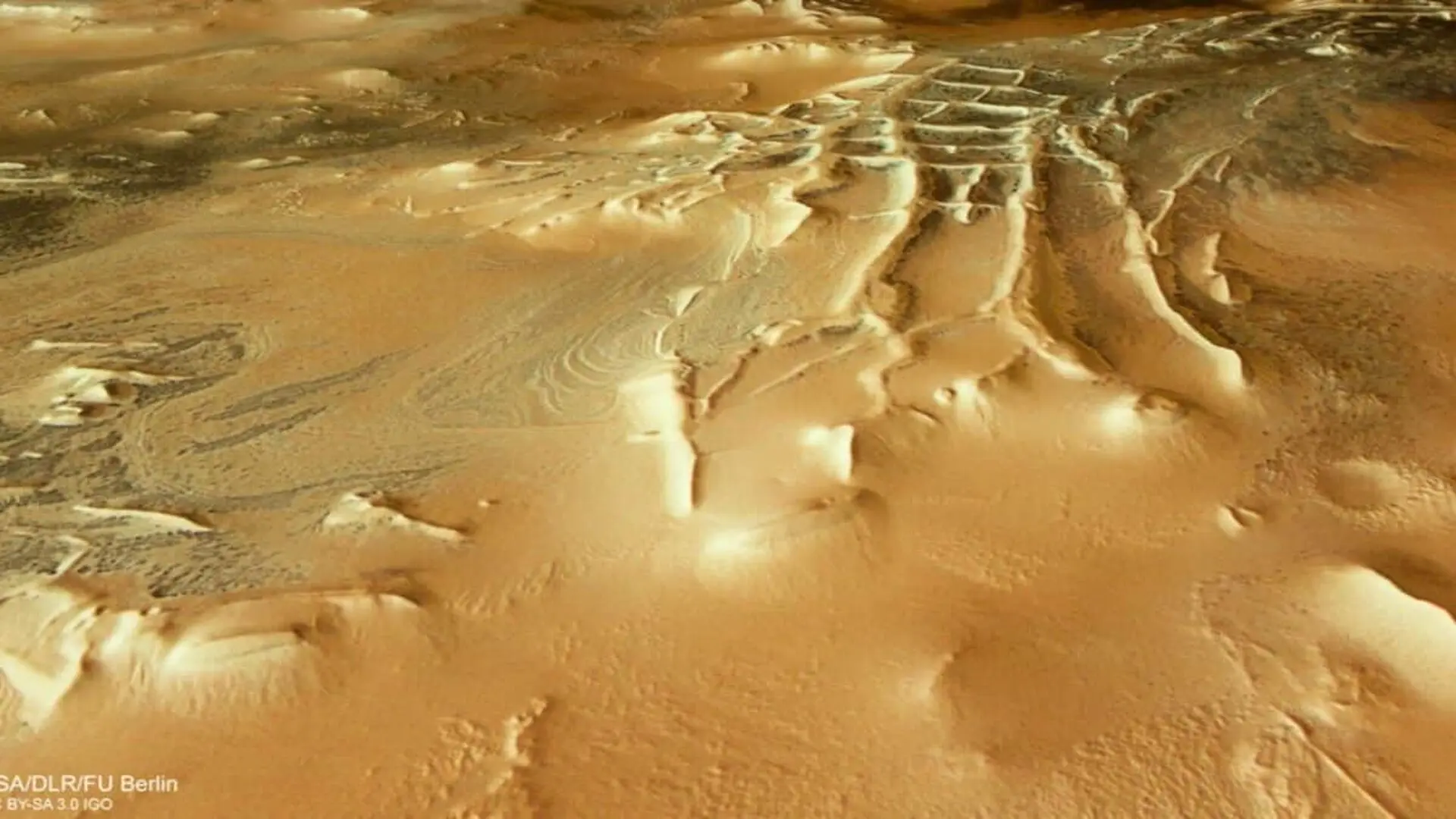
A network of dark, spider‑shaped markings blankets portions of the southern polar region of Mars, including the area dubbed Inca City. High‑resolution pictures taken by the European Space Agency’s Mars Express orbiter reveal these patterns spread across plateaus, hills and the margins of a ridge complex near the planet’s south pole.
Spring sunlight triggers gas eruptions beneath seasonal carbon‑dioxide ice
During the long Martian winter, carbon dioxide from the thin atmosphere settles as a translucent frost over the polar terrain. When spring arrives, sunlight penetrates the ice, warming the layer that contacts the darker ground below.
The heated carbon dioxide sublimates—transitioning directly from solid to gas—while remaining trapped under the still‑solid slab. Pressure builds until cracks open in ice sheets that can be up to a metre thick.
The escaping gas, mixed with dust, erupts through these fissures, creating what the European Space Agency describes as “tall fountains or geysers.” The dark particles are carried upward, then fall back onto the bright surface, forming the characteristic spots that range from about 45 metres to a kilometre across.
As the pressurised gas moves beneath the ice, it follows multiple pathways that carve branching channels. These radiating grooves, hidden below the seasonal frost, give rise to the spider‑like silhouettes visible in orbital images.
Dual perspectives from Mars Express and ExoMars Trace Gas Orbiter
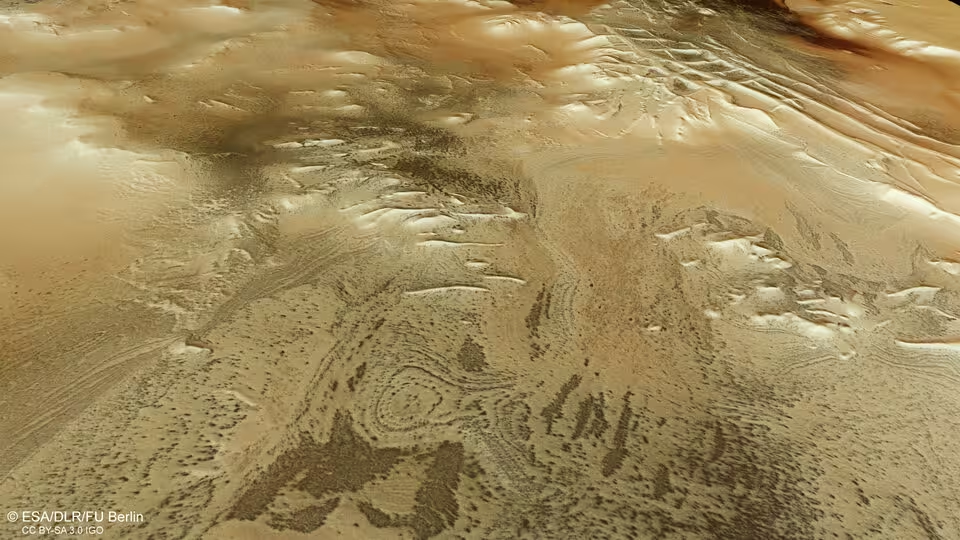
Mars Express captured the broad landscape and the dark deposits left by the gas eruptions. Its High Resolution Stereo Camera recorded the terrain from several angles, enabling scientists to map the elevations of ridges, plateaus and hills surrounding the spider sites.
The ExoMars Trace Gas Orbiter, a second ESA mission, focused on the fine‑scale tendril‑shaped channels beneath the ice. Its observations show the same spider patterns, positioned just outside the region highlighted by the newer Mars Express images.
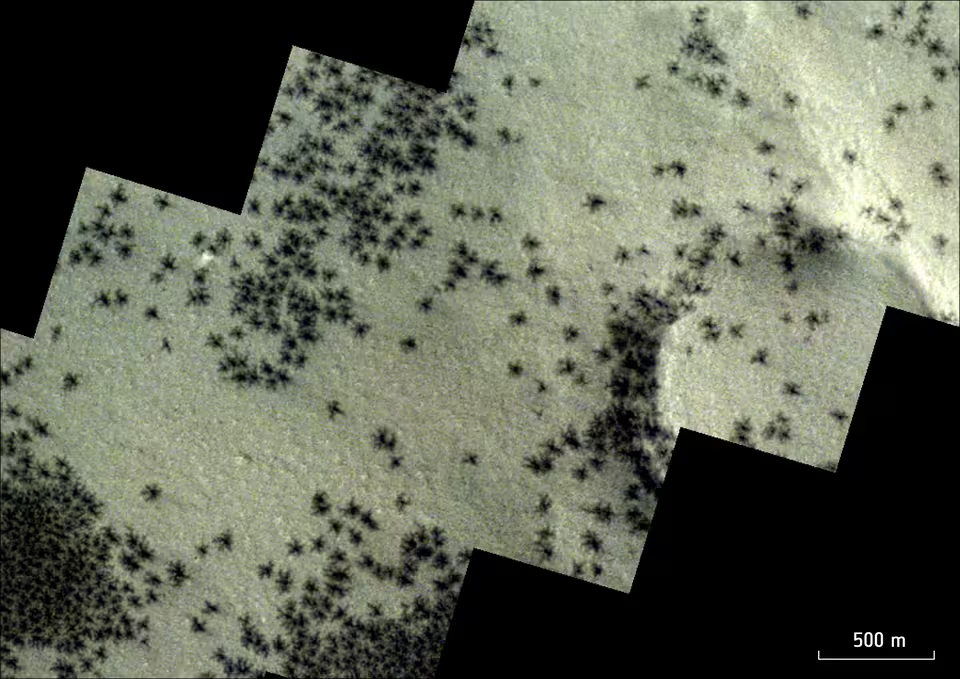
Together, the two datasets illustrate a single seasonal process: Mars Express documents the dust that settles after gas release, while the Trace Gas Orbiter reveals the web‑like grooves etched beneath the frost.
Inca City’s maze of ridges concentrates the spider markings
A large number of dark spots cluster around Inca City, formally known as Angustus Labyrinthus. The nickname stems from the region’s rectilinear, intersecting ridges that resemble the streets and walls of an ancient ruin when seen from orbit.
First identified by NASA’s Mariner 9 probe in 1972, the area spans roughly an 86‑kilometre‑wide circle. Researchers suspect the pattern sits within a massive impact crater, where the shock of a meteorite collision fractured the crust, allowing lava to intrude before later erosion exposed the more resistant material.
Alternative explanations propose that some ridges are cemented sand dunes, while others might be eskers—sinuous sedimentary ridges formed by glacial meltwater. Magmatic activity or sand movement through crustal fractures could also have contributed to the geometric layout.
Erosional features shape the surrounding terrain
Beyond the straight ridges, the Mars Express imagery displays rounded and oval formations that resemble marble swirls. ESA attributes these shapes to the gradual erosion of layered deposits, which gradually reveal different materials as the upper strata wear away.
Steep‑sided, flat‑topped hills rise more than 1,500 metres above the adjacent plains, formed as wind, water or ice stripped away softer rock and left behind more durable material.
Pale, fine‑grained dust coats parts of the northern side of the scene, yet spider‑type markings remain visible across several plateaus, intermingled with canyons, troughs and other surface features.
This article has been fact checked for accuracy, with information verified against reputable sources. Learn more about us and our editorial process.
Last reviewed on .
Article history
- Latest version
Reference(s)
- “Signs of spiders from Mars.” <https://www.esa.int/Science_Exploration/Space_Science/Mars_Express/Signs_of_spiders_from_Mars>.
Cite this page:
- Posted by Karan Das