Horses Make Two Sounds at Once, And One Is Actually a Whistle
Scientists have discovered that the high-pitched part of a horse’s whinny is not made by vibrating vocal folds, but by a whistle inside the larynx, revealing an unexpected source of vocal complexity in one of the world’s largest land mammals.
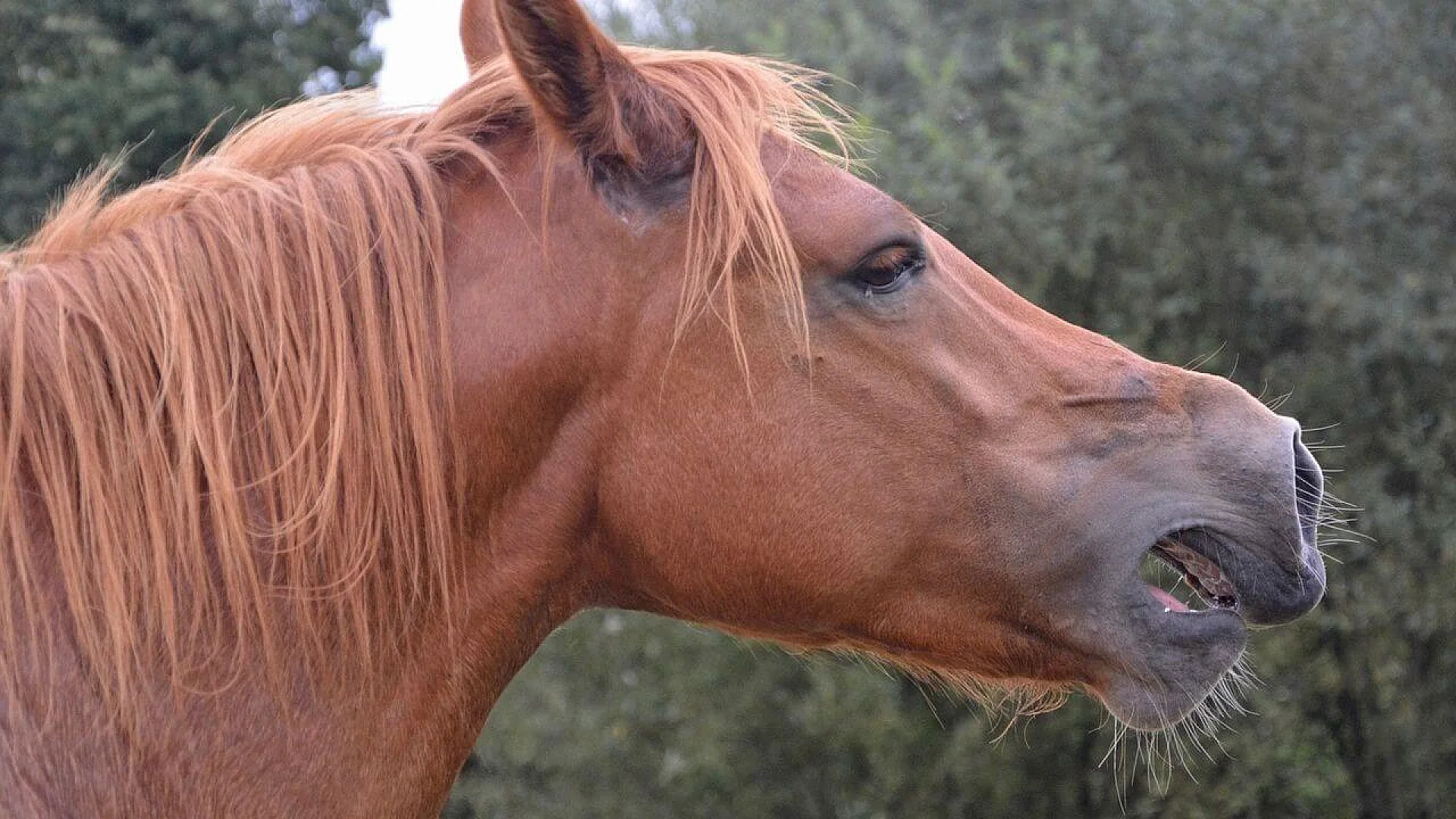
There is a general rule in biology. Small animals make high-pitched sounds. Large animals make low-pitched sounds.
This pattern is called acoustic allometry. It works because larger animals usually have longer and heavier vocal folds, and those tend to vibrate more slowly.
Horses mostly follow that rule. But not completely.
An adult horse can weigh around 500 kilograms. Based on size alone, its voice should stay under about 100 hertz. And part of its call does.
But when a horse whinnies, something unusual happens. Along with a low tone, it produces another sound that can rise above 1,000 hertz. On average, this high tone sits around 1,500 hertz.
That is far higher than expected for such a large mammal.
For years, scientists knew this high component existed. What they did not know was how it was produced.
Now, new research published in Current Biology shows that the answer is surprisingly simple, and also surprisingly elegant.
The high sound is a whistle.
Two Sounds at the Same Time
When you look at a horse whinny on a sound spectrogram, you see two separate lines.
One is the low fundamental frequency, called “fo.” It usually falls between about 200 and 400 hertz. This part matches what we expect from vocal fold vibration in a large animal.
The second is much higher. This one is called “go.” It often sits above 1,000 hertz.
These two frequencies happen at the same time. They are not harmonics of each other. They are independent.
This phenomenon is called biphonation, meaning two fundamental frequencies produced simultaneously.
In many mammals, biphonation happens only occasionally, often during strong emotional states. In horses, it is a normal and regular part of the whinny.
So the question became clear. Are both of these sounds made by vibrating vocal folds, or is something else happening?
A Simple but Powerful Test: Helium
To answer that question, researchers performed a clever experiment using helium.
Helium is less dense than air. If a sound is created by airflow and resonance, like a whistle, its frequency changes in helium. But if a sound comes from vibrating tissue, such as vocal folds, helium does not significantly change its pitch.
The team obtained six horse larynges and produced sounds in a lab setting. They created low-frequency sounds that matched fo, and high-frequency sounds that matched go. Then they repeated the process while flowing helium instead of normal air.
The results were striking.
The low-frequency sounds stayed almost the same in helium.
The high-frequency sounds shifted upward.
That shift is exactly what scientists expect from a whistle. It is not what they expect from vibrating tissue.
This was strong evidence that the high component of the whinny is generated by airflow, not by vocal fold vibration.
In simple words, horses are whistling inside their throats.
The Anatomy Did Not Add Up
Even before the helium experiment, the anatomy raised doubts.
Using CT scans of three horse larynges, researchers measured the length of the vocal folds. On average, they were about 24 millimeters long.
Based on well-established biomechanical models, vocal folds of that size can realistically produce frequencies up to around 400 hertz under strong tension. That fits the low fo component.
But producing 1,500 hertz by vibration alone would require extreme tissue stress, far beyond known physiological limits.
The math simply did not work.
The larynx was too large, and the vocal folds were too long, to vibrate that fast in a normal biological way.
However, CT scans also revealed something interesting. Researchers identified a small structure called an anterior bulla, located just above the glottis. Along with the lateral ventricles of the larynx, this cavity could help shape airflow and support a stable whistle.
There were no extra vibrating membranes or special tissue structures that could explain the high pitch.
Everything pointed toward airflow.
Watching a Whinny From the Inside
Lab experiments are powerful. But what happens in a living horse?
To find out, researchers performed endoscopic recordings on ten adult stallions. A small camera allowed them to observe the larynx during natural whinnies.
At the very beginning of a whinny, only the high-frequency go was present.
During this phase, the arytenoid cartilages moved inward. The glottis narrowed. Airflow was restricted through a tight opening.
This setup likely created a high-speed jet of air, which can produce vortex shedding and resonance, the physical basis of a whistle.
Later in the call, the thyroid cartilage tilted, and the vocal folds began vibrating. That produced the lower fo component.
For a period, both mechanisms operated together.
Statistical analysis showed only a weak correlation between fo and go. That suggests they are controlled separately, even though they overlap in time.
It is almost as if the horse’s larynx switches on one instrument, and then adds a second one.
A Natural Test Case: Horses With Nerve Damage
Researchers also studied horses with recurrent laryngeal neuropathy, a condition that partially paralyzes one vocal fold.
If the high-frequency go depended on vocal fold vibration, it should be disrupted in these animals.
It was not.
In affected horses, the low fo component was often unstable or completely absent. In some individuals, nearly one third of whinnies lacked a proper low tone.
But the high go component remained intact.
This difference was critical.
It showed that fo depends on vocal fold vibration, while go does not. The whistle mechanism works even when the vocal folds are impaired.
That finding reinforced the helium results and the anatomical evidence.
Why Would Horses Evolve This?
The next question is not about physics. It is about function.
Why would a large mammal evolve a dual sound system?
One possibility is communication efficiency. The low-frequency fo may carry information about body size or identity. The high-frequency go may reflect emotional arousal or urgency.
By separating information into two independent channels, horses may increase the complexity of their signals.
Another possibility involves signal salience. High-frequency sounds can stand out more clearly against background noise. In certain environments, they may travel differently or attract attention more effectively.
Interestingly, similar biphonic calls are found in the bugles of North American wapiti. However, in horses, this whistle mechanism appears to be fully integrated with normal vocal fold vibration.
Other equids, such as plains zebras and domestic donkeys, do not show systematic biphonation in the same way.
This suggests that the dual system evolved specifically in horses and closely related lineages.
Expanding What We Know About Mammalian Voices
Aerodynamic whistles are known in small rodents, like mice and rats. But clear experimental evidence of a laryngeal whistle in a large non-rodent mammal had not been demonstrated before.
This study changes that.
It shows that the mammalian larynx is more flexible than previously thought. It can function not just as a vibrating tissue source, but also as an airflow-driven whistle generator.
And in horses, it can do both at the same time.
That combination produces a rich, layered call that carries multiple streams of information.
A Whistle Hidden Inside a Familiar Sound
The horse’s whinny is one of the most recognizable animal sounds in the world. It is common in farms, fields, and films.
Yet inside that familiar call lies a hidden mechanism.
A narrow opening. A rush of air. A stable aerodynamic whistle.
For decades, the high pitch seemed like a mystery that did not fit biological rules about size and sound.
Now the explanation is clearer.
The horse does not break the rule of body size and voice pitch.
It simply adds a second voice.
And that second voice is a whistle.
The research was published in Current Biology on February 23, 2026.
This content has been reviewed by subject-matter experts to ensure scientific accuracy. Learn more about us and our editorial process.
Last reviewed on .
Article history
- Latest version
Reference(s)
- Lefèvre, Romain Adrien., et al. “The high fundamental frequency in horse whinnies is generated by an aerodynamic whistle.” Current Biology, vol. 36, no. 4, 23 February 2026 Elsevier, doi: 10.1016/j.cub.2026.01.004. <https://doi.org/10.1016/j.cub.2026.01.004>.
Cite this page:
- Posted by Zara Tariq