UVA Rays Through Car Windows Cause One‑Sided Facial Aging
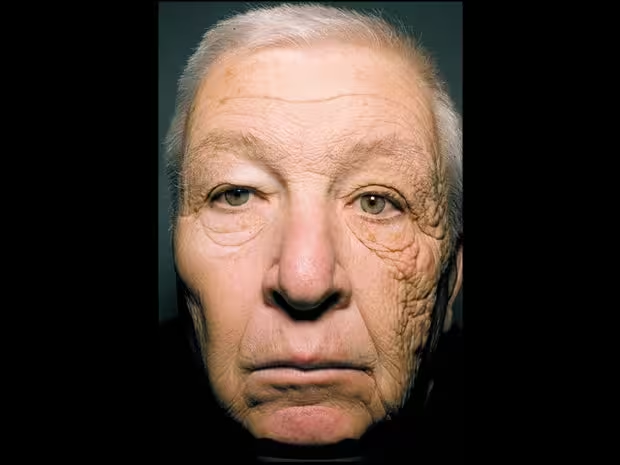
Truck driver spent decades behind cab windows, yet one side of his face shows hidden sunlight damage.

A 69‑year‑old truck driver exhibited deep furrows, thickened dermis, and other signs of intense solar injury predominantly on the left half of his face. He spent 28 years behind the wheel, with that side of his face consistently nearest the driver‑side window throughout his career.
The striking asymmetry was recorded in a case report in the New England Journal of Medicine. Clinicians identified the condition as unilateral dermatoheliosis, a form of chronic skin injury resulting from uneven ultraviolet exposure. The report demonstrated that sunlight filtered through a closed vehicle window can gradually degrade skin even without overt sunburn.
According to the medical article, the driver noted “progressive thickening and wrinkling” on the left side of his visage for roughly 25 years. While the alterations were not painful, the disparity between the two halves of his face grew increasingly apparent as the damage accrued.
Unequal Sun Damage Linked to UVA Penetration
Examination revealed deep wrinkles, a sturdier epidermal layer, open comedones, and tiny nodules on the more exposed side. Histologic analysis showed alterations in the dermis, the supportive tissue beneath the skin surface, including compromised elastic fibers and small cysts surrounding fine hair follicles.
These observations aligned with Favre‑Racouchot syndrome, a disorder tied to extensive solar injury that typically presents as coarse wrinkles, yellow‑tinged thickening, blackheads, and follicular changes. In this instance, those characteristics were largely confined to the side facing the truck’s window.
A CBS News story highlighted that the driver’s left side bore the brunt of exposure because of the many hours spent behind the wheel, while the right side—positioned farther from the glass—showed far fewer visible effects.
The disparity illustrates severe facial photoaging rather than a difference in chronological age. Both sides aged biologically at the same pace; however, one side absorbed a substantially larger ultraviolet dose over decades of driving.
Window Glass Allows UVA to Reach Skin
Sunlight contains several ultraviolet bands. UVB rays primarily affect the outermost skin layers and are closely linked to erythema and sunburn. Conventional automotive glass blocks much of UVB, giving occupants a false sense of protection.
UVA rays behave differently; they readily pass through glass and can infiltrate the epidermis and upper dermal layers. Consequently, a driver may accumulate repeated UVA exposure on the face, neck, hands, and forearms without experiencing the immediate burning sensation associated with UVB.
Prolonged UVA exposure can thicken both the epidermis and the stratum corneum, the outermost dead‑cell layer that serves as a barrier. It also degrades elastic fibers that enable skin to stretch and recoil, leading to a rougher texture, reduced flexibility, and deeper lines.
Because the driver’s genetics, diet, age, and other personal variables were identical on both sides, the pronounced contrast serves as a visual record of long‑term occupational sun exposure.
Chronic UV Exposure Harms More Than Appearance
While the case centered on visible aging, ultraviolet radiation also inflicts damage beneath the surface. UVA contributes to DNA injury and cellular stress, whereas UVB is strongly associated with mutations that can lead to skin cancer.
The report did not document malignancy in the driver, but physicians advised routine skin checks given the magnitude and duration of his exposure. They also recommended protective measures and the use of topical retinoids, vitamin‑A derivatives that can mitigate some signs of thickened, damaged skin.
The findings do not imply that every regular driver will develop such a stark bilateral difference. Instead, they illustrate how modest, repeated exposures can accumulate over decades, especially for truckers, delivery personnel, taxi operators, and others who spend extensive periods adjacent to vehicle windows.
Effective protection must address both ultraviolet bands. Broad‑spectrum sunscreens shield against UVA and UVB, while appropriate clothing, headwear, shade, and UV‑filtering window films can further limit radiation reaching exposed skin.
Occupational Sunlight Accumulates Over Decades
The striking photograph captured public attention because the contrast was immediately apparent, yet the underlying medical significance lies in the gradual process. The alterations did not result from a single intense bout of sun; they emerged slowly as the same skin region was bathed in filtered sunlight during routine driving.
This pattern underscores the relevance of occupational sun exposure for work performed inside vehicles. An individual does not need to labor outdoors with an uncovered head to acquire a substantial cumulative ultraviolet dose.
The original NEJM case linked the unilateral damage to the driver’s lengthy road career and the ability of UVA to traverse glass. It offers a vivid illustration of how everyday exposure can remodel skin structure and appearance over time.
This article has been fact checked for accuracy, with information verified against reputable sources. Learn more about us and our editorial process.
Last reviewed on .
Article history
- Latest version
Reference(s)
- Gordon, Jennifer R.S.., et al. “Unilateral Dermatoheliosis.” New England Journal of Medicine, vol. 366, no. 16, April 19, 2012, pp. e25 Massachusetts Medical Society, doi: 10.1056/NEJMicm1104059. <https://www.nejm.org/doi/full/10.1056/NEJMicm1104059>.
- Jaslow, Ryan. “Trucker accumulates skin damage on left side of his face after 28 years on the road.”, June 4, 2012 CBS News <https://www.cbsnews.com/news/trucker-accumulates-skin-damage-on-left-side-of-his-face-after-28-years-on-the-road/>.
Cite this page:
- Posted by Elizabeth Taylor