Fish and Urchin Grazing Reveal Hidden Shifts Across Reefs
Ecology

Fish and Urchin Grazing Reveal Hidden Shifts Across Reefs

Standardised assays across 29 degrees of latitude show that temperate reefs rely on sea urchins while tropical reefs depend on fish.
By Omar Mirza
Published:
Email this Article
Fish and Urchin Grazing Reveal Hidden Shifts Across Reefs
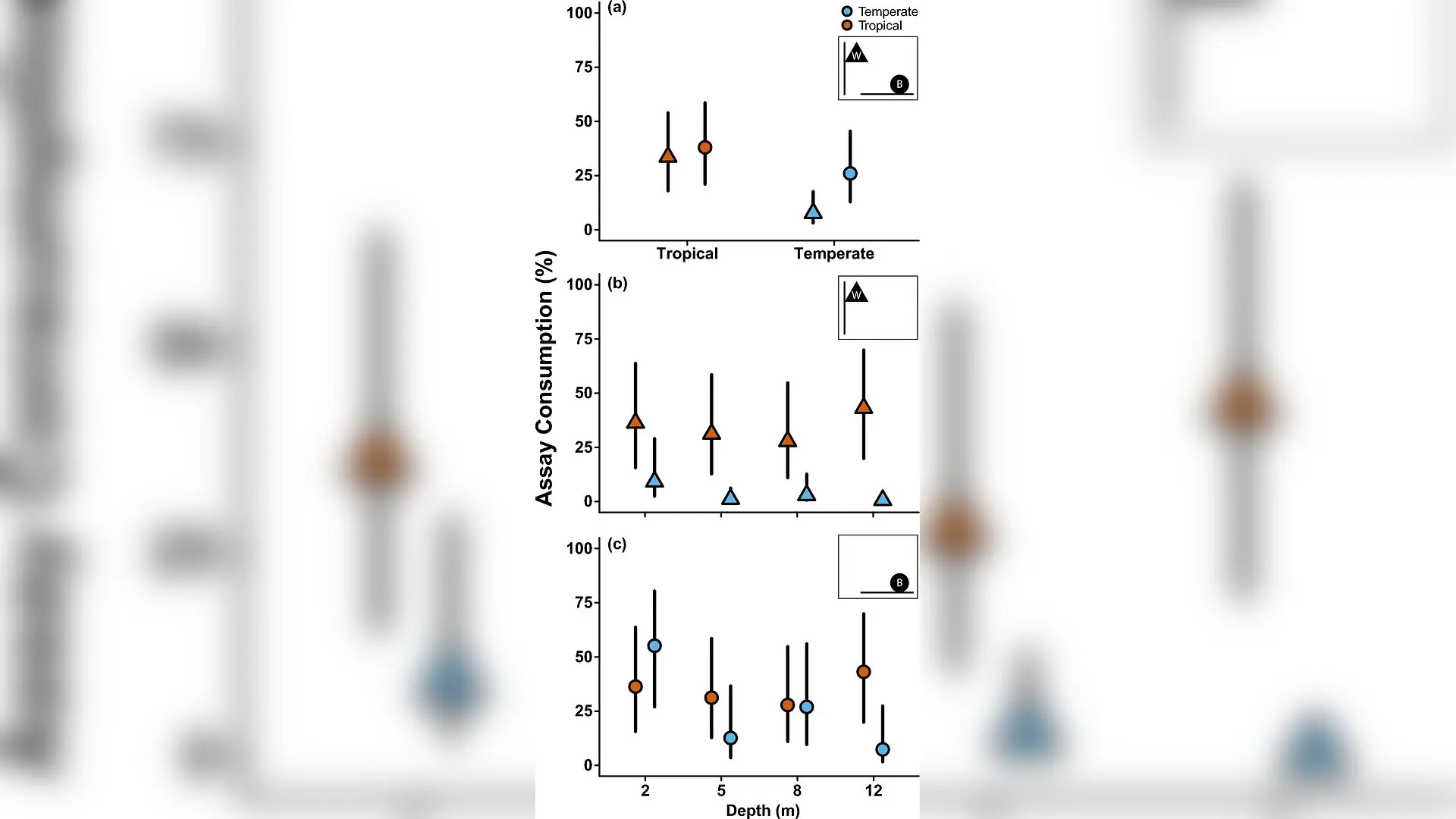
Percent consumption of algal assays suspended in the water-column (triangles) and laying across the benthos (circles) consumed between tropical (orange) and temperate (blue) thermal realms. (a) water-column and benthic assay consumption by thermal realm, (b) water-column assay consumption measuring relative fish herbivory by thermal realm and depth (2, 5, 8 and 12-m), and (c) benthic assay consumption by thermal realm and depth. For (a), assay partitioning differed significantly for temperate reefs but not tropical (temperate realm × water-column, P <0.001). For realm-level patterns in (a), models were conducted using data across n = 28 tropical and n = 21 temperate single-contour sites (N = 49); (b) and (c) were conducted using data from the six depth-stratified sites (one site per location, N = 6). Large points and line ranges denote estimated marginal means with 95% confidence intervals from generalised linear mixed effects models Matthew Rose et al. / Oecologia

Marine researchers examining eastern Australian coastal waters discovered that while tropical reefs experience intense fish grazing, temperate reef ecosystems rely heavily on bottom-dwelling sea urchins to consume vegetation. The comprehensive study, which spanned 49 sites across 29 degrees of latitude between 2022 and 2025, reveals fundamental differences in how plant consumption operates across thermal zones. The findings were published in Oecologia, shedding light on the structural forces shaping shallow marine habitats.

How Fish and Urchins Shape Coastal Waters

To measure relative plant consumption, the research team deployed 1,340 standardised macroalgal assays using rehydrated sea lettuce, scientifically known as Ulva lactuca. The experiment used two distinct deployment setups to separate the impact of swimming fish from bottom-dwelling grazers. Water-column assays were suspended above the sea floor on 650-millimetre fibreglass stakes so only fish could reach them, while benthic assays lay flat on the benthos to allow consumption by both fish and sea urchins.

Parallel underwater visual surveys involving 67 separate assessments documented local herbivore populations across depths of 2, 5, 8, and 12 metres. The team recorded the abundance and body size of all herbivorous fish and invertebrates across three tropical locations, including Lizard Island, Orpheus Island, and Heron Island, alongside three temperate locations near Sydney and northeastern and southeastern Tasmania.
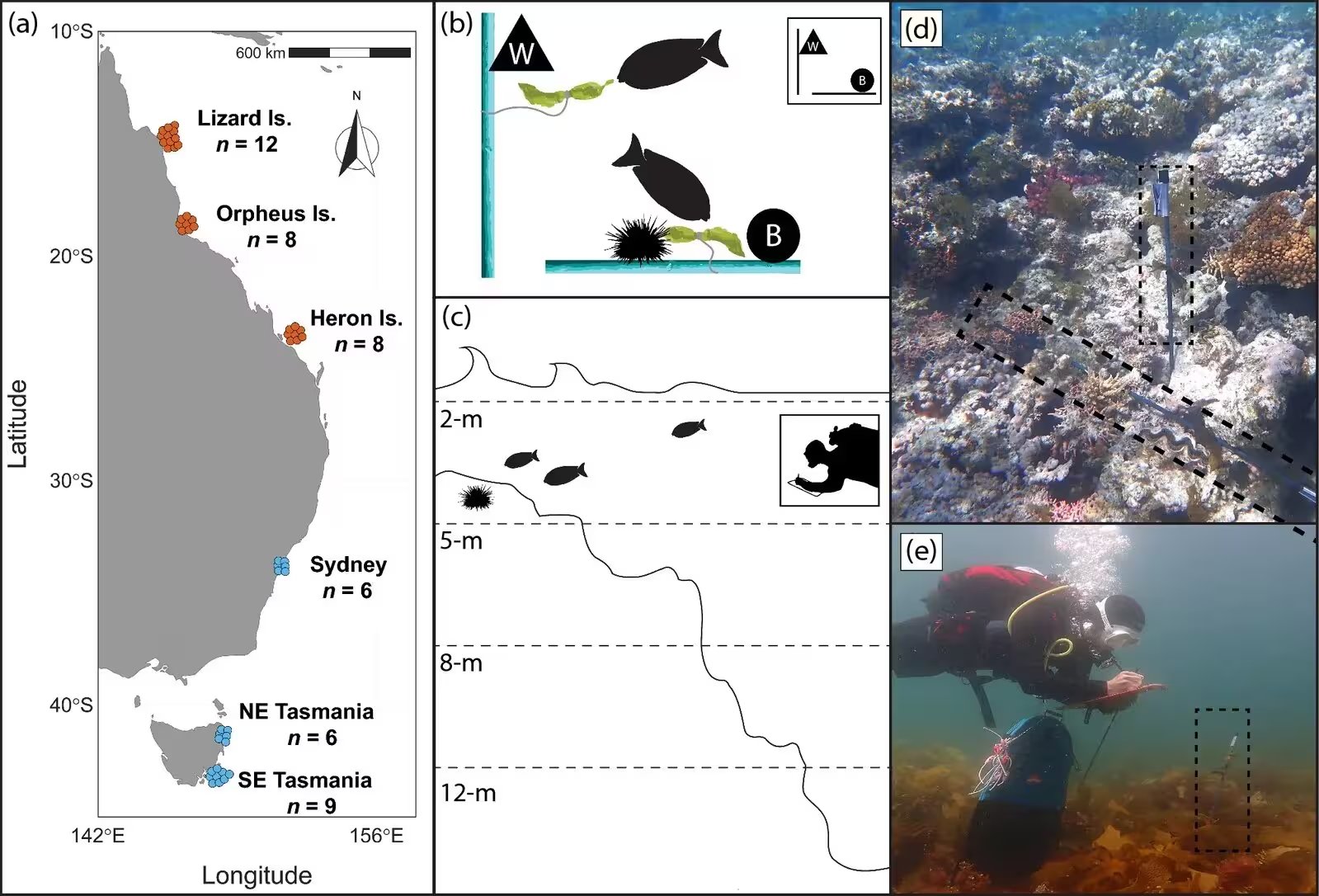
Fig. 1: Tropical (orange) and temperate (blue) study locations spanning approximately 29° of latitude and schematic of experimental design including assays of herbivory and underwater visual surveys of herbivores. (a) Map of eastern Australia showing experimental sites (coloured circles jittered for clarity) with n = number of total sites within each of the three tropical and three temperate locations (N = 49). (b) Schematic of assay treatments partitioning consumption of the standard alga Ulva lactuca by fishes in the water-column (‘W’ depicted within triangle) and herbivory by fishes and urchins on the benthos (‘B’ in circle), noting images are not drawn to scale. (c) Schematic of depth-stratified design of herbivory assays and herbivore surveys at four depth contours (2, 5, 8, and 12-m) which was performed at a single site within each of the six locations. Example photos captured in situ are shown for (d) tropical assays on a coral reef and (e) temperate assays in a kelp bed, with black bou
Tropical (orange) and temperate (blue) study locations spanning approximately 29° of latitude and schematic of experimental design including assays of herbivory and underwater visual surveys of herbivores. (a) Map of eastern Australia showing experimental sites (coloured circles jittered for clarity) with n = number of total sites within each of the three tropical and three temperate locations (N = 49). (b) Schematic of assay treatments partitioning consumption of the standard alga Ulva lactuca by fishes in the water-column (‘W’ depicted within triangle) and herbivory by fishes and urchins on the benthos (‘B’ in circle), noting images are not drawn to scale. (c) Schematic of depth-stratified design of herbivory assays and herbivore surveys at four depth contours (2, 5, 8, and 12-m) which was performed at a single site within each of the six locations. Example photos captured in situ are shown for (d) tropical assays on a coral reef and (e) temperate assays in a kelp bed, with black bou Credit: Matthew Rose et al. / Oecologia

Surprising Parities and Striking Contrasts

The assays revealed that overall relative consumption levels were remarkably similar between tropical and temperate reefs. However, the underlying mechanisms driving that consumption differed significantly. On tropical reefs, fish and benthic assays were consumed at roughly equal rates, with fish grazing dominating the water column. On temperate reefs, benthic consumption greatly exceeded water-column consumption.

Visual surveys aligned with these assay results, showing a massive shift in dominant animal groups. Herbivorous fish abundance and biomass peaked on tropical reefs, whereas sea urchin abundance was 145-fold higher on temperate reefs, with urchin biomass averaging 141 times greater in cooler waters. The dominant temperate urchin species, Centrostephanus rodgersii, exerts intense grazing pressure that restricts feeding activity to immediate local crevices.

Depth Variations and Macroalgal Cover

Erect macroalgal cover showed a stark 213-fold increase on temperate reefs compared to tropical locations. Tropical sites were almost entirely devoid of erect macroalgae, save for sparse patches of the heavily calcified alga Halimeda, which averaged just 0.3 percent cover. In contrast, temperate reefs averaged 64.1 percent macroalgal cover, dominated by the laminarian kelp Ecklonia radiata, alongside Phyllospora comosa and Sargassum species.
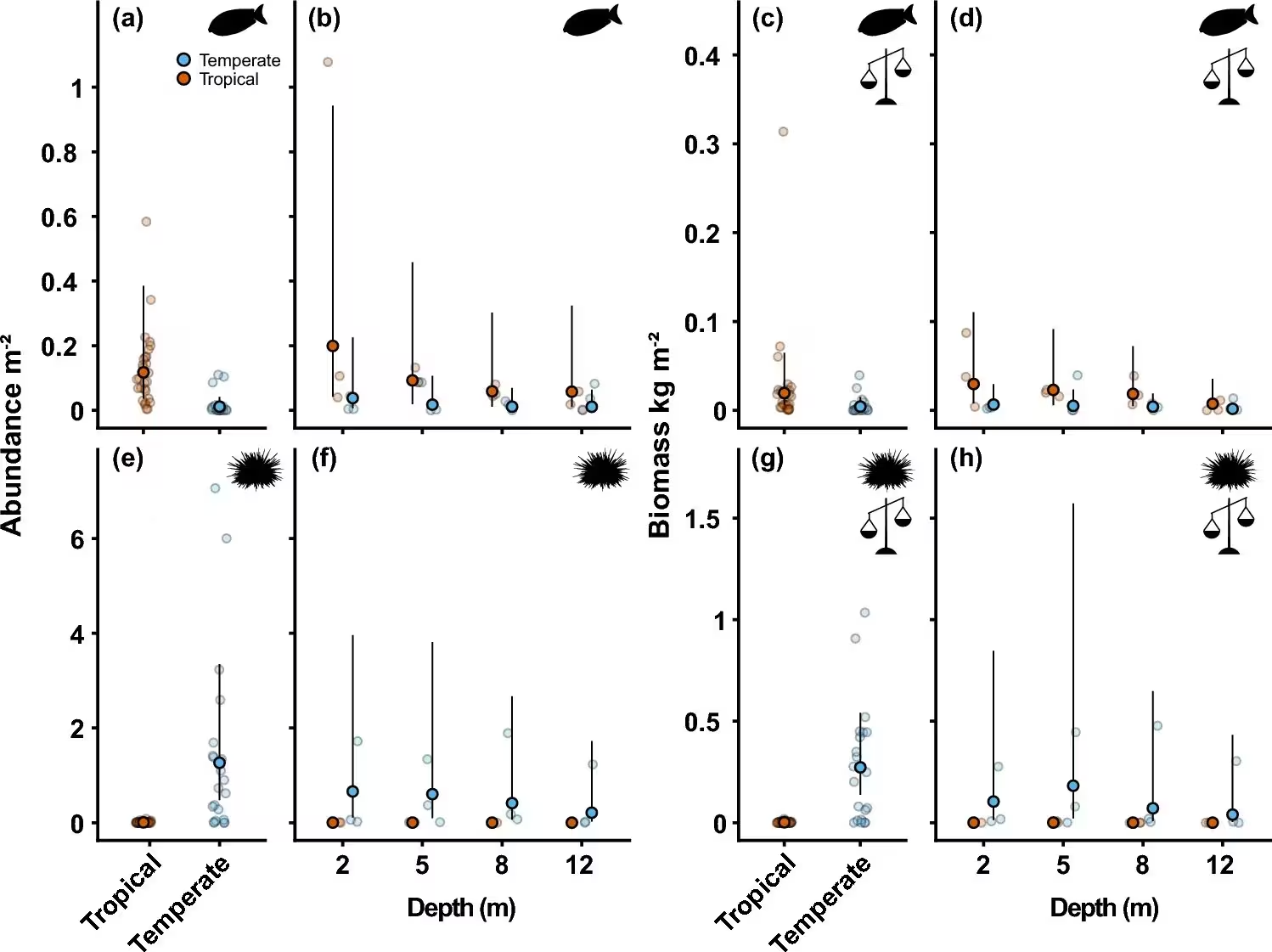
Fig. 3: Surveys of nominal herbivore groups by thermal realm and depth. Herbivore abundance (m−2) and biomass (kg m−2) by depth on tropical (orange) and temperate (blue) reefs for fish (top panels: a-d) and urchins (bottom panels: e–h). Large points and line ranges show estimated marginal means with 95% confidence intervals from generalised linear mixed effects models, with small translucent points denoting raw survey observations which are jittered for clarity, (n = 49 surveys for (a), (c), (e), (g); n = 24 surveys for (b), (d), (f), (h); inclusive of the 5-m depth data from the depth-stratified sites). Black icons of herbivore groups denote model responses; an individual fish or urchin for abundance models and an individual with a set of scales for biomass
Surveys of nominal herbivore groups by thermal realm and depth. Herbivore abundance (m−2) and biomass (kg m−2) by depth on tropical (orange) and temperate (blue) reefs for fish (top panels: a-d) and urchins (bottom panels: e–h). Large points and line ranges show estimated marginal means with 95% confidence intervals from generalised linear mixed effects models, with small translucent points denoting raw survey observations which are jittered for clarity, (n = 49 surveys for (a), (c), (e), (g); n = 24 surveys for (b), (d), (f), (h); inclusive of the 5-m depth data from the depth-stratified sites). Black icons of herbivore groups denote model responses; an individual fish or urchin for abundance models and an individual with a set of scales for biomass Credit: Matthew Rose et al. / Oecologia

Across temperate depth gradients, macroalgal cover peaked at 79 percent at a depth of 5 metres before declining to 44.6 percent at 12 metres. Temperate herbivory rates also shifted across depth zones, with consumption odds dropping significantly at 5-metre and 12-metre contours compared to shallow 2-metre waters. Conversely, tropical fish herbivory showed no significant variation across the tested depth range.

Implications for Warming Oceans

The authors note that these distinct patterns of constrained versus diffuse herbivory represent a vital baseline for understanding reef tropicalization, a climate-driven process where warm-adapted species migrate toward cooler latitudes. As oceans continue to warm and tropical fish expand into temperate zones, grazing pressure is expected to become less spatially restricted. This shift could accelerate the loss of kelp forests and alter the balance of coastal ecosystems worldwide.

The research was published in Oecologia on October 25, 2026.

Fact Checked

This article has been fact checked for accuracy, with information verified against reputable sources. Learn more about us and our editorial process.

Last reviewed on .

Article history

  • Latest version

Reference(s)

  1. Rose, Matthew., et al. “Partitioning patterns of fish and sea urchin herbivory from tropical to temperate reefs.” Oecologia, vol. 208, no. 11, October 25, 2026 Springer Science and Business Media LLC, doi: 10.1007/s00442-026-05997-0. <https://doi.org/10.1007/s00442-026-05997-0>.

Cite this page:

Mirza, Omar. “Fish and Urchin Grazing Reveal Hidden Shifts Across Reefs.” BioScience. BioScience ISSN 2521-5760, 28 October 2026. <https://www.bioscience.com.pk/en/subject/ecology/partitioning-patterns-of-fish-and-sea-urchin-herbivory-from-tropical-to-temperate-reefs>. Mirza, O. (2026, October 28). “Fish and Urchin Grazing Reveal Hidden Shifts Across Reefs.” BioScience. ISSN 2521-5760. Retrieved October 28, 2026 from https://www.bioscience.com.pk/en/subject/ecology/partitioning-patterns-of-fish-and-sea-urchin-herbivory-from-tropical-to-temperate-reefs Mirza, Omar. “Fish and Urchin Grazing Reveal Hidden Shifts Across Reefs.” BioScience. ISSN 2521-5760. https://www.bioscience.com.pk/en/subject/ecology/partitioning-patterns-of-fish-and-sea-urchin-herbivory-from-tropical-to-temperate-reefs (accessed October 28, 2026).
End of the article