Hubble Discovers The Largest Known Planet Factory Unlike Anything Seen Before 1,000 Light-Years Away
NASA’s Hubble Space Telescope has uncovered an enormous and turbulent planet-forming disk, presenting astronomers with an unprecedented celestial phenomenon.
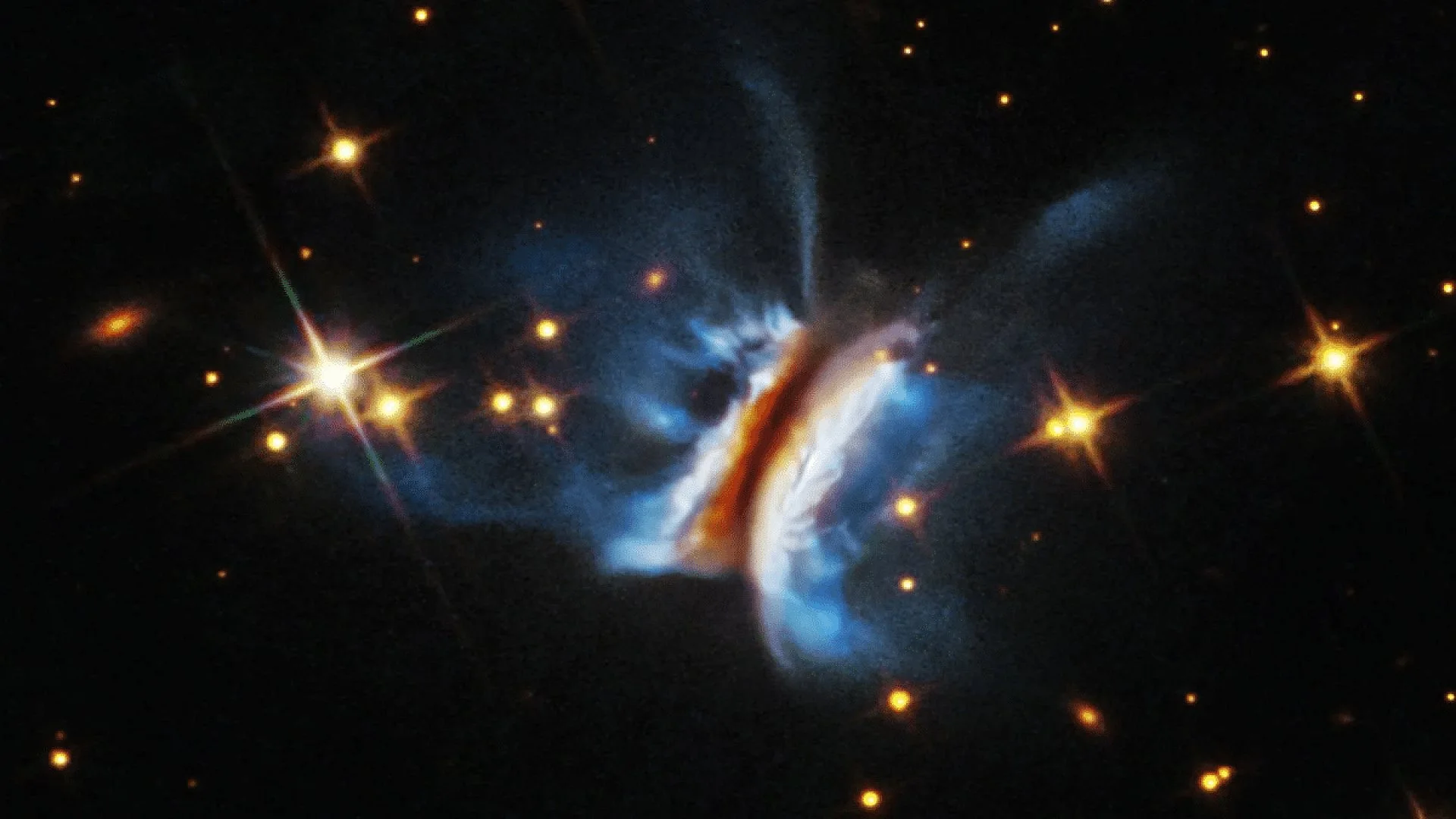
A groundbreaking discovery has been made by NASA’s Hubble Space Telescope, capturing the most detailed visible-light images of a massive planet-forming disk surrounding a young star approximately 1,000 light-years away. This extraordinary find, highlighted by the NASA Hubble Mission Team, reveals a turbulent and highly uneven environment filled with towering gas and dust streams that challenge our current understanding of planetary system evolution.
A colossal disk, known as IRAS 23077+6707 and affectionately nicknamed “Dracula’s Chivito,” stretches roughly 400 billion miles across, making it one of the largest protoplanetary disks ever observed. This gargantuan structure is estimated to be around 40 times wider than our solar system when measured out to the Kuiper Belt. At its center lies a young star, or possibly a pair of stars orbiting each other, shrouded in thick clouds of gas and dust.
The newly imaged system stands out due to its immense scale and unusual appearance. Astronomers estimate the disk is approximately 40 times wider than our solar system when measured out to the Kuiper Belt. At its center lies a young star, or possibly a pair of stars orbiting each other, buried deep within thick clouds of gas and dust. Seen nearly edge-on from Earth, the structure resembles a glowing cosmic sandwich with a dark central lane cutting through luminous layers above and below. However, the most striking feature is not its size, but the chaos unfolding within it.
Instead of appearing smooth and orderly like many other protoplanetary disks, the system displays enormous wisps and filament-like structures erupting unevenly from one side. Some of these towering features extend far above the disk, while the opposite side appears comparatively clean and sharply defined. The asymmetry surprised researchers because such extreme imbalance is rarely observed in planet-forming environments.
“The level of detail we’re seeing is rare in protoplanetary disk imaging, and these new Hubble images show that planet nurseries can be much more active and chaotic than we expected,” said lead author Kristina Monsch of the Center for Astrophysics | Harvard & Smithsonian (CfA). “We’re seeing this disk nearly edge-on and its wispy upper layers and asymmetric features are especially striking. Both Hubble and NASA’s James Webb Space Telescope have glimpsed similar structures in other disks, but IRAS 23077+6707 provides us with an exceptional perspective — allowing us to trace its substructures in visible light at an unprecedented level of detail. This makes the system a unique, new laboratory for studying planet formation and the environments where it happens.”
The images provide astronomers with a rare opportunity to study how massive disks behave during the earliest stages of planetary development. Researchers believe the strange structures may be linked to fresh material collapsing into the disk, interactions with nearby cosmic environments, or violent internal processes shaping future planets.
One of the biggest mysteries surrounding “Dracula’s Chivito” involves the giant filaments visible only on one side of the disk. Hubble’s visible-light observations revealed enormous plume-like structures extending outward in dramatic fashion, while the opposite edge remains sharply truncated and almost unnaturally smooth. Scientists are still investigating why the material distribution appears so uneven.
The unusual geometry could signal that external forces are disturbing the disk. Another possibility is that the system itself is highly unstable, with turbulence and gravitational interactions sculpting the gas and dust into distorted forms. Since protoplanetary disks serve as the raw material for future planets, understanding these asymmetries may reveal how giant worlds emerge under chaotic conditions.
“We were stunned to see how asymmetric this disk is,” said co-investigator Joshua Bennett Lovell, also an astronomer at the CfA. “Hubble has given us a front row seat to the chaotic processes that are shaping disks as they build new planets — processes that we don’t yet fully understand but can now study in a whole new way.”
The discovery adds to growing evidence that planet formation may be far more dynamic than earlier models suggested. For decades, astronomers often pictured young planetary systems as relatively stable disks slowly condensing into planets over millions of years. New observations from Hubble and the James Webb Space Telescope now suggest many of these systems experience violent phases marked by turbulence, uneven accretion, and large-scale structural disruptions.
Scientists estimate the total mass of the disk could equal between 10 and 30 times the mass of Jupiter. That amount of material would be enough to create several giant planets and potentially an enormous planetary system dwarfing our own. Researchers describe the environment as an oversized version of the early solar system, though one evolving under far more extreme conditions.
Because the central star remains hidden behind dense dust clouds, astronomers still do not fully understand the system’s internal structure. Future observations may determine whether one star or two stars sit at the center of the disk, a detail that could dramatically influence how planets eventually form there. Binary star systems often produce highly disturbed gravitational environments capable of reshaping surrounding disks.
“In theory, IRAS 23077+6707 could host a vast planetary system,” said Monsch. “While planet formation may differ in such massive environments, the underlying processes are likely similar. Right now, we have more questions than answers, but these new images are a starting point for understanding how planets form over time and in different environments.”
The nickname “Dracula’s Chivito” also reflects the personalities behind the discovery. One researcher involved in the project comes from Transylvania, while another is from Uruguay, where a chivito is a popular sandwich. The humorous label stuck because the edge-on disk resembles a glowing hamburger floating through space.
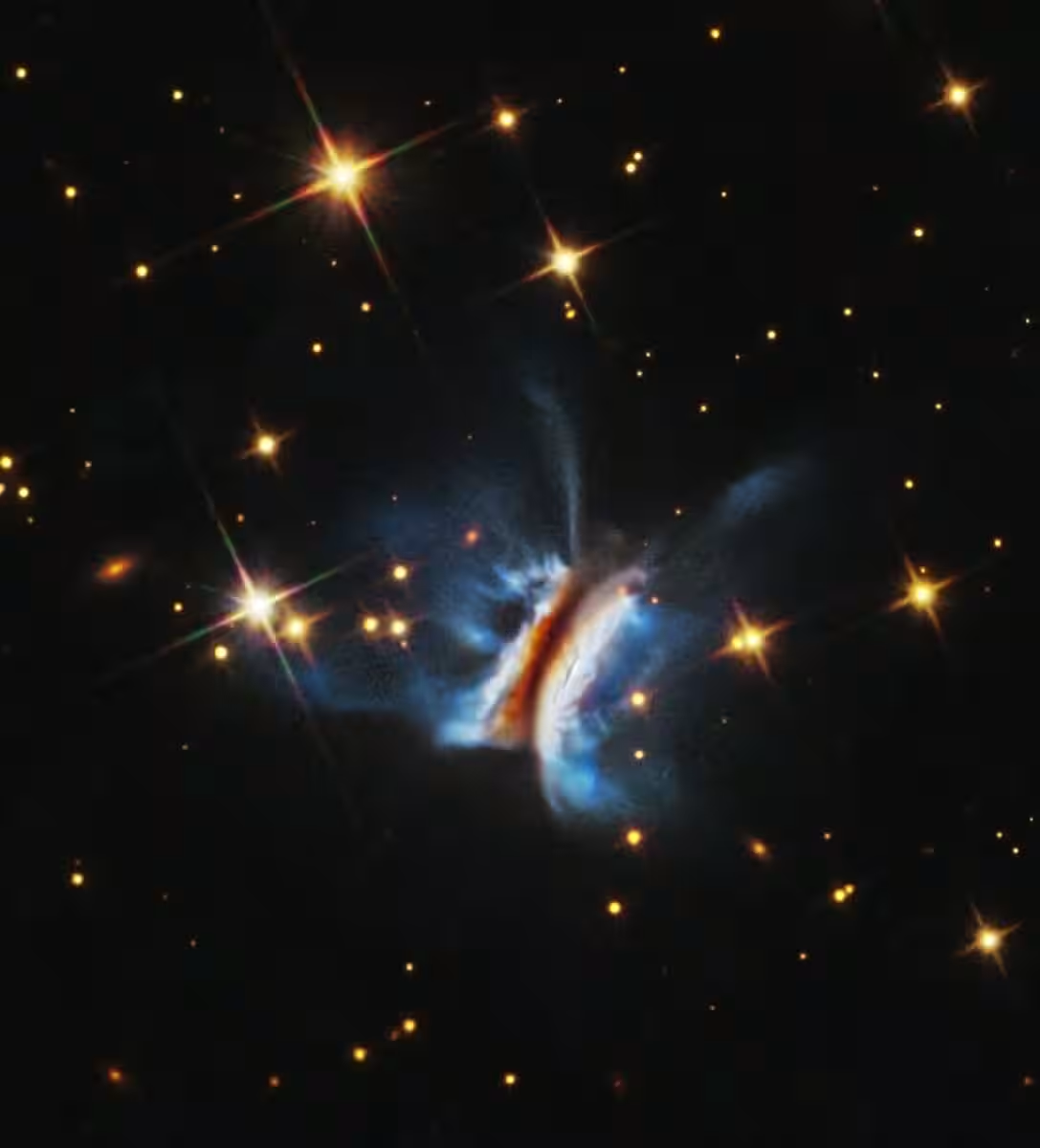
Image: NASA, ESA, STScI, Kristina Monsch (CfA); Image Processing: Joseph DePasquale (STScI)
This article has been fact checked for accuracy, with information verified against reputable sources. Learn more about us and our editorial process.
Last reviewed on .
Article history
- Latest version
Cite this page:
- Posted by Farah Siddiqui