AI Identifies 100+ Exoplanets in NASA’s TESS Archive and Thousands More Could Be Waiting
Researchers leveraging NASA’s TESS mission have uncovered over a hundred previously unrecognized exoplanets concealed within its data archives, with the possibility of thousands more still lying dormant in the observations.
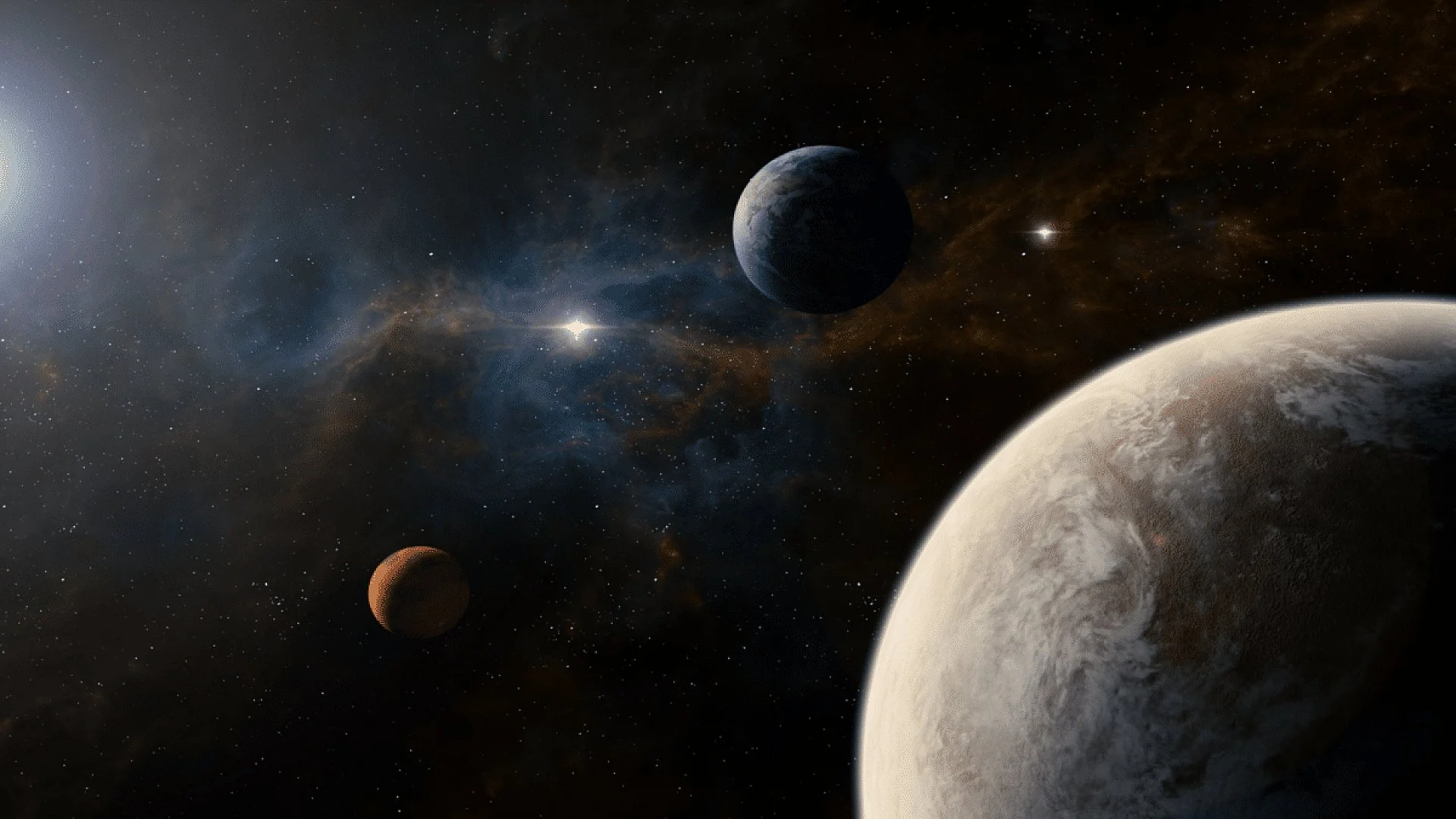
Scientists using NASA’s TESS satellite have unearthed over 100 new exoplanets hidden within years of data. This groundbreaking discovery opens up fresh avenues for understanding distant worlds and provides an unprecedented glimpse into previously hidden planets, solidifying TESS’s role in reshaping our understanding of the universe.
A New Era in Exoplanet Discovery
For years, the data collected by NASA’s Transiting Exoplanet Survey Satellite (TESS) has offered tantalizing clues about the universe’s distant worlds. However, much of this valuable information has remained unexplored due to the overwhelming amount of data gathered, with more than 2 million stars under constant observation. While TESS had already confirmed around 700 exoplanets, many promising signals were buried in the noise, never fully investigated. Enter RAVEN, a powerful software developed by the University of Warwick, which has made it possible to sift through this data with incredible precision.
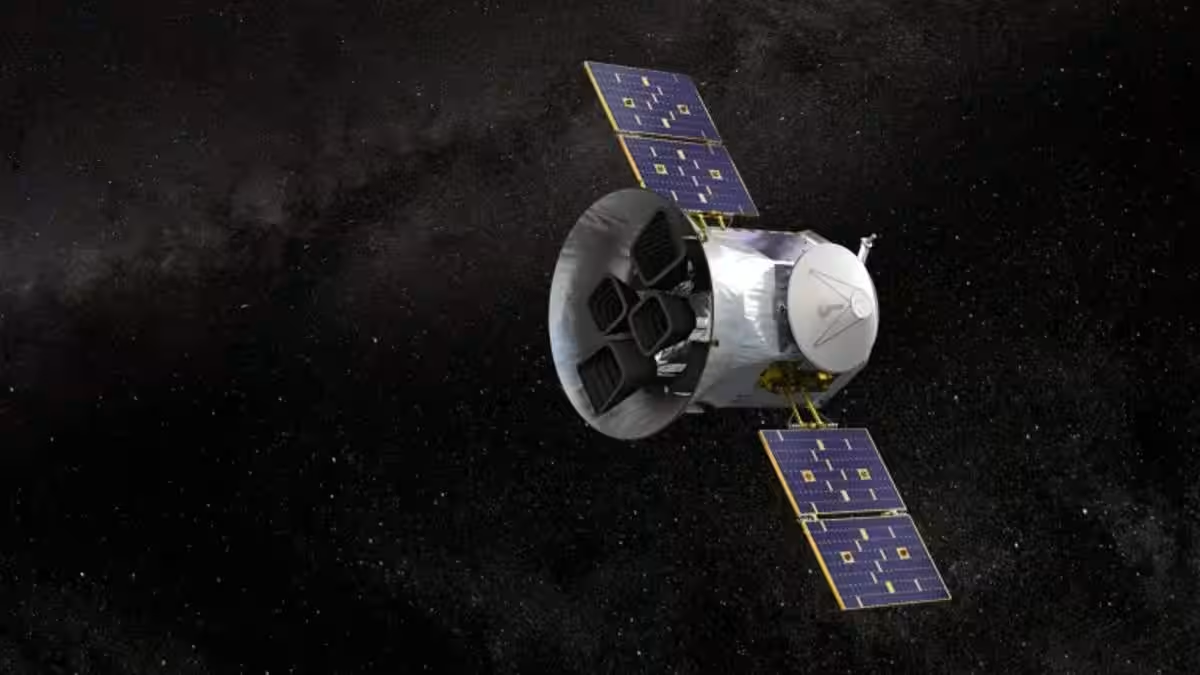
Image Source: NASA
Using this innovative tool, the research team was able to identify 118 previously unvalidated exoplanets, adding to the growing catalog of known worlds. Dr. Marina Lafarga Magro, a lead researcher on the project, shared the excitement:
“Using our newly developed RAVEN pipeline, we were able to validate 118 new planets, and over 2,000 high-quality planet candidates, nearly 1,000 of them entirely new.”
With this success, RAVEN is poised to revolutionize the way scientists explore exoplanet data, allowing for more thorough analyses in a fraction of the time.
Unraveling the Mysteries of the Neptunian Desert
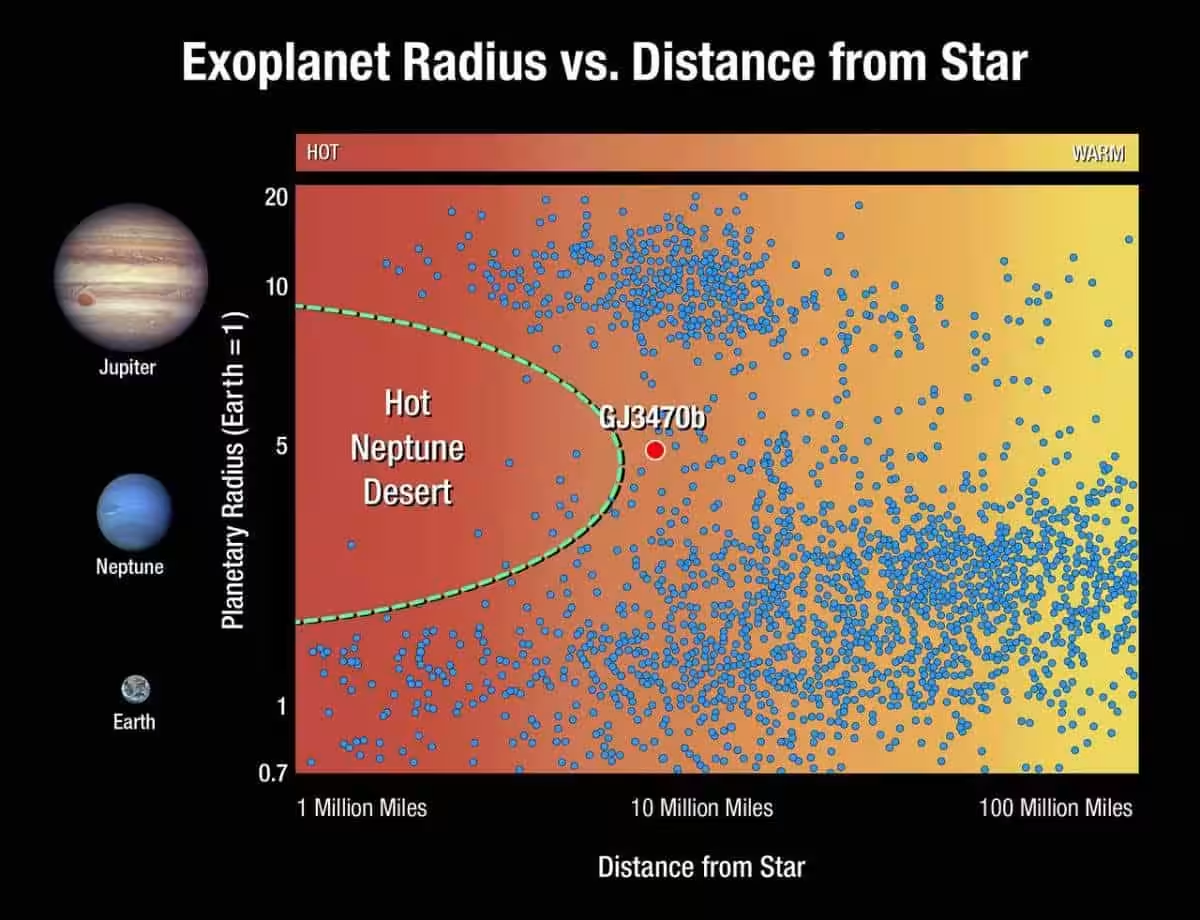
The latest findings highlight some of the most intriguing aspects of exoplanet discovery, particularly regarding the so-called “Neptunian desert.” This phenomenon refers to a strange gap in the distribution of exoplanets, there’s a conspicuous absence of Neptune-like planets, which are typically expected to be abundant in certain orbital regions.
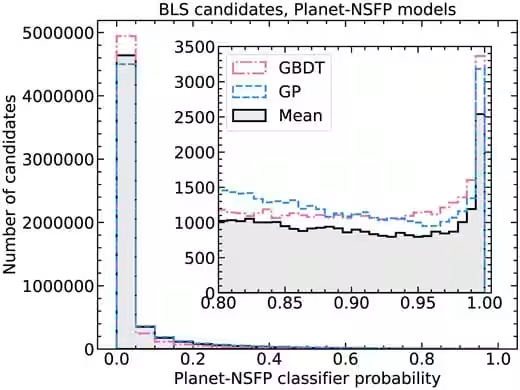
(see Section 3.2.3), pink dashed lines show the subsample stars with vetted candidates (see Section 4.1), and yellow solid lines show the subsample stars with validated candidates (see Section 4.2). The numbers in parenthesis in the legend show the number of stars in each sample. The inset panels show a zoom-in of the stars in the vetted and validated samples. Note that the y-axes of the main panels are in logarithmic scale while, in the insets, they are in linear scale.
The team’s new data has allowed them to precisely measure the rarity of these missing worlds, providing a concrete number for the first time. Dr. Kaiming Cui, another key researcher, emphasized the importance of this:
“For the first time, we can put a precise number on just how empty this desert is.” The findings suggest that Neptune-sized planets are strikingly scarce around Sun-like stars, adding another layer of complexity to our understanding of planet formation.
The Neptunian desert’s boundaries had been theorized since a 2016 study, but this new research, published in Monthly Notices of the Royal Astronomical Society, brings clarity and precision to the picture. By analyzing the validated planets in the TESS dataset, the team has created a more accurate map of the cosmic landscape and its planetary inhabitants, addressing some of the unanswered questions left by earlier surveys.
Ultra-Short Period Planets and Tight Multi-Planet Systems
Beyond the Neptunian desert, the new catalog also reveals a fascinating discovery: ultra-short-period planets, which complete an orbit in less than 24 hours. These worlds are of particular interest to researchers because their extreme proximity to their parent stars challenges existing theories of planetary formation. The new exoplanets found by the TESS team push the boundaries of what we thought possible and could offer critical insights into the forces shaping planetary systems.
Credit: NASA, ESA, and A. Feild (STScI)]
Another noteworthy discovery is the identification of tightly packed multi-planet systems. These systems, where planets are positioned extremely close together, demonstrate the gravitational forces at play in densely populated orbits. These densely packed worlds, often interacting with one another, provide a unique opportunity to study planetary dynamics and formation theories in real-time.
The Path Forward: Data, Tools, and Opportunities for the Future
As the TESS mission continues, the newly validated exoplanets are now available for further analysis by the global research community. The data is now in the public domain, allowing other astronomers to apply advanced techniques to measure the planets’ masses, study their atmospheres, and examine their potential for hosting life. Future space missions, such as the European Space Agency’s PLATO mission, will benefit from this curated catalog, allowing for more efficient targeting of exoplanets that deserve further investigation.
With a cleaner sample of exoplanets in hand, researchers are poised to answer some of the most pressing questions in astrophysics: How do tightly packed systems stay stable? Why are some orbits empty, like the Neptunian desert? As astronomers continue to probe the data, the next round of discoveries could unlock entirely new realms of knowledge.
This article has been fact checked for accuracy, with information verified against reputable sources. Learn more about us and our editorial process.
Last reviewed on .
Article history
- Latest version
Cite this page:
- Posted by Farah Siddiqui