TESS Finds Brown Dwarf on Extreme Orbit With Two Inner Planets
Rare brown dwarf in an extreme orbit may have shaped a planetary system, challenging long‑standing theories of planet formation.
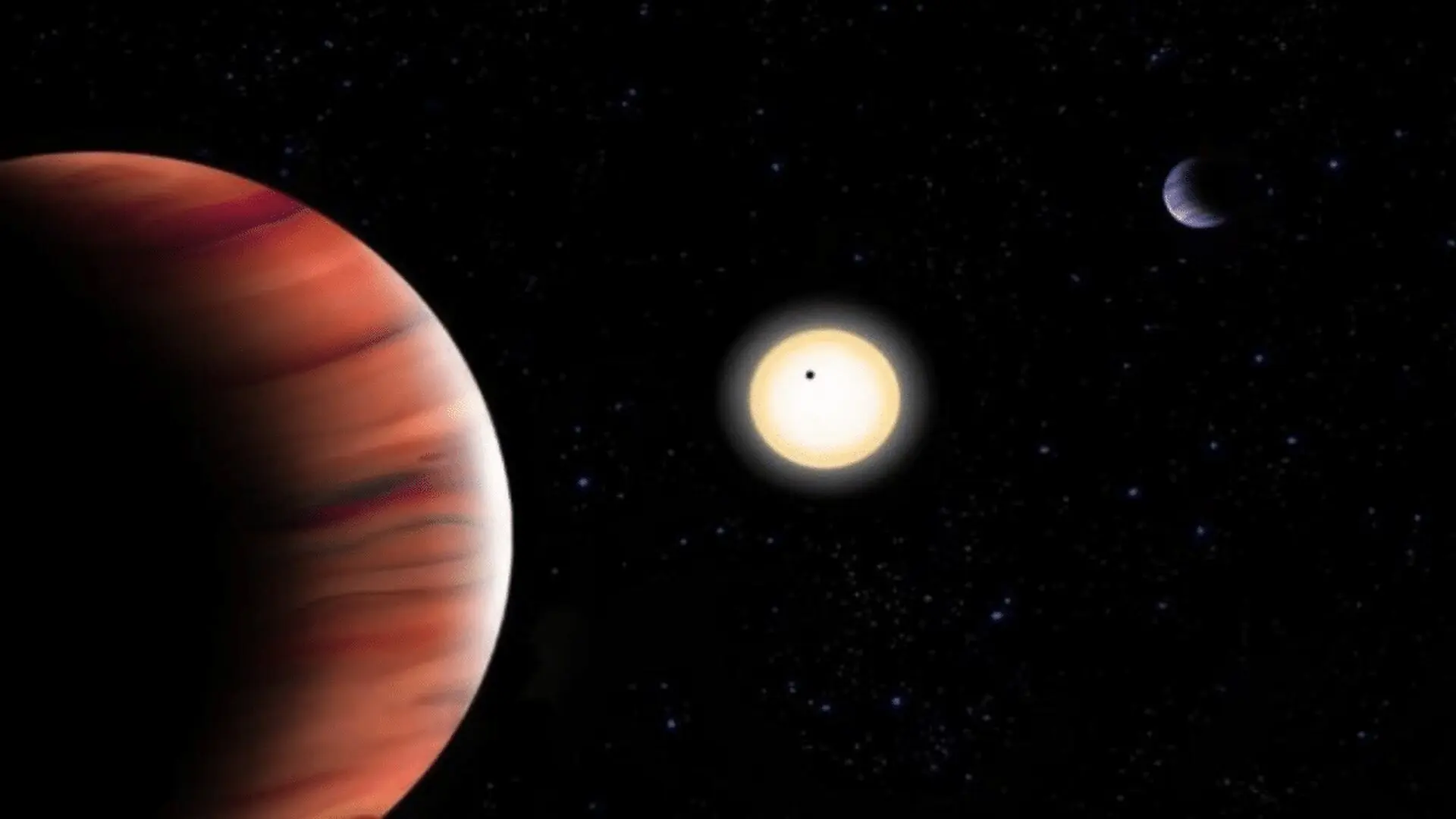
NASA’s Transiting Exoplanet Survey Satellite (TESS) has uncovered a planetary system that defies conventional ideas about planet birth and endurance. At its heart lies TOI‑201 c, a heavyweight brown dwarf tracing a highly stretched orbit around its star. Reported in Nature, the system shows that planets can arise and persist even when a massive companion exerts powerful, destabilising forces, offering a rare window onto planetary resilience in extreme environments.
A Massive Brown Dwarf Shapes an Unusual Planetary System
Brown dwarfs straddle the line between planets and stars: they form from collapsing nebulae like stars but never gather enough material to sustain hydrogen fusion, earning them the moniker “failed stars.” TOI‑201 c pushes this category to its limits, circling its host star on an eccentric path that takes roughly 2,881 days to complete.
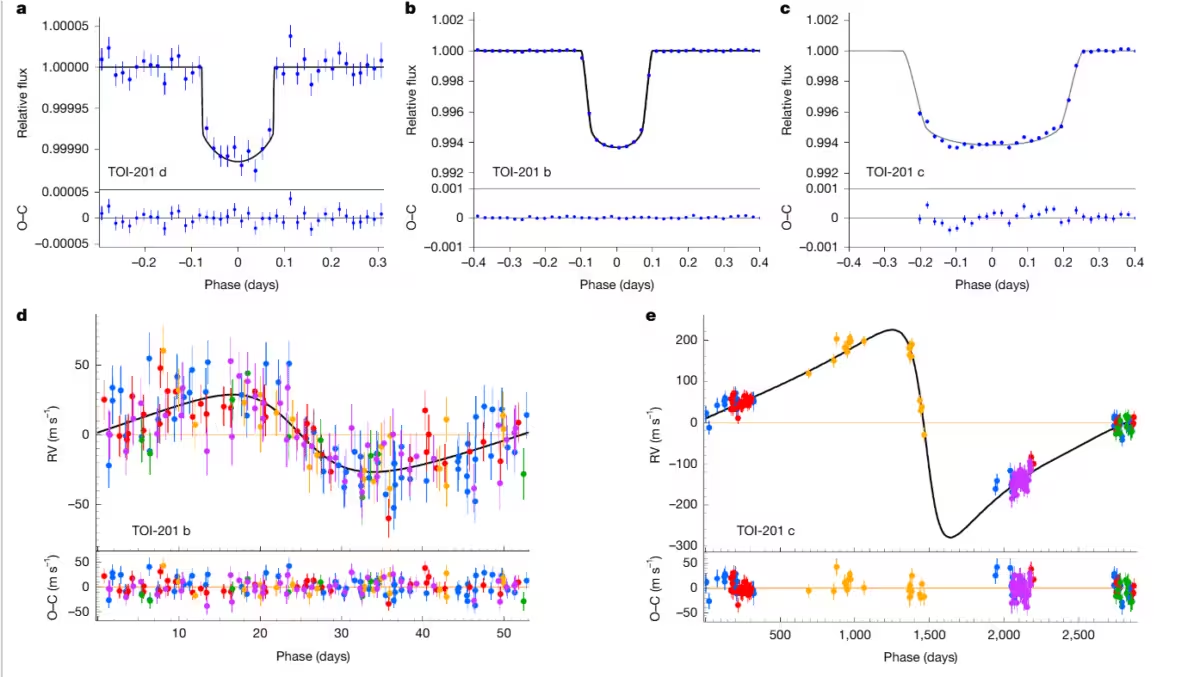
Despite the disruptive gravity of such a heavyweight object, two inner planets have managed to take hold. A rocky super‑Earth, TOI‑201 d, orbits every 5.8 days, while a warm Jupiter, TOI‑201 b, circles the star every 53 days. Both reside well inside the brown dwarf’s elongated trajectory, occupying a compact zone that, according to traditional models, should have been hostile to planet formation. Their apparent long‑term stability suggests that planetary architectures can survive in environments previously deemed prohibitive.
“This discovery provides a crucial insight into how planets form even around massive, eccentric objects,” said INAF researcher Aldo Bonomo in an emailed statement.
Inner Worlds Thrive Amidst a Turbulent Disk
The elongated orbit of the brown dwarf likely stirred the surrounding protoplanetary disk, creating gravitational instabilities that would normally impede the aggregation of solid material. Researchers now argue that the inner region closest to the star offered the only relatively calm sanctuary, allowing the planets to coalesce and remain bound.
“The presence of the brown dwarf on such an elliptical orbit forced the planets to form and survive by occupying the innermost and hottest edges of the primordial disk,” explained Luca Naponiello of the National Institute for Astrophysics (INAF).
Ongoing Gravitational Tug‑of‑War
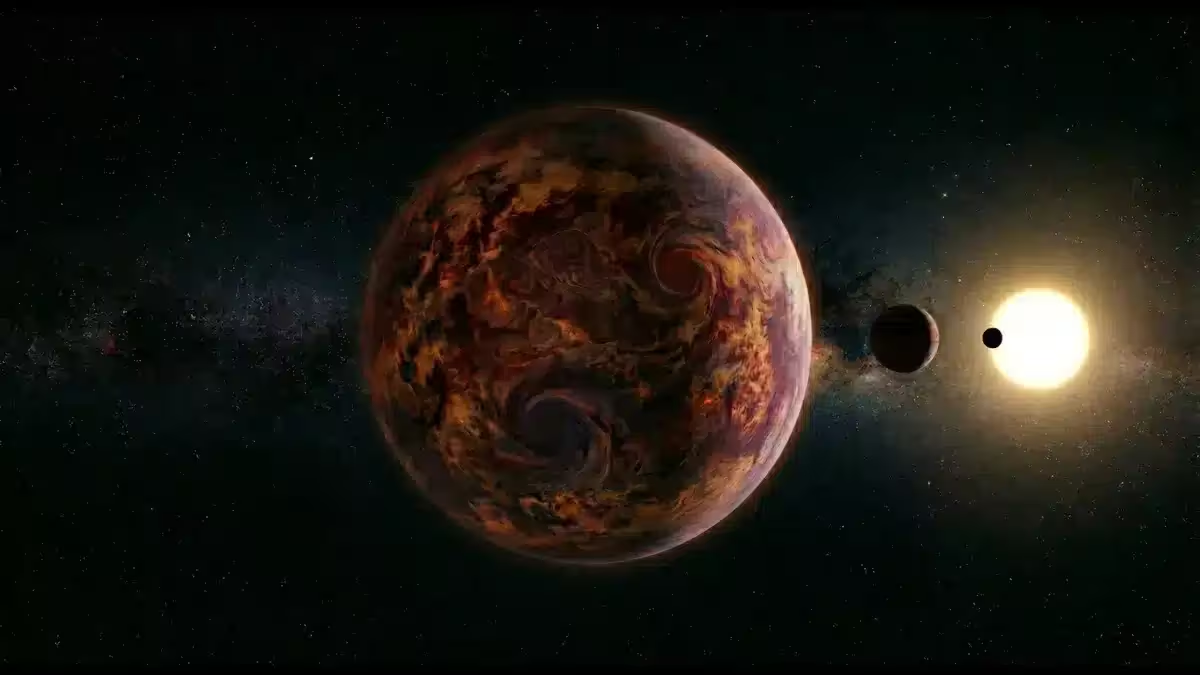
The interaction between the brown dwarf and the warm Jupiter is not a relic of the past; it continues to play out today. As TOI‑201 c swings close to its star, its pull distorts the orbit of TOI‑201 b, producing measurable shifts in the timing of the giant planet’s transits.
Astronomers have tracked these transit‑timing variations, using them as a diagnostic of unseen or distant companions within the system.
“Furthermore, the data show that during the close approach of the brown dwarf, the warm Jupiter undergoes strong and sudden variations in its transit timing, bearing witness to an intense and vigorous dynamic interaction currently underway between the two giants.”
Capturing these real‑time dynamics offers a rare laboratory for probing planetary masses, orbital evolution, and the long‑term stability of intricate systems.
Detecting a Long‑Period Mono‑Transit Required a Global Effort
The first hint of the brown dwarf emerged as a mono‑transit—a single dip in the star’s brightness captured during TESS’s observing window. Unlike short‑period planets that transit repeatedly, objects with extended orbits often reveal themselves only once, making confirmation a daunting task.
Following the initial detection by TESS, an intensive ground‑based campaign was launched to verify the object’s nature and measure its mass. This coordinated approach was essential because brown dwarfs on such elongated, eccentric paths are notoriously hard to characterise.
The combined analysis, published in Nature, showcases how space‑based surveys and terrestrial telescopes can together unravel the architecture of systems that would remain opaque to either method alone.
Record‑Setting Long‑Period Transiting Brown Dwarf
Beyond its dynamical influence, TOI‑201 c holds a first‑of‑its‑kind distinction: it is the transiting object with the longest known orbital period for which a precise mass has been measured.
“It [TOI‑201 c] is the transiting object with the longest orbital period for which the mass is known,” Naponiello remarked.
This milestone, coupled with the system’s atypical planetary layout, provides an invaluable testbed for probing the outer limits of planet formation and gravitational evolution. As the catalog of exoplanetary systems expands, TOI‑201 serves as a reminder that nature often engineers configurations far more intricate than our models anticipate, urging astronomers to refine the theories that describe planetary system development across the galaxy.
This article has been fact checked for accuracy, with information verified against reputable sources. Learn more about us and our editorial process.
Last reviewed on .
Article history
- Latest version
Reference(s)
- Jones, Matías. “A distant brown dwarf coplanar to a warm Jupiter and a hot super-Earth - Nature.”, vol. 654, no. 8119, pp. 614-618. Nature, doi: 10.1038/s41586-026-10586-5. <https://www.nature.com/articles/s41586-026-10586-5>.
Cite this page:
- Posted by Farah Siddiqui