JWST Reveals Possible Star Companion to Fast Radio Burst, Hinting at Magnetar Source
Astronomers trace a fleeting powerful radio burst’s lingering imprint, revealing a clue to the source of one of space’s most elusive phenomena.
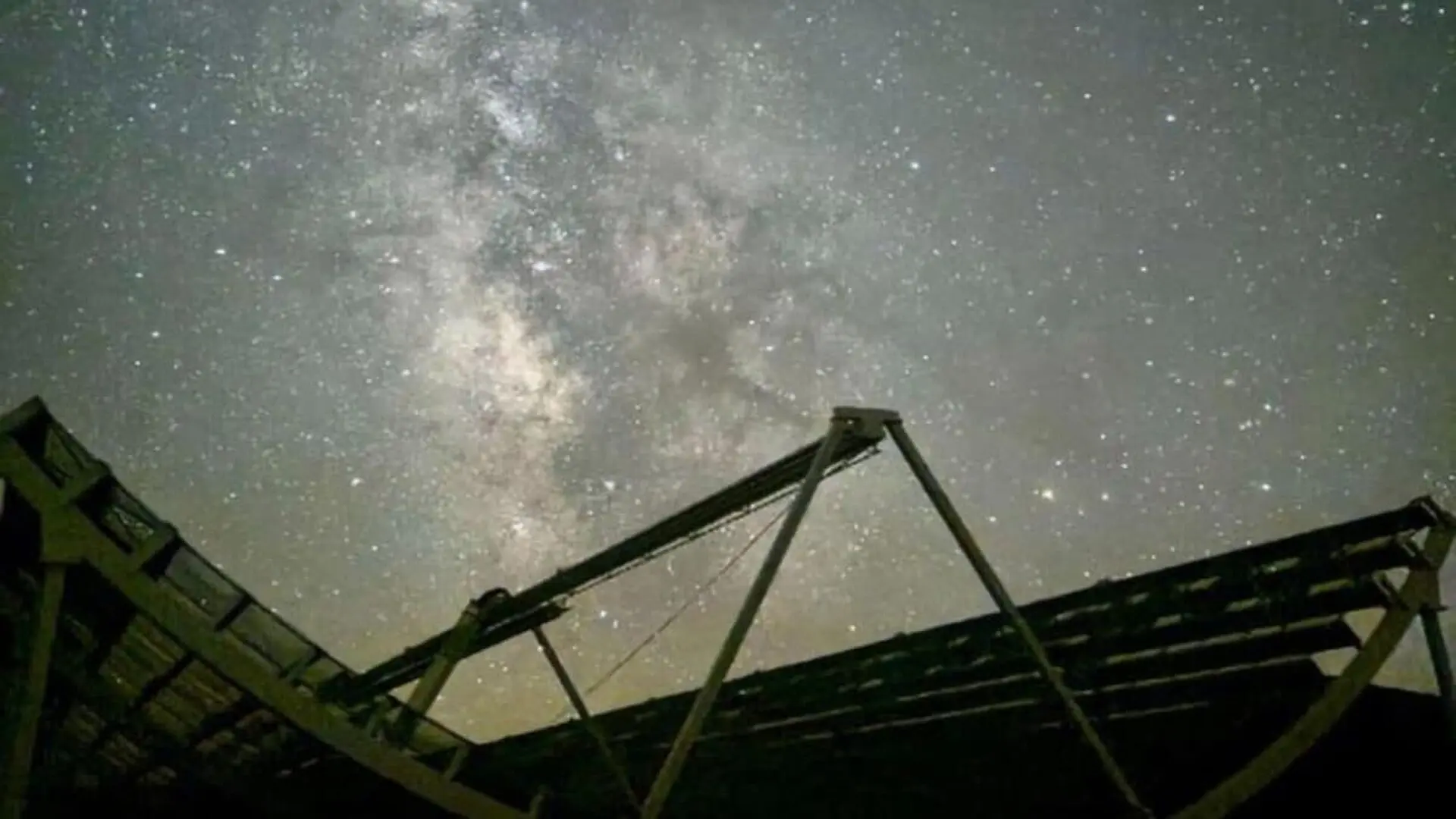
Astronomers have identified a faint infrared source that may be the first object directly linked to a fast radio burst (FRB) occurring outside the Milky Way. By pairing ultra‑precise radio measurements from the CHIME Outriggers with deep infrared imaging from the James Webb Space Telescope (JWST), the team pinpointed the burst’s origin and uncovered a dim object that could hold clues to the phenomenon’s cause.
Fast radio bursts are brief, millisecond‑long flashes of radio energy that can be detected across billions of light‑years. Since the inaugural detection in 2007, hundreds have been catalogued, yet the astrophysical mechanisms behind them remain largely speculative.
The investigation was coordinated by Peter Blanchard, a research associate at the Harvard College Observatory, part of the Center for Astrophysics | Harvard & Smithsonian (CfA). Leveraging data from the upgraded CHIME Outriggers array in Canada together with JWST’s infrared capabilities, the researchers performed the most sensitive search to date for an FRB counterpart.
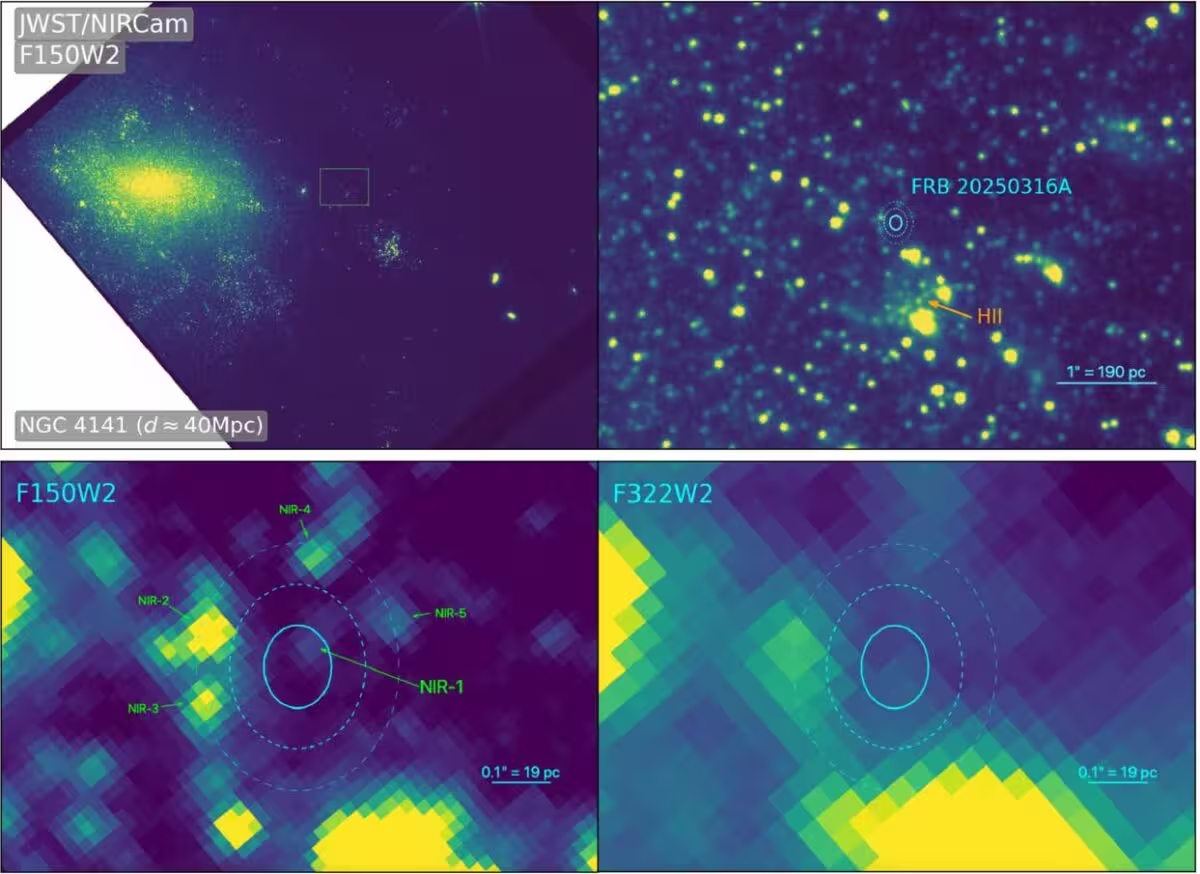
The target, designated FRB 20250316A, was recorded on 16 March 2025 within the galaxy NGC 4141, roughly 130 million light‑years away. Its relatively close distance and precise localization made it an excellent candidate for follow‑up observations.
Precise Radio Localization Enables Infrared Follow‑up
While FRBs have been confirmed to originate beyond the Milky Way, pinpointing the exact host environment has been a persistent challenge. The enhanced resolution of the CHIME Outriggers allowed astronomers to narrow the burst’s sky position to a tiny region, guiding JWST to the exact spot.
Infrared imaging with JWST revealed a weak source of light situated extremely close to the radio coordinates. The discovery was highlighted in a release from the Center for Astrophysics | Harvard & Smithsonian.
“This was a unique opportunity to quickly turn JWST’s powerful infrared eye on the location of an FRB for the first time,” Blanchard said. “And we were rewarded with an exciting result – we see a faint source of infrared light very close to where the radio burst occurred.”
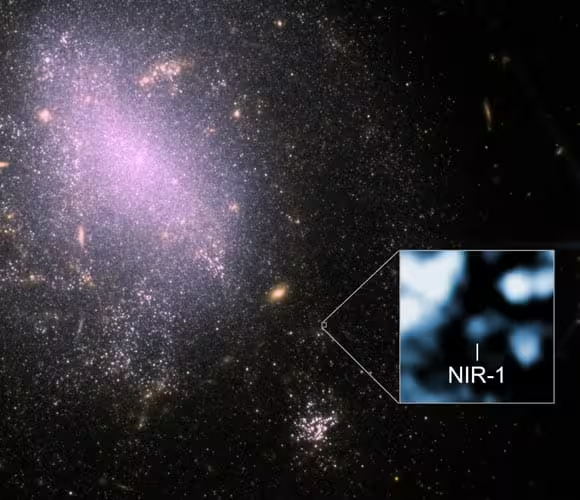
The infrared source, labeled NIR‑1, became the focus of subsequent analysis.
Infrared Object Suggests a Binary Star System
Based on its spectral characteristics, NIR‑1 could be either a red‑giant star entering the late stages of its life or a moderately massive, middle‑aged star. Neither class is expected to emit FRBs on its own, prompting the authors to propose that the visible star may be paired with an unseen neutron‑star companion. Accretion of material onto the compact object could create conditions suitable for generating a fast radio burst.
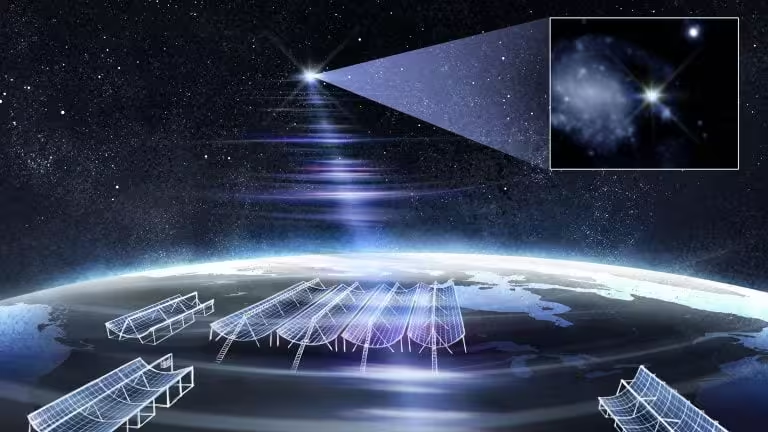
Edo Berger, a CfA scientist and co‑author, emphasized that the ability to isolate individual stars around an FRB marks a significant advance over earlier surveys.
“Being able to isolate individual stars around an FRB is a huge gain over previous searches, and it begins to tell us what sort of stellar systems could produce these powerful bursts,” Berger said.
Cluster Environment Points to a Magnetar Scenario
The researchers also examined the broader stellar population near the burst location and identified a compact cluster of young, massive stars. This environment raises the possibility that a magnetar—a highly magnetized neutron star formed from a massive‑star collapse—could be responsible for the radio flash. Such an object would be too faint to appear directly in the JWST images.
The team evaluated alternative explanations, including origins in an old‑star cluster or from a solitary massive giant, but dismissed them because those scenarios would produce a brighter infrared signal than observed.
The findings appear in The Astrophysical Journal Letters, where the authors note that future JWST observations will test whether the infrared emission fades, which could indicate reflected light from a flare associated with the FRB source.
“Whether or not the association with the star is real, we’ve learned a lot about the burst’s origin,” Blanchard said. “If a double star system isn’t the answer, our work hints that an isolated magnetar caused the FRB.”
This article has been fact checked for accuracy, with information verified against reputable sources. Learn more about us and our editorial process.
Last reviewed on .
Article history
- Latest version
Reference(s)
- Blanchard, Peter K.., et al. “James Webb Space Telescope Observations of the Nearby and Precisely Localized FRB 20250316A: A Potential Near-IR Counterpart and Implications for the Progenitors of Fast Radio Bursts.” The Astrophysical Journal Letters, vol. 989, no. 2, August 21, 2025, pp. L49 American Astronomical Society, doi: 10.3847/2041-8213/adf29f. <https://iopscience.iop.org/article/10.3847/2041-8213/adf29f>.
Cite this page:
- Posted by Farah Siddiqui