Webb Uncovers Triple Black Hole System in Galaxy 12.5 Billion Light Years Away
James Webb spots three actively feeding supermassive black holes in a galaxy just 1.2 billion years after the Big Bang.
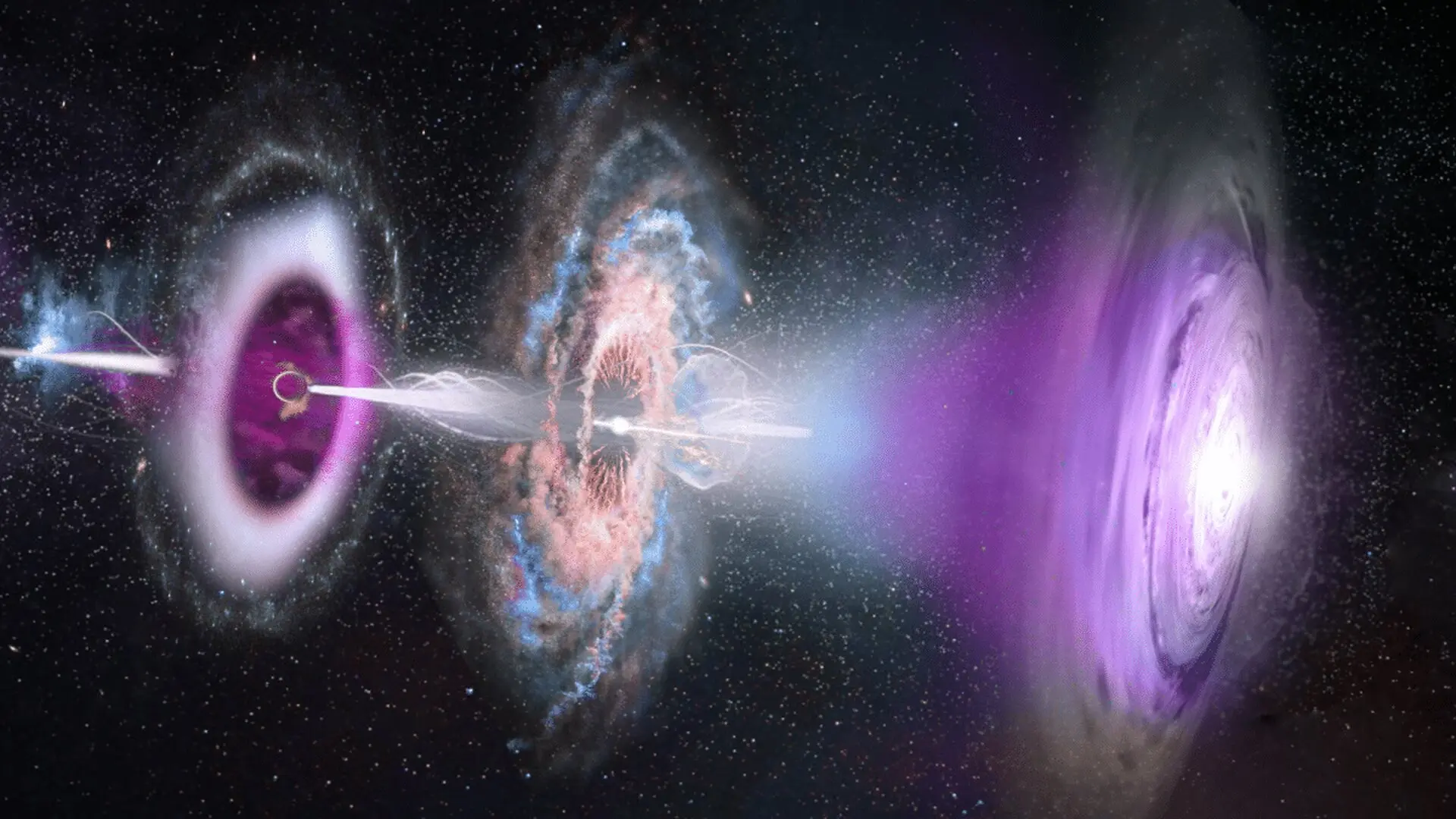
An international team led by the Max Planck Institute for Extraterrestrial Physics has used the James Webb Space Telescope to reveal three actively feeding black holes within a single galaxy that lies more than 12.5 billion light‑years from Earth, when the universe was roughly 1.2 billion years old.
Three Accreting Black Holes Discovered in a Young Galaxy
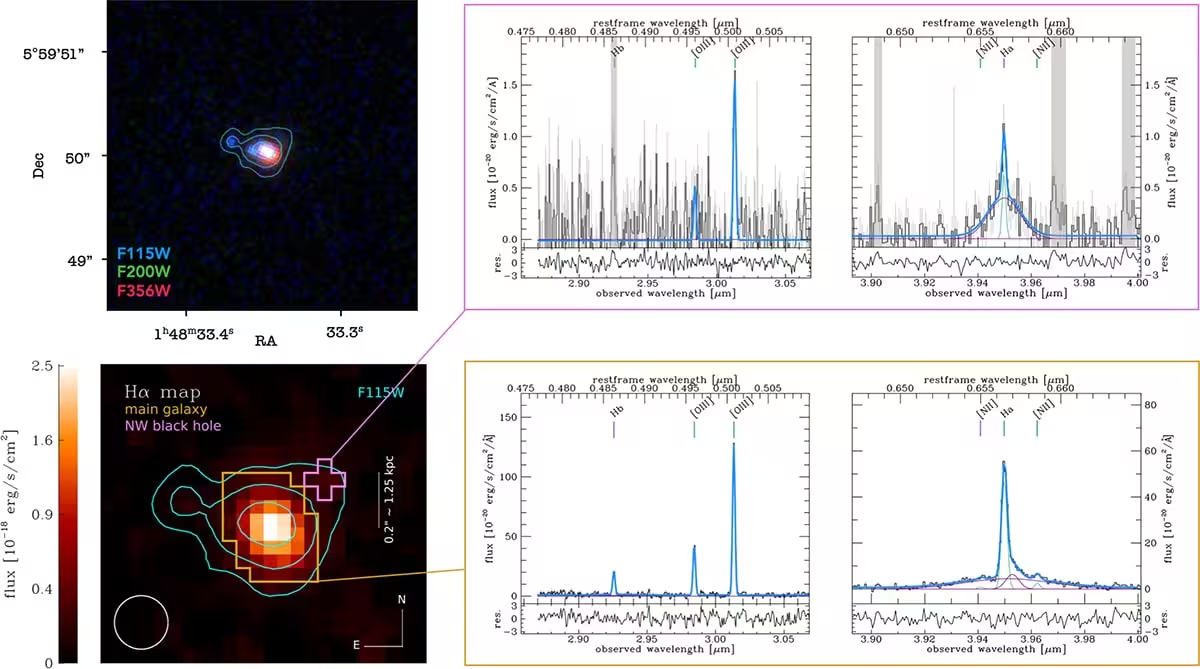
The galaxy, catalogued as J0148-4214 and measured at a redshift of z = 5.02, offers a rare snapshot of black‑hole growth in the early cosmos. Spectroscopic data indicate that two of the black holes occupy the central region, separated by an estimated about 620 light‑years (projected), while a third resides farther out, roughly 5,500 light‑years from the core.
All three objects are actively accreting gas, producing hot accretion disks that emit distinctive spectral signatures. By dissecting these signatures, the researchers were able to attribute the observed emission to three separate black holes rather than a single, blended source.
“It suggests that processes in the early universe were efficient at bringing massive black holes together, setting the stage for the massive black hole mergers we expect to detect with future gravitational wave observatories,” says Hannah Übler, research group leader at MPE and lead author of the study.
The presence of three active nuclei in a galaxy this young implies that galaxy interactions and mergers were already shaping black‑hole populations at a very early epoch. The outermost black hole could be the remnant of a prior merger, a recoiling object displaced from the nucleus, or a black hole in the early stages of spiraling inward. If the central pair continues to lose orbital energy, they may coalesce within a few hundred million years, potentially generating gravitational‑wave signals detectable by next‑generation observatories.
JWST’s Spectroscopic Power Unveils the Hidden Trio
The team relied on JWST’s NIRSpec integral‑field spectroscopy, which couples spectral information with spatial resolution across the target. This capability was crucial because conventional spectroscopy would have blended the emissions from the two central black holes into a single feature.
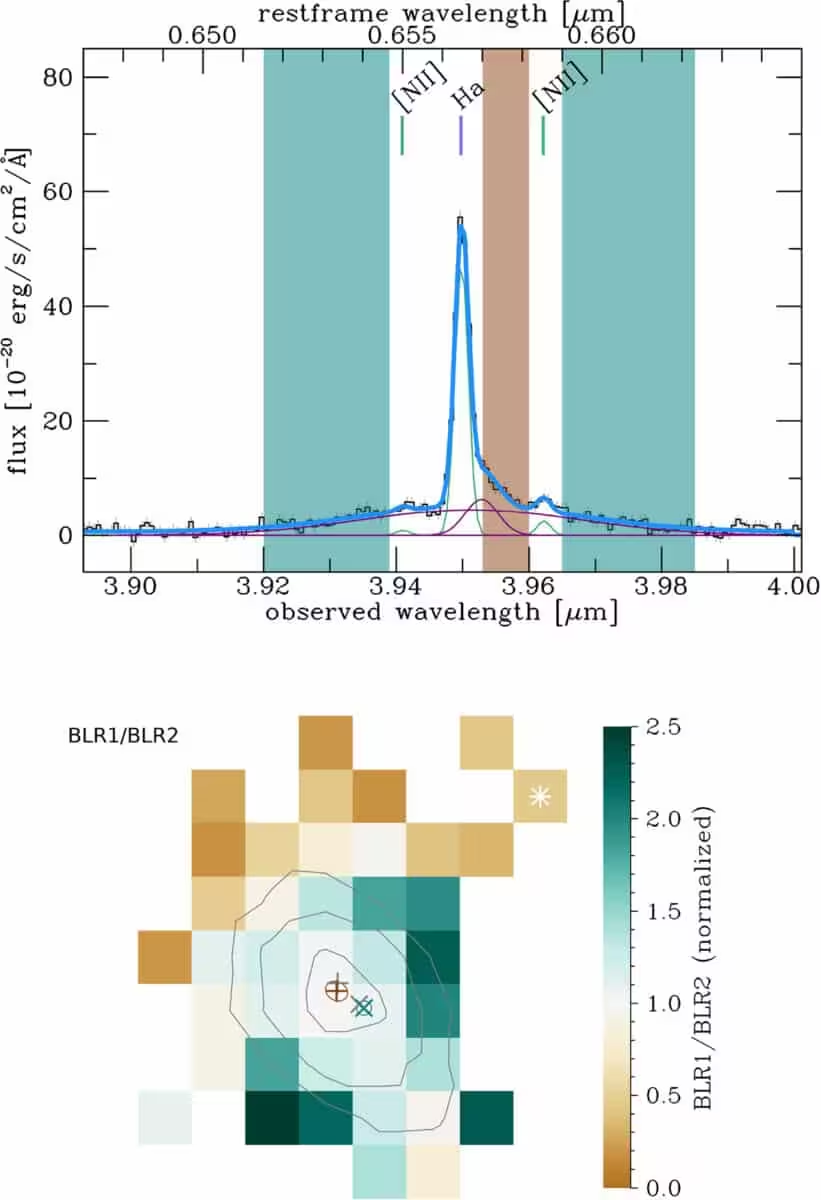
To tease apart the overlapping signals, the researchers employed spectro‑astrometry, a method that tracks minute positional shifts of emission lines as a function of wavelength. By mapping these shifts, they could infer the locations of distinct emitting regions even when the sources were too close to be resolved directly in imaging.
This article has been fact checked for accuracy, with information verified against reputable sources. Learn more about us and our editorial process.
Last reviewed on .
Article history
- Latest version
Cite this page:
- Posted by Farah Siddiqui