How Whale Tracking Uncovered a Wave Trick That Makes Energy Appear to Beat Light Speed
A surprising new light‑speed experiment reveals a puzzling anomaly, and scientists propose the underlying cause.

A team of physicists has demonstrated that the peak of an acoustic signal can be shifted forward through interference, creating the illusion that energy travels faster than the usual speed of sound. The study, led by John L. Spiesberger of the University of Pennsylvania and Eugene Terray of the Woods Hole Oceanographic Institution, shows that this phenomenon does not transmit information faster than light, but it reveals a subtle property of wave propagation.
Marine Acoustics Uncovers a Surprising Interference Effect
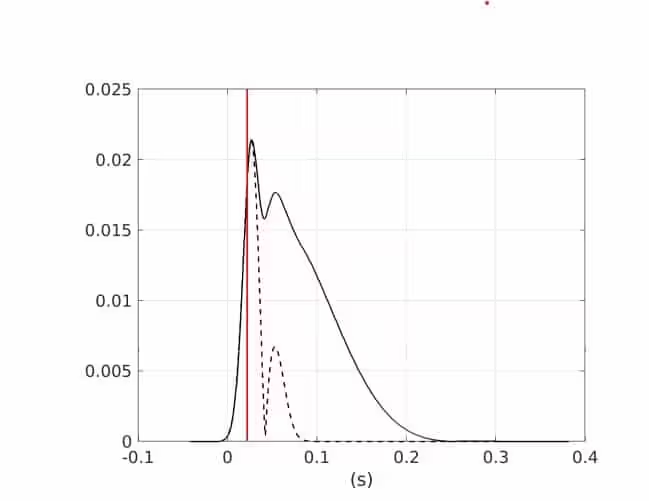
The research originated from attempts to pinpoint cetaceans by recording their vocalizations with arrays of hydrophones. By measuring the arrival times of a whale’s call at multiple sensors, scientists can triangulate the animal’s position. However, when a call is emitted near the water’s surface, part of the sound travels directly to a hydrophone while another portion reflects off the surface before arriving. The superposition of these two paths reshapes the signal, sometimes moving the highest‑energy point to a location that differs from the direct‑path expectation.
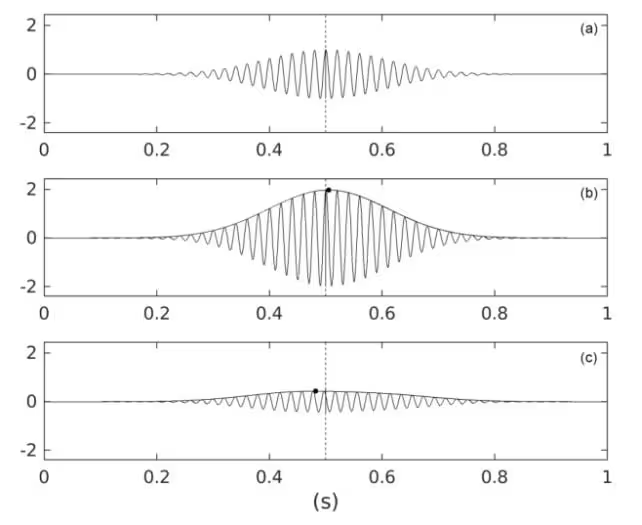
Earlier work by Spiesberger and Terray documented cases where the interference caused an apparent slowdown of the acoustic pulse. In the latest simulations, the authors identified conditions under which the opposite occurs: the combined signal’s peak arrives before the direct‑path peak, suggesting an apparent velocity that exceeds the normal propagation speed of sound.
Apparent Super‑Speed of the Energy Peak Does Not Convey Faster Information
Using a model in which sound travels at roughly 1,500 m s⁻¹, the researchers adjusted the phase relationship between the direct and reflected components. The resulting interference produced effective peak velocities of about 1,694.5 m s⁻¹ and even 2,782.5 m s⁻¹. Although these numbers surpass the baseline sound speed, the underlying physics remains consistent with special relativity because no actual information outruns the light‑speed limit.
The team tested a binary signaling scheme (representing “1” and “0”) and found that the receiver could only decode the new bit after the full waveform had arrived. The shifted peak merely altered the shape of the received pulse; it did not allow a message to be read ahead of the causal wavefront. As Spiesberger and Terray note, “We prove the speed of information is less than or equal to the speed of light in a vacuum, so the effect does not violate special relativity,” in their paper forthcoming in Physical Review E.
Prospects for an Optical Counterpart
Spiesberger and Terray now wonder whether an analogous mechanism could operate with electromagnetic waves. If light reflecting off a boundary were to interfere with a direct path in a comparable way, the resulting intensity peak might appear to travel faster than the vacuum speed of light, without transmitting information superluminally. The authors suggest this “direct + reflected path effect” would differ from previously studied phenomena such as microwave tunneling, quantum tunneling, or anomalous dispersion.
They also propose that the effect could intersect with concepts from quantum mechanics, where wave‑particle duality often yields counterintuitive outcomes. Ongoing laboratory experiments—using either acoustic setups or optical arrangements—will test whether the simulated behavior can be reproduced in real‑world conditions.
This article has been fact checked for accuracy, with information verified against reputable sources. Learn more about us and our editorial process.
Last reviewed on .
Article history
- Latest version
Reference(s)
- Anonymous, “Supersonic and superluminal energy and speed of information via temporal interference in a dispersionless environment.” Physical Review E, July 1, 2026 American Physical Society (APS), doi: 10.1103/1mth-rs2j. <https://journals.aps.org/pre/accepted/10.1103/1mth-rs2j>.
Cite this page:
- Posted by Farah Siddiqui