Third Dark-Matter-Free Galaxy Found Hinting at Violent Cosmic Collision
Astronomers find a third dark‑matter‑free galaxy line, likely forged by an ancient violent collision, challenging our view of cosmic gravity.
Dark matter is believed to dominate the mass budget of the cosmos, providing the unseen gravitational glue that holds galaxies together. Since Vera Rubin’s pioneering work in the 1970s, a growing body of evidence—from galaxy rotation curves to gravitational lensing—has cemented its role as a fundamental component of modern cosmology.
Nevertheless, a handful of galaxies appear to break this rule. A research team led by Yale has now added a third such object to the roster, intensifying a mystery that could force a rethink of galaxy assembly and the nature of dark matter itself.
New Dwarf Galaxy Challenges Dark‑Matter Expectations
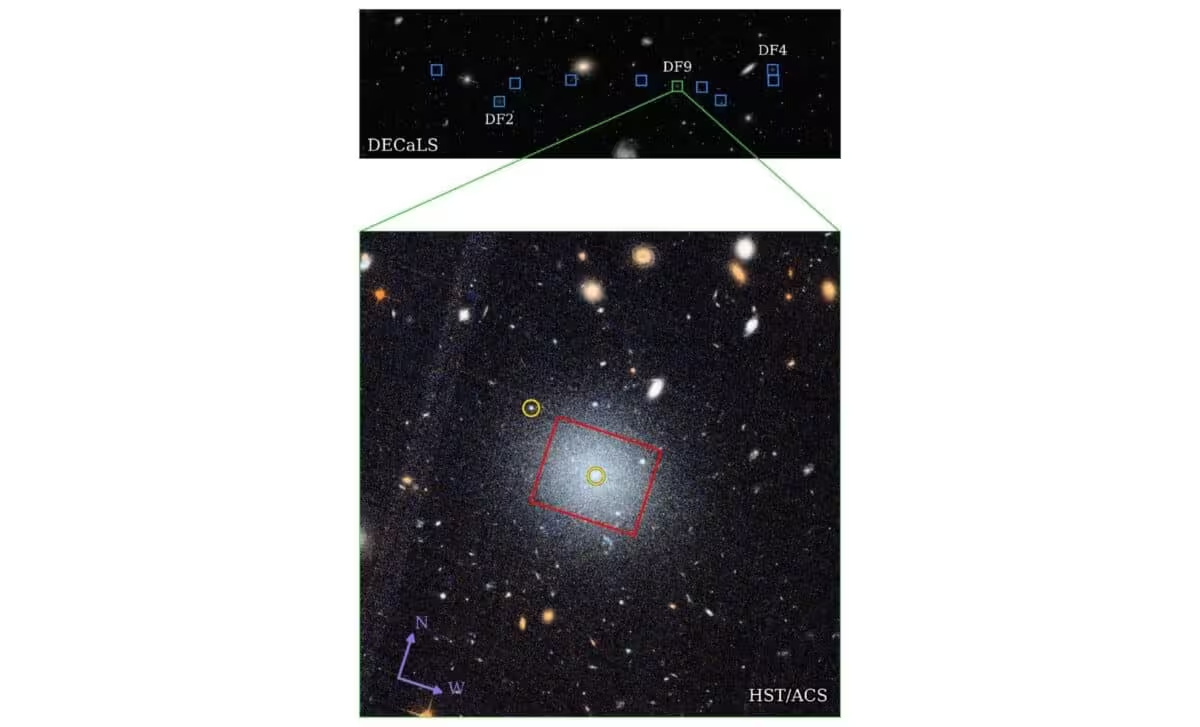
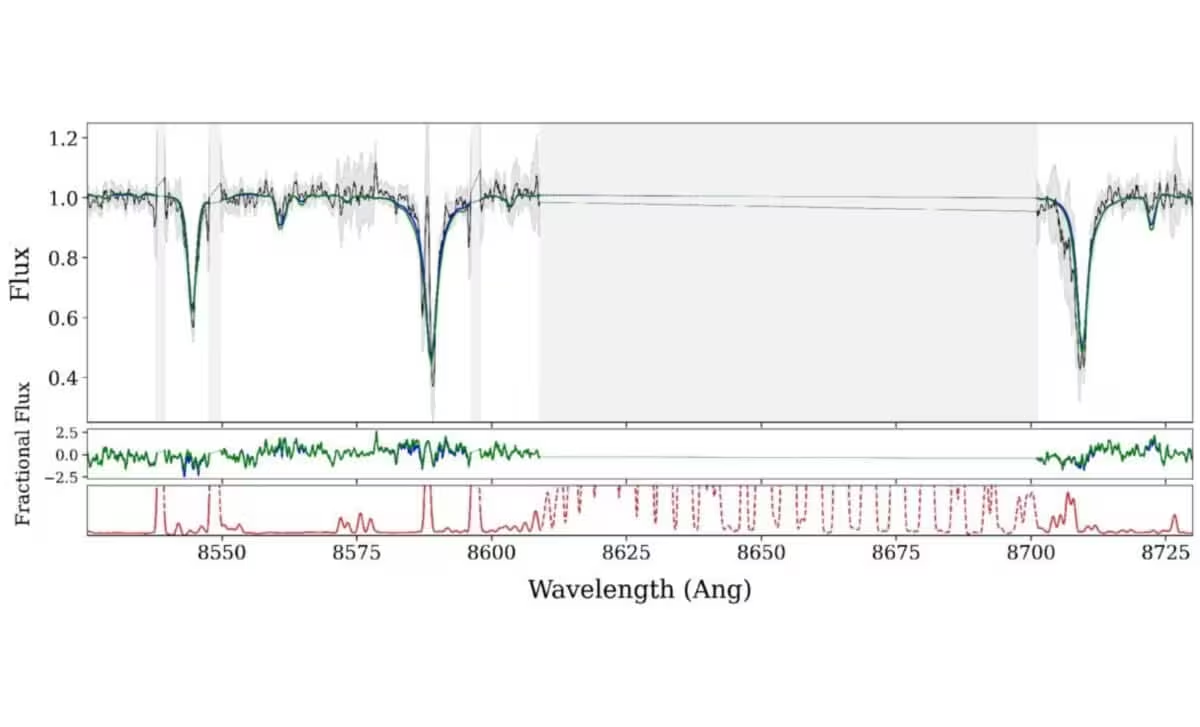
At the W.M. Keck Observatory, a group headed by Yale PhD candidate Michael Keim measured the mass of a faint dwarf system named DF9, situated about 45 million light‑years from Earth. By analysing the velocities of its stars, they derived a total mass of roughly 100 million solar masses—essentially identical to the amount of visible matter, leaving no room for a dark‑matter halo.
DF9 joins two earlier outliers, DF2 and DF4, which also showed a striking lack of dark matter. According to the paper published in The Astrophysical Journal, the three galaxies belong to a linear arrangement of seven objects that likely share a common origin. Pieter van Dokkum, Keim’s advisor and co‑author, previously identified DF2 and DF4 as anomalous; Keim’s new measurements confirm that DF9 is a bona‑fide dwarf galaxy rather than a compact object such as a black hole.
Keim emphasized that the Keck Cosmic Web Imager was crucial for the discovery; its design to capture extremely faint light allowed the team to pin down DF9’s unusually low mass with the precision needed to exclude any hidden dark‑matter component.
Implications for Galaxy Formation Theory
The findings pose a direct challenge to the prevailing picture in which galaxies form inside massive dark‑matter halos that account for about 85 percent of the universe’s total mass. The existence of three galaxies devoid of such halos hints at an alternative pathway, albeit one that may be rare.
One leading scenario envisions a high‑velocity encounter between galaxies, akin to a cosmic “bullet,” that strips gas from the original dark‑matter envelopes. The liberated gas could then collapse to form stars, yielding a galaxy composed solely of ordinary matter. In a Yale press release, Keim noted that a chain of dark‑matter‑free galaxies had never been observed before, and that this system provides some of the strongest support for such an extreme formation channel.
Van Dokkum added that the result bolsters the view of dark matter as a tangible substance rather than an artifact of modified gravity—a distinction that becomes especially critical on the small scales of dwarf galaxies, where alternative gravity theories are most stringently tested.
The team is now planning follow‑up observations to hunt for any leftover gas that might have survived the proposed collision, an effort that will involve the newly commissioned Mothra telescope. Co‑founded by van Dokkum and University of Toronto astronomer Roberto Abraham (who did not take part in the DF9 analysis), the instrument could provide a direct detection of residual material and further validate the collision hypothesis.
At present, DF9 offers the clearest demonstration that a small subset of galaxies can arise without the scaffolding of dark matter, furnishing astronomers with a unique laboratory to probe the properties—and limits—of the elusive component that dominates the cosmos.
This article has been fact checked for accuracy, with information verified against reputable sources. Learn more about us and our editorial process.
Last reviewed on .
Article history
- Latest version
Reference(s)
- “Michael Keim | Department of Astronomy.” <https://astronomy.yale.edu/people/michael-keim>.
- Keim, Michael A.., et al. “A Third Galaxy Missing Dark Matter along a Trail of Galaxies in the NGC 1052 Field.” The Astrophysical Journal, vol. 1004, no. 2, June 16, 2026, pp. 210 American Astronomical Society, doi: 10.3847/1538-4357/ae6b8d. <https://iopscience.iop.org/article/10.3847/1538-4357/ae6b8d>.
- “Pieter van Dokkum | Department of Physics.” <https://physics.yale.edu/people/pieter-van-dokkum>.
- Shelton, Jim. “Third time’s the charm for a row of faint galaxies without dark matter.”, June 16, 2026 Yale News <https://news.yale.edu/2026/06/16/third-times-charm-row-faint-galaxies-without-dark-matter>.
Cite this page:
- Posted by Farah Siddiqui