Earth’s Magnetic Field Nudges Human Decision Making in Lab Under Specific Conditions
New study suggests Earth’s magnetic field may subtly influence subconscious decisions, hinting at a weak human magnetoreception.

The possibility that humans possess a magnetic sense has long been contested. While many migratory species—including birds, sea turtles, salmon and certain insects—rely on geomagnetic cues for navigation, scientific consensus on a comparable capability in people remains elusive.
A recent laboratory study examined whether an Earth‑strength magnetic field could subtly sway human decision‑making without participants’ awareness. The investigators reported a statistically measurable effect under narrowly defined conditions, yet the underlying biological mechanism remains uncertain.
The authors stress that their findings do not imply that everyday mood, sleep patterns or routine choices are driven by geomagnetic fluctuations. Instead, the results pertain to a specific behavioral bias observed in a controlled setting, adding to a growing body of work suggesting that the human brain can respond to magnetic fields without conscious perception.
Unconscious Choice Shifts When Ambient Magnetism Is Suppressed
In a 2025 article published in Frontiers in Neuroscience, researchers from Kyungpook National University recruited 108 healthy adults (55 men and 53 women) to perform a decision‑making task modeled after a traditional Go ritual. In the game, the player who receives the black stones moves first, and a concealed number of white stones is used to determine who gains that advantage.
The experiment was carried out inside a magnetically shielded chamber equipped with electromagnetic coils. In some trials the Earth’s natural field was left untouched; in others the coils generated an opposing field that almost entirely neutralized it. Neither the participants nor the data analyst knew which condition was active during any given trial.
When the ambient magnetic field was canceled, subjects were assigned the black stones significantly less often than random chance would predict. This effect emerged only among participants who had fasted before the session and whose blood‑glucose concentrations fell within a tight range. Nearly 98 % of volunteers reported no sensation or awareness of the magnetic manipulation.
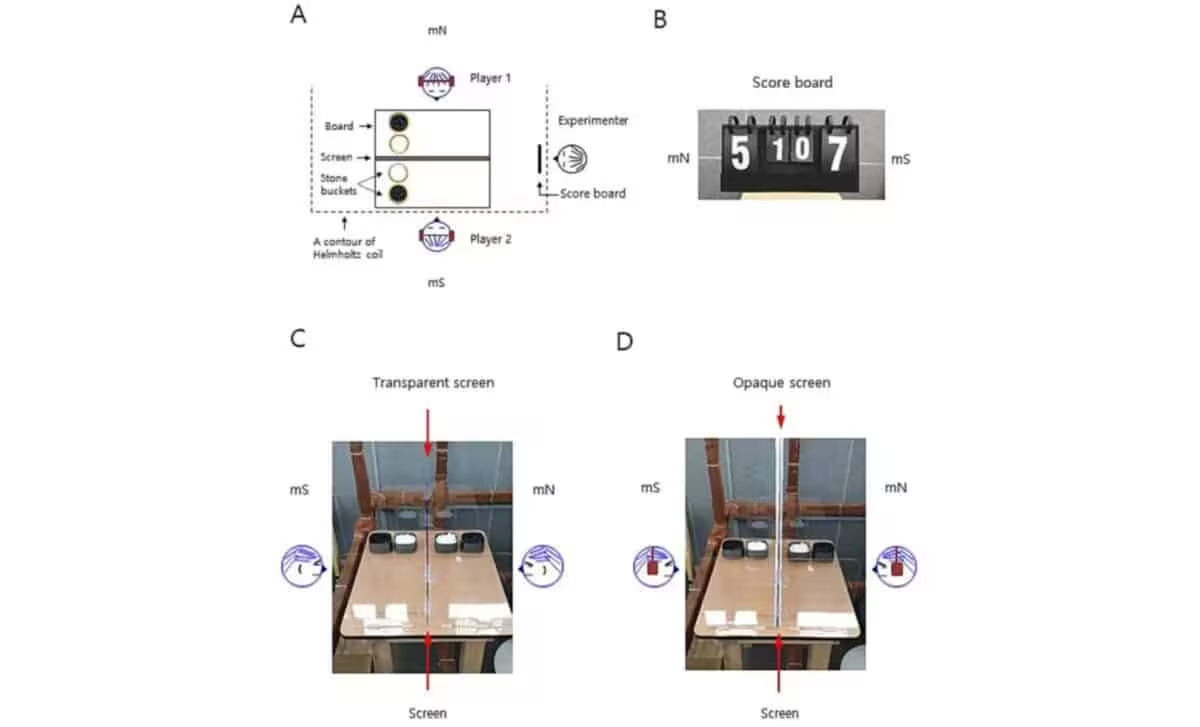
Senior author Kwon‑Seok Chae interpreted the outcome as evidence that the magnetic field influenced a largely subconscious component of the task, rather than the participants’ deliberate choice of placing one or two black stones. The team’s analysis of more than 21,000 professional Go matches had previously shown that higher‑ranked players secured the advantageous black stones more often than chance would allow.
Exploring Biological Routes for Human Magnetoreception
The same study also probed potential mechanisms behind the observed bias. In a follow‑up experiment the researchers did not alter the geomagnetic field; instead, they exposed subjects to a faint radio‑frequency signal at 1.26 MHz—a frequency predicted to disrupt cryptochrome activity.
Cryptochromes are light‑sensitive proteins present in the retinas of both birds and humans and have been linked to magnetic navigation in avian species. The 1.26 MHz stimulus reproduced the behavioral shift seen when the Earth’s field was suppressed, whereas a control signal at 1.89 MHz produced no effect, lending credence to the cryptochrome hypothesis.
An alternative hypothesis involves magnetite, a naturally occurring magnetic mineral. Minute magnetite crystals have been identified in human brain tissue and could, in theory, act as magnetic detectors. Chae noted that some electroencephalography studies have been interpreted as supporting this magnetite‑based mechanism.
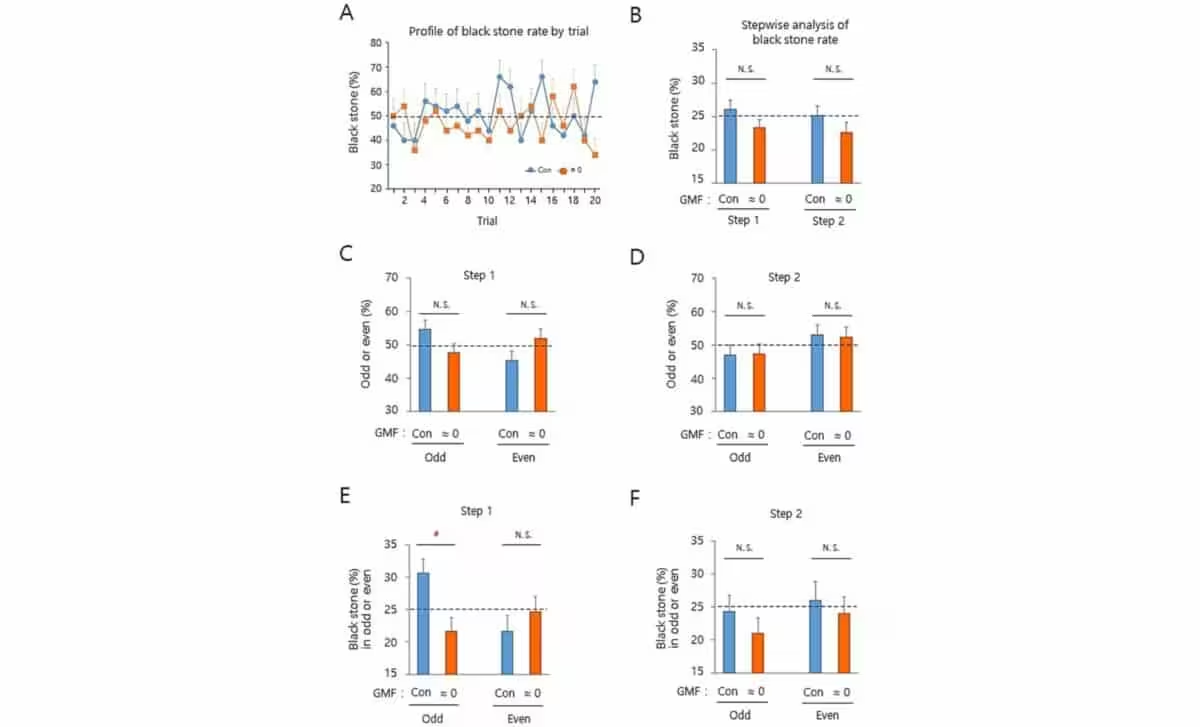
Earlier work has also reported magnetic sensitivity in humans. A 2019 Caltech study demonstrated that rotating an Earth‑strength magnetic field induced reproducible changes in participants’ brain activity despite a lack of conscious detection. Chae’s group has separately presented data suggesting that blue‑light conditions may facilitate magnetic field perception.
Nevertheless, none of these investigations conclusively establishes magnetoreception as a functional human sense. Chae described the 2025 results as preliminary evidence that requires independent replication. Neuroscientist Robert Alexander of the New York Institute of Technology called the findings “provocative but not established,” noting that a modest shift in decision patterns does not alone confirm the existence of a dedicated sensory system.
Both researchers agree that current data do not demonstrate everyday awareness of geomagnetic variations nor any direct impact on mood or sleep. The observed effect remains confined to tightly controlled laboratory conditions, leaving open the question of whether human responses to Earth’s magnetic field play any role beyond experimental settings.
This article has been fact checked for accuracy, with information verified against reputable sources. Learn more about us and our editorial process.
Last reviewed on .
Article history
- Latest version
Reference(s)
- “Robert G. Alexander | New York Tech.”, October 30, 2025 New York Tech <https://www.nyit.edu/bio/robert-g-alexander/>.
Cite this page:
- Posted by Hassan Raza