Loudest Gravitational Wave Reveals Black Hole Spin and Surface Gravity Near Event Horizon
Scientists uncover a hidden signal in the loudest black‑hole merger ever detected, revealing new insights into gravitational wave events.
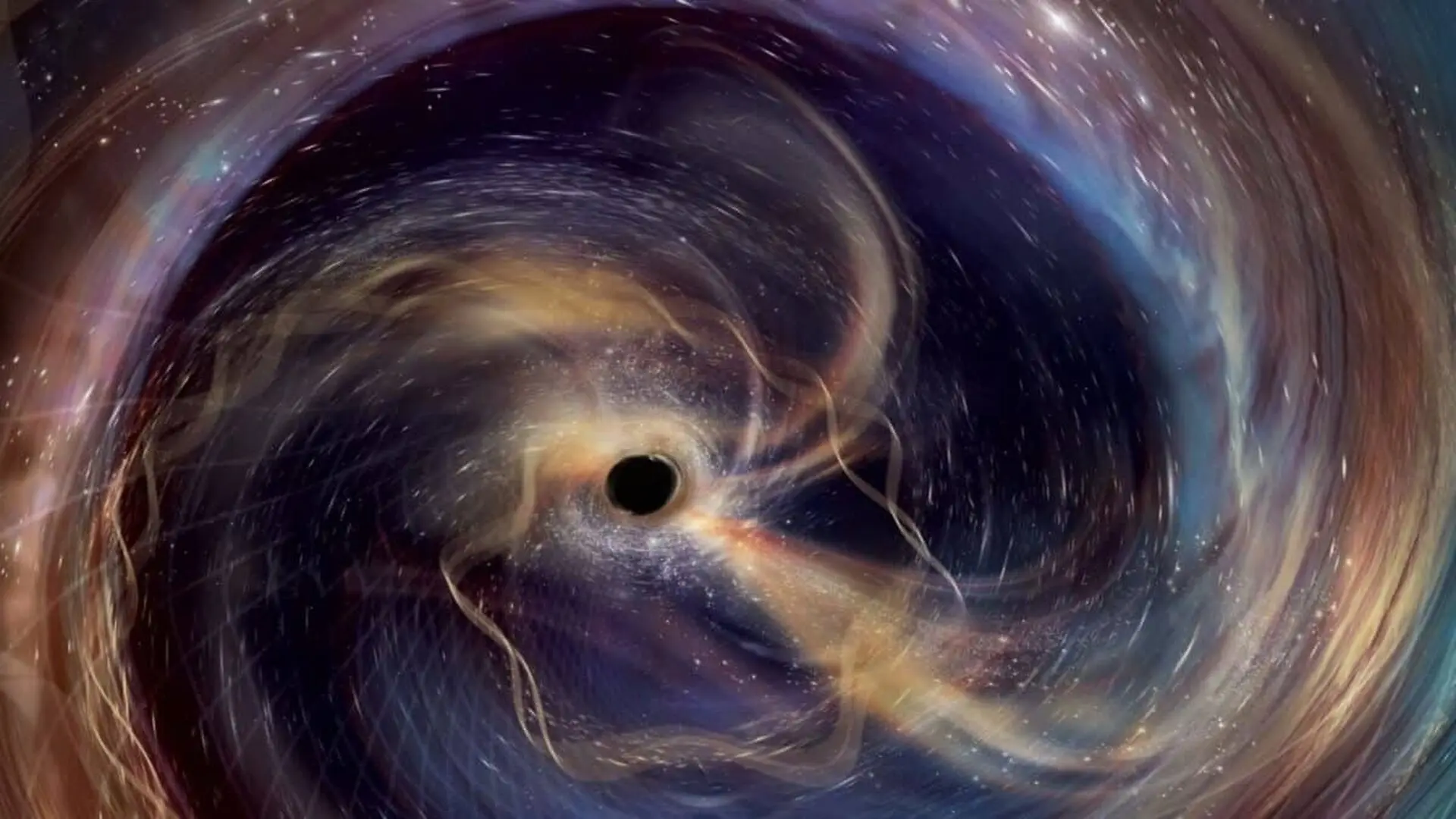
A team of researchers has, for the first time, extracted details about the environment just outside a newly formed black hole’s event horizon by scrutinizing the strongest gravitational‑wave signal ever recorded. The findings, appearing in NatureAstronomy, demonstrate a novel approach to probing one of the universe’s most extreme regions using data from the binary‑black‑hole merger designated GW250114.
Led by scientists from the ARC Centre of Excellence for Gravitational Wave Discovery (OzGrav) and the Australian National University, the analysis reveals that the merger’s signal carries far more subtle information than previously recognized. By revisiting the landmark event GW250114, the international collaboration identified faint waveform components that encode the dynamics occurring immediately beyond the horizon after the two black holes coalesced.
Loudest Merger Yet Detected Opens New Window
The signal was captured in 2025 by the two Laser Interferometer Gravitational‑Wave Observatory (LIGO) detectors in the United States. GW250114 stands out as the most powerful binary‑black‑hole merger observed to date, offering a level of detail that weaker events simply cannot provide.
“We studied GW250114, the loudest binary black hole signal observed to date, about three times louder than the first gravitational-wave signal detected a decade ago,” Sun said. “Our analysis shows that this exceptionally loud signal can be used as a powerful probe of the remnant black hole’s horizon, allowing us to measure its two fundamental properties: rotation frequency and surface gravity.”
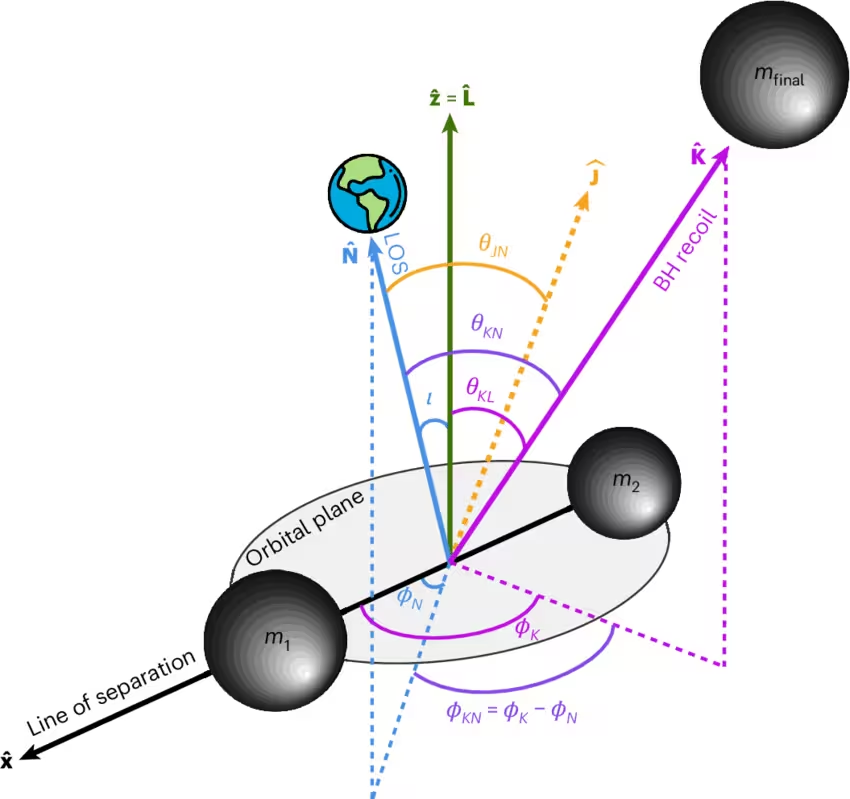
By targeting portions of the waveform that had been ignored in conventional analyses, the scientists were able to determine both the black hole’s rotation frequency and its surface gravity.
Unearthing Subtle Direct Waves
Instead of concentrating solely on the dominant peak of the gravitational‑wave burst, the team isolated a much weaker element known as direct waves. According to the paper, this segment of the signal had remained largely unexplored until now.
Neil Lu, a Ph.D. candidate at OzGrav and the Australian National University, explained that the new analytical technique enabled the separation of this concealed component from the rest of the waveform.
“We measured the last sound the black holes made when they crashed. Hidden within that signal is a small component, called direct waves, that had not previously been well understood,” Lu explained. “Our new analysis allows us to decipher this component and extract unique information from close to the event horizon.”
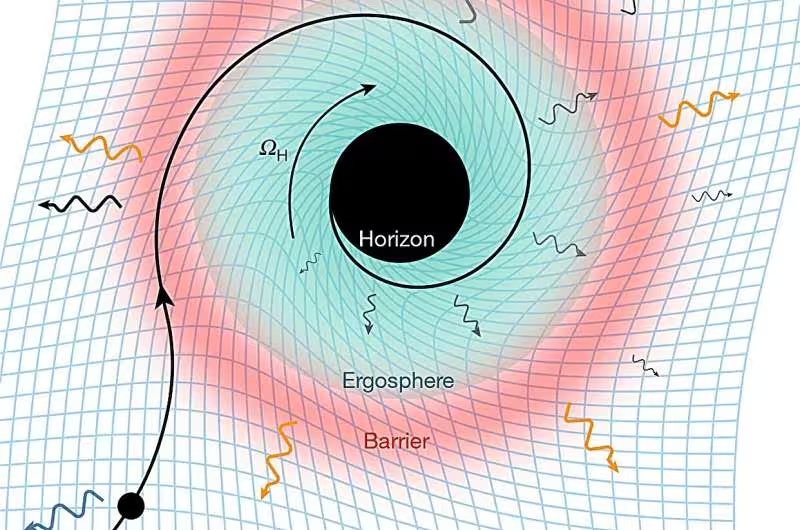
A Fresh Lens on Relativistic Gravity
These results create a new observational channel for examining the region where general relativity and quantum physics intersect. NatureAstronomy notes that the analytical framework developed by the team will empower future gravitational‑wave detections to probe the extreme gravity near black‑hole horizons.
The methodology also opens the door to studying frame dragging—the effect by which a rapidly spinning black hole twists the surrounding spacetime. In such a regime, no object can remain stationary relative to a distant observer. Lu emphasizes that the current measurements represent only an early glimpse of what the technique may uncover.
“These measurements mark a first step toward future tests of general relativity with direct waves,” he added.
This article has been fact checked for accuracy, with information verified against reputable sources. Learn more about us and our editorial process.
Last reviewed on .
Article history
- Latest version
Reference(s)
- “Gravitational-Wave Science – LSC – LIGO Scientific Collaboration.” <https://ligo.org/gravitational-wave-science/>.
- Lu, Neil. “GW250114 reveals signatures of post-merger black-hole horizon - Nature.”, June 24, 2026, pp. 1-5. Nature, doi: 10.1038/s41586-026-10696-0. <https://www.nature.com/articles/s41586-026-10696-0>.
- “Neil Lu - OzGrav.”, June 11, 2024 OzGrav <https://www.ozgrav.org/person/neil-lu/>.
Cite this page:
- Posted by Farah Siddiqui