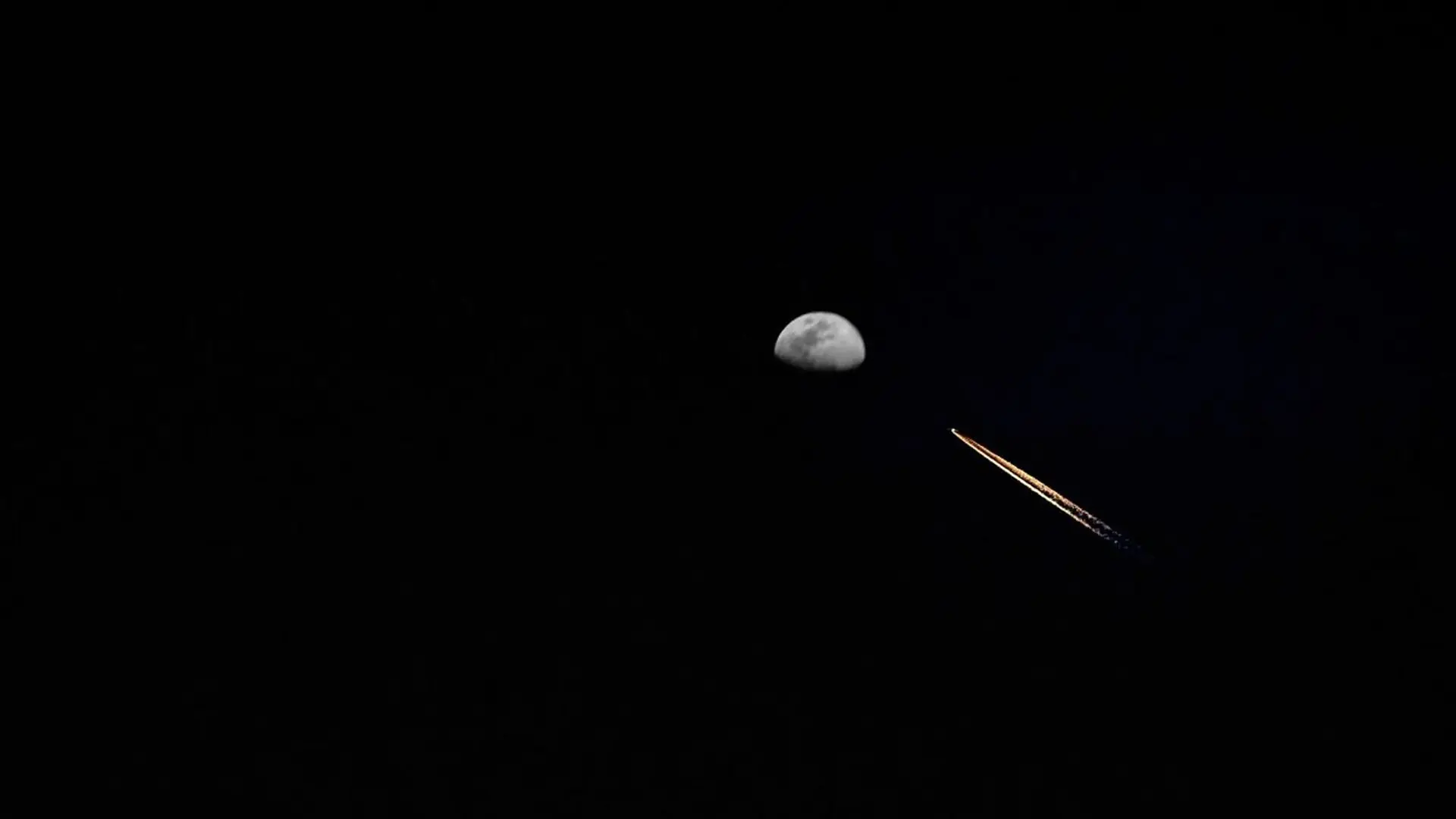
A spent upper stage from a SpaceX Falcon 9 launch is projected to strike the Moon’s near side on 5 August 2026, close to Einstein Crater. The event offers astronomers a rare chance to witness a human‑made object colliding with the lunar surface in real time.
Upper Stage on a Lunar Collision Course
Designated 2025‑010D, the component has been orbiting since January 2025 after delivering two private robotic landers toward the Moon. With insufficient propellant to return to Earth or divert elsewhere, the stage continued on a trajectory that now intersects the Moon.
The vehicle measures roughly 12 metres (39 ft) in length, 4 metres (13 ft) in diameter, and carries a mass of about 4 000 kg. Simulations indicate it will impact at approximately 8 750 km h⁻¹ (5 400 mph).
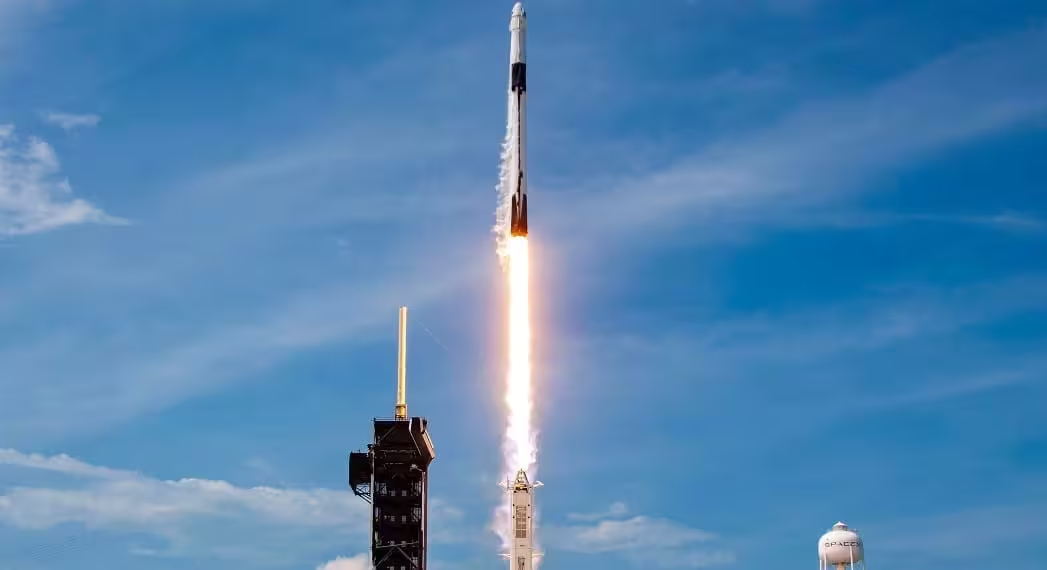
A SpaceX Falcon 9 rocket launches from Earth during a previous mission. Credit: SpaceX
Astronomer Bill Grey provided tracking data that researchers fed into computer models. Because the stage consists mainly of a hollow metal shell, the simulations predict it will collapse on impact, forming a crater roughly 20–30 metres (66–98 ft) across and lofting a plume of dust several kilometres high.
The immediate aftermath is expected to produce a brief flash and an ejecta cloud that rise above the lunar surface. The study posted on arXiv notes that these signatures will let scientists compare real‑world observations with their predictive models.
“Potential observables from this event include the flash at the time of impact … and the ejecta plume.” These observations will allow scientists to compare what actually happens with their computer models.
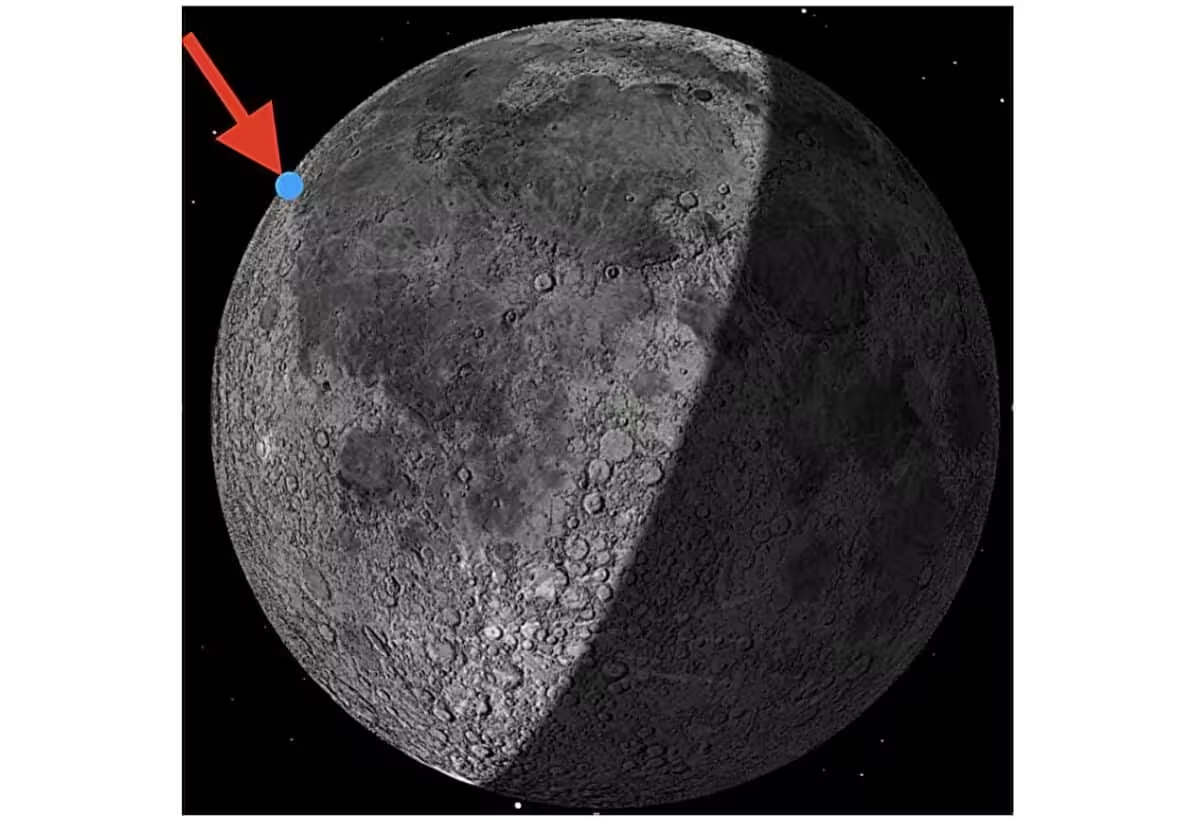
The blue marker identifies the estimated lunar impact location of the Falcon 9 upper stage. Credit: arXiv
Because the impact point lies on the Moon’s near side, observers on Earth have a window to record the event. Researchers stress that cameras capable of high‑speed video will be essential to capture the fleeting flash and dust expansion.
The projected impact time is 06:35 UTC on 5 August 2026. The authors of the preprint encourage both professional observatories and amateur astronomers to participate in the monitoring campaign.
Transforming an otherwise discarded rocket stage into a scientific probe could enhance techniques for locating lunar impacts. Improved detection methods would benefit upcoming missions that plan to deploy seismometers on the Moon, offering new insights into subsurface vibrations and activity.
The research underscores how accidental collisions can become valuable experiments, shedding light on the dynamics of artificial objects interacting with the lunar regolith.
A SpaceX Falcon 9 Just Hit The Moon! A spent SpaceX Falcon 9 upper stage is set to impact the Moon this August. This unplanned event marks the first time a piece of space junk will hit the lunar surface after an uncontrolled trajectory. The collision offers a unique… pic.twitter.com/zoswMgJLL3
Tariq, Zara. “SpaceX Falcon 9 Upper Stage Set to Hit Moon on Aug 5 2026 Rare Live Lunar Impact.” BioScience. BioScience ISSN 2521-5760, 24 July 2026. <https://www.bioscience.com.pk/en/subject/science/a-4-000-kilogram-spacex-rocket-stage-is-about-to-crash-into-the-moon-and-scientists-know-the-exact-day>.
Tariq, Z. (2026, July 24). “SpaceX Falcon 9 Upper Stage Set to Hit Moon on Aug 5 2026 Rare Live Lunar Impact.” BioScience. ISSN 2521-5760. Retrieved July 24, 2026 from https://www.bioscience.com.pk/en/subject/science/a-4-000-kilogram-spacex-rocket-stage-is-about-to-crash-into-the-moon-and-scientists-know-the-exact-day
Tariq, Zara. “SpaceX Falcon 9 Upper Stage Set to Hit Moon on Aug 5 2026 Rare Live Lunar Impact.” BioScience. ISSN 2521-5760. https://www.bioscience.com.pk/en/subject/science/a-4-000-kilogram-spacex-rocket-stage-is-about-to-crash-into-the-moon-and-scientists-know-the-exact-day (accessed July 24, 2026).