Archaeologists Enter a Hidden Luxor Chamber and Find 22 Painted Coffins of Amun’s Sacred Singers With 8 Sealed Papyri Untouched for Centuries
Within an undiscovered sepulcher, archaeologists uncovered 22 vividly decorated sarcophagi alongside sealed scrolls connected to the enigmatic Amun Singers.
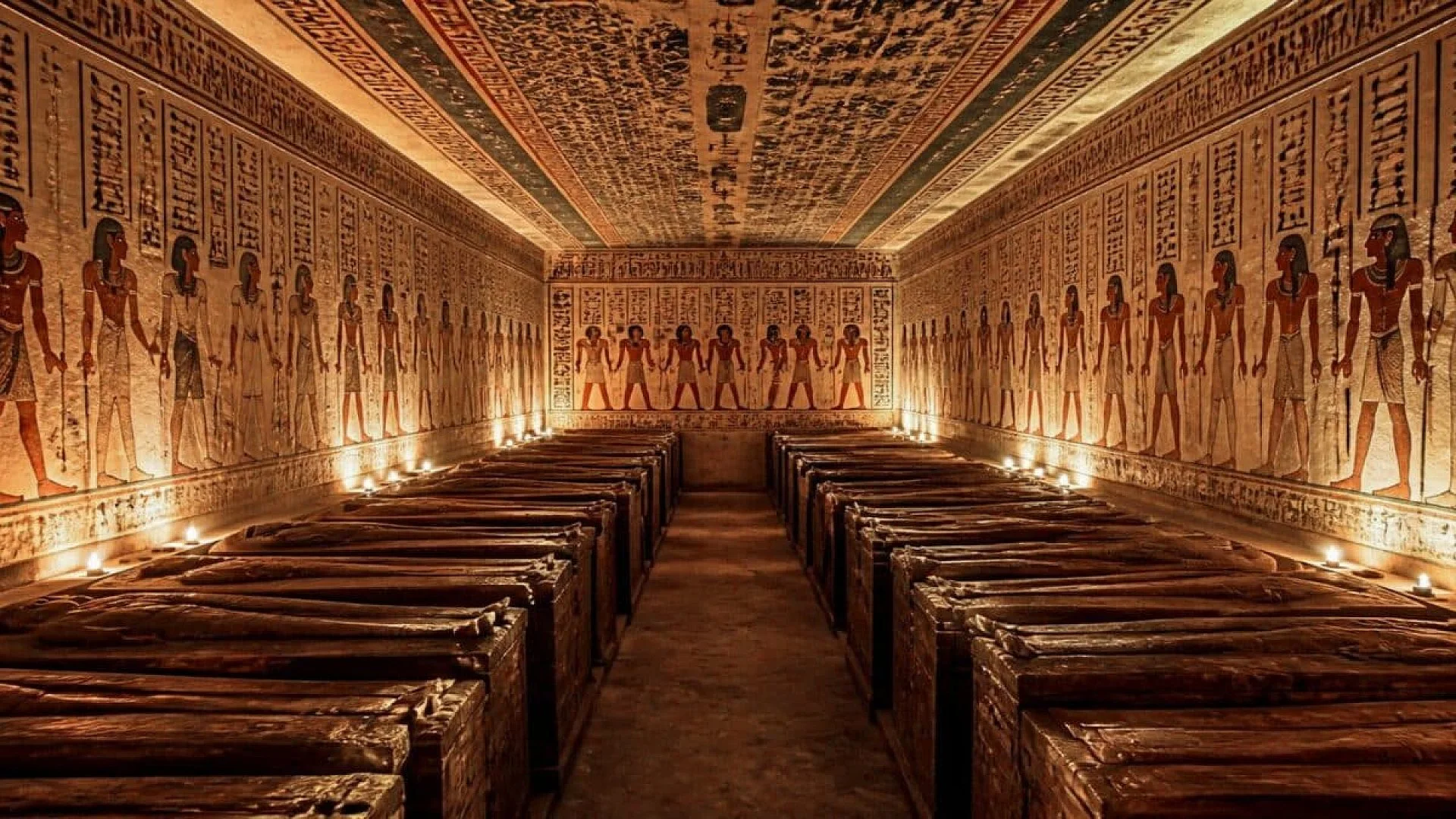
The discovery of a rock-cut chamber beneath the Luxor desert has yielded an extraordinary funerary find from Egypt’s Third Intermediate Period: 22 intricately painted wooden coffins belonging to women who served as Singers of Amun, stacked in ten horizontal rows alongside eight sealed papyri stored inside a ceramic vessel. This remarkable discovery was announced in March 2026 by Egypt’s Ministry of Tourism and Antiquities following excavations in the Asasif necropolis on Luxor’s West Bank.
The joint mission, conducted by the Supreme Council of Antiquities and the Zahi Hawass Foundation for Archaeology and Heritage, located the cache in the southwestern sector of the courtyard of the tomb of Sennep in the Qurna area, part of the broader Theban necropolis. The coffins still contained mummified remains, a relatively rare outcome given how many reburials from this era were disturbed or emptied in antiquity.
A Chamber Built for Systematic Storage
The burial chamber was carved directly into bedrock and appears to have functioned as a secondary repository rather than an original tomb. Coffin lids were separated from their boxes and the burials were stacked across ten rows, a configuration that suggests deliberate space management rather than rushed reinterment.
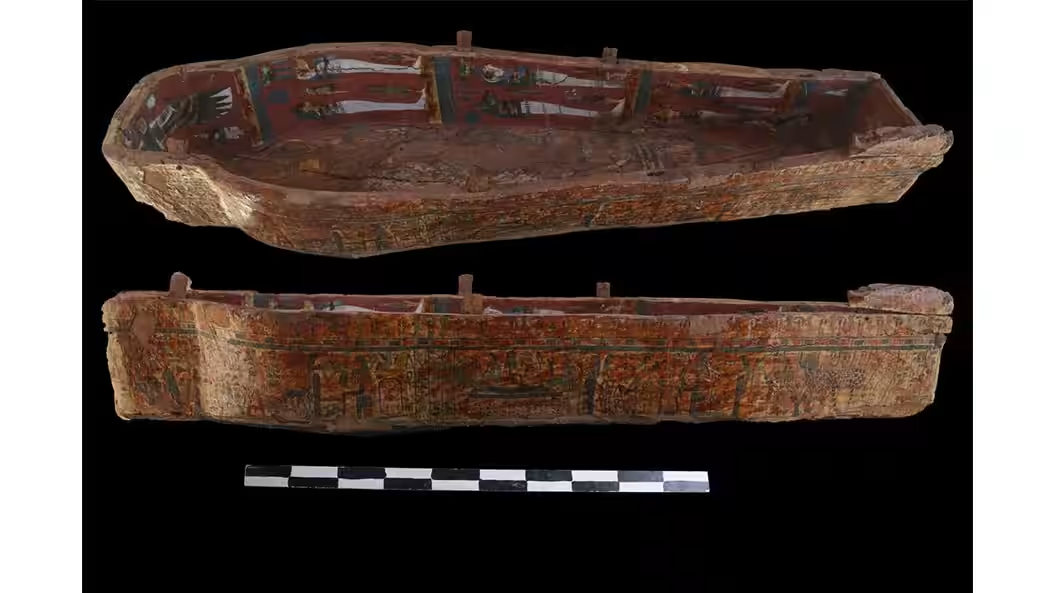
Archaeologists interpret the arrangement as evidence of institutional oversight, most likely coordinated by temple authorities. The level of organization points to a planned consolidation, not an emergency or improvised transfer. Most coffins bear no personal names, but many carry the professional designation “Singer of Amun” in place of individual identity.
That detail is significant. It suggests that, at least in a funerary context, religious office mattered more than lineage or personal history. The cache offers material evidence of a collective burial tradition tied directly to temple employment, a dimension of Third Intermediate Period mortuary practice that has limited physical documentation.
Who the Singers of Amun Were
During the Third Intermediate Period, which ran from roughly 1070 to 664 BCE across Dynasties 21 through 25, Egypt’s political center fractured. Northern power shifted to Tanis while Thebes remained under the strong administrative grip of the Amun priesthood at Karnak. The Singers of Amun were part of that structure.
These women held formal roles within the ritual life of the temple, participating in sacred music, chanting, and ceremonial performance at Karnak Temple. They were not peripheral figures. The priesthood they served controlled extensive landholdings and wielded considerable economic power throughout Upper Egypt.
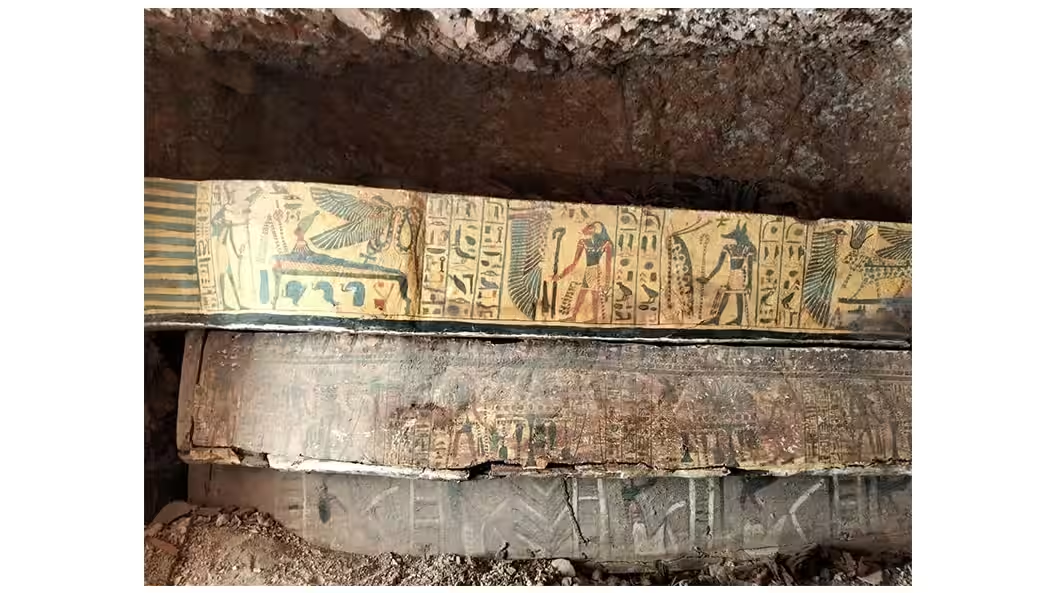
The repeated use of their professional title on coffins, rather than personal names, reinforces the idea that their identity as temple functionaries defined how they were remembered and interred. The Asasif necropolis find provides a rare physical record of how this class of female religious officials was collectively managed in death.
Eight Papyri, Several Still Sealed
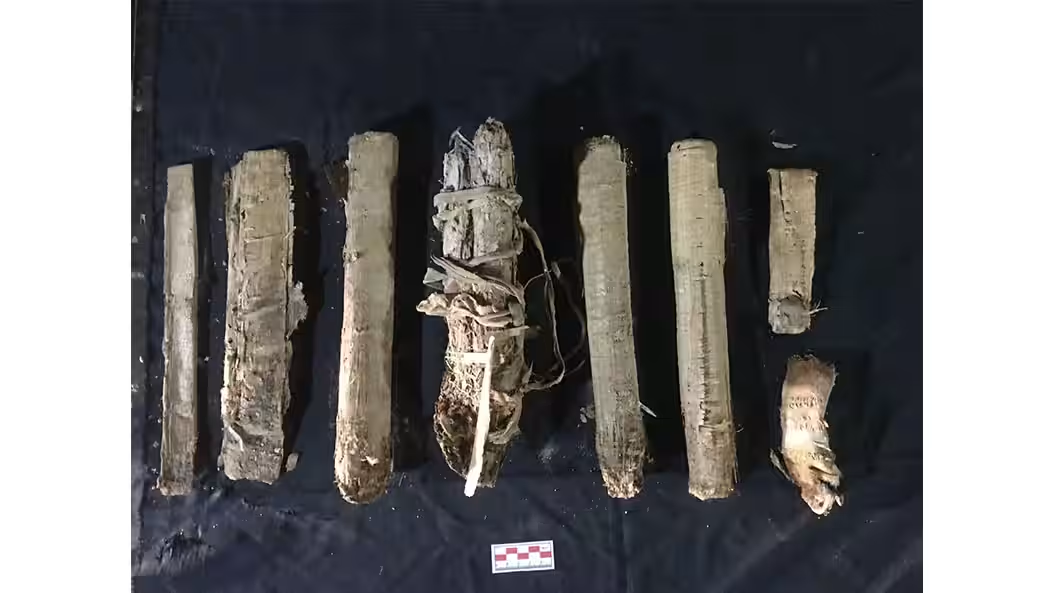
Set apart from the coffins, eight papyri were found inside a large pottery vessel within the same chamber. Several remain sealed with intact clay closures, which officials from the Ministry of Tourism and Antiquities described as an “information treasure” awaiting conservation and translation.
The varying sizes of the papyri and the preservation of their original seals suggest they were deposited with care. Depending on what the texts contain, they could illuminate temple administration, funerary ritual, embalming procedures, or economic records connected to the Amun cult. Because sealed papyri recovered from secure and documented archaeological contexts are relatively uncommon, their value extends beyond the written content alone. Residue analysis and material studies may also clarify how documents were stored and handled in ancient Thebes.
Also recovered from the chamber were pottery vessels believed connected to mummification, possibly used to store natron, resins, or linen. Their presence alongside the coffins and papyri reinforces the interpretation that this was an organized funerary consolidation rather than an isolated burial event.
Conservation Work and Ongoing Excavation
The wooden coffins were in fragile condition when found. On-site conservators stabilized weakened fibers, consolidated flaking plaster, and cleaned painted surfaces mechanically before full photographic and architectural documentation was completed. The objects were then transferred to storage facilities for further work.
Excavations are continuing. The mission is now searching for the original tombs from which these coffins were moved, hoping to determine whether the women were initially buried together as a temple group or relocated from separate sites at a later point. Identifying those primary locations would clarify the scope of the consolidation and the social networks that connected these women in life.
This article has been fact checked for accuracy, with information verified against reputable sources. Learn more about us and our editorial process.
Last reviewed on .
Article history
- Latest version
Reference(s)
- Altuntaş, Leman. “Singers of Amun Coffins and Sealed Papyri Discovered in Luxor’s Asasif Necropolis.”, March 3, 2026 arkeonews.net <https://arkeonews.net/singers-of-amun-coffins-and-sealed-papyri-discovered-in-luxors-asasif-necropolis/>.
Cite this page:
- Posted by Zara Tariq