Why Attention Is All You Need in Quantum Physics
A new study reveals that self-attention acts as a physical Dyson equation, explaining its surprising success in modeling complex quantum states.
When artificial intelligence models analyze complex chemical and physical systems, standard pooling architectures often stumble over correlated wavefunctions and excited states, but self-attention mechanisms bypass this limitation by operating as a physical Dyson equation. Researchers have long puzzled over why simple sum-pooling models accurately predict ground-state potentials yet fail completely for nonlocal quantum behaviors. A new study addresses this discrepancy by proving that self-attention acts as a spatial Dyson iteration, where the softmax kernel functions as a two-body self-energy.
The work, available in an arXiv preprint server report by chemist and physicist Jarvist Moore Frost from Imperial College London, demonstrates that because physical Hamiltonians are governed strictly by pairwise interactions, iterative self-attention is formally sufficient to capture the exact energetics of correlated matter. This mathematical equivalence helps explain why attention mechanisms achieve superior electronic correlation across diverse molecular systems.
Why Simple Pooling Fails for Complex Quantum States
To understand the architectural split in atomistic machine learning, researchers compare symmetric sum-pooling, commonly known as DeepSets, with modern self-attention frameworks. In standard DeepSets architectures, interactions between particles are aggregated via an unweighted symmetric sum. This design scalarizes interactions into one-body terms, which functions well for additive, locally nearsighted quantities like ground-state energies and forces.
However, this mean-field approach assigns an identical background potential to every particle, effectively diluting specific pairwise correlations by a factor of 1 over N. When two particles approach each other closely, the model broadcasts spurious crosstalk to distant spectator particles. Consequently, the off-diagonal Jacobian collapses, washing out detailed structural information and leaving behind a smooth, featureless energy envelope.
How Self-Attention Recovers Real-Space Correlators
Self-attention solves this collapse by replacing uniform weighting with a state-dependent Boltzmann kernel derived from query, key, and value projections. Rather than treating all particles uniformly, the softmax mechanism concentrates large weight on immediate interacting partners while silencing distant spectators. This maintains an order-1 off-diagonal sensitivity regardless of system size.
What Happens When Testing Against Fractal Wavefunctions
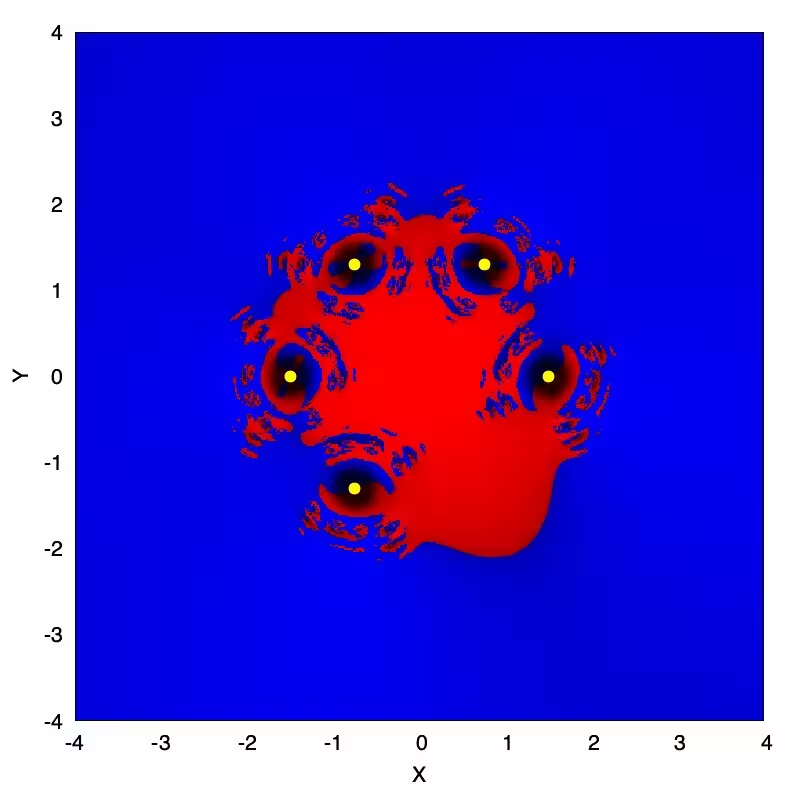
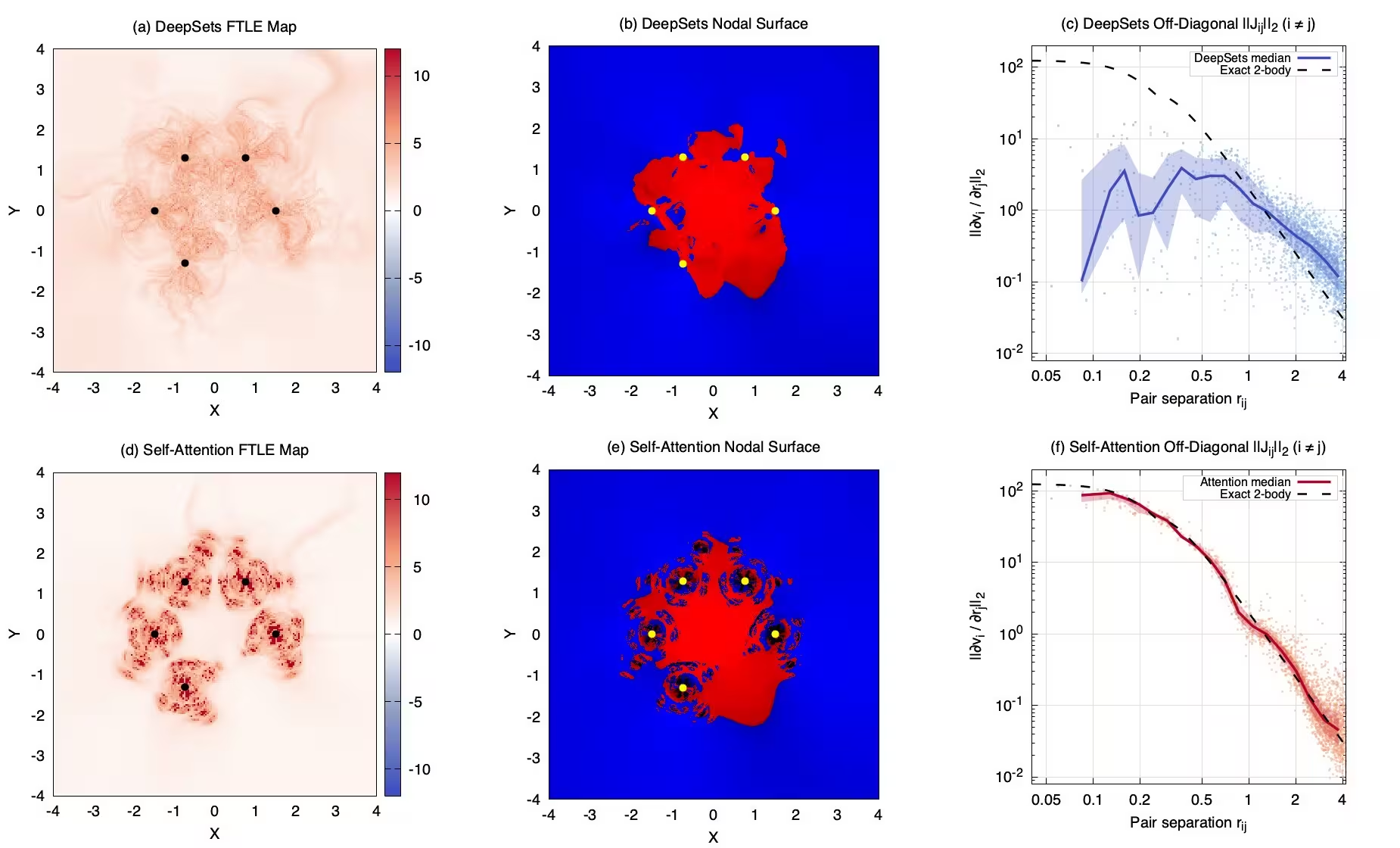
To test these theoretical predictions, the author fitted models to a complex fractal determinant derived from a hydrodynamic backflow wavefunction. While the equivariant DeepSets architecture completely flattened the intricate fractal structure into a featureless shape resembling a squashed strawberry, a width-matched self-attention network successfully recovered the nested fractal pockets and dipolar rosettes.
Quantitative analysis of the velocity Jacobian revealed that as probe particles approached stationary reference points, self-attention tracked the exact analytic derivative within 1.6 percent accuracy over four decades of separation. DeepSets, by contrast, suffered severe saturation at short ranges and generated long-range outliers due to its mean-field averaging.
What This Means for Future Architecture Design
This correspondence between neural network layers and many-body quantum theory clarifies several empirical design choices in modern machine learning. The exponential Boltzmann factor is essential because linear attention reduces to a low-rank kernel representing only finite-order perturbation theory, whereas expanding the exponential generates all powers of the two-body vertex.
Furthermore, recomputing queries and keys from already-dressed states at every layer executes a self-consistent skeleton expansion akin to discrete functional renormalization group flows. Multi-head attention naturally decomposes this self-energy action into parallel interaction channels, allowing models to separate short-range intramolecular exchange from long-range intermolecular dispersion.
Ultimately, the study suggests that equivariant sum-pooling and self-attention mirror the two foundational approximations that have structured condensed-matter physics for a century. While mean-field pooling suffices for local potentials governed by nearsightedness, correlated matter and long-range quantum states require the two-body Dyson iteration native to self-attention.
The study was posted to the arXiv preprint server on November 16, 2026.
This article has been fact checked for accuracy, with information verified against reputable sources. Learn more about us and our editorial process.
Last reviewed on .
Article history
- Latest version
Reference(s)
- Frost, Jarvist. “Self-attention is a Dyson equation for many-body machine learning.” arXiv.org <http://arxiv.org/abs/2611.21398v1>.
Cite this page:
- Posted by Anjali Singh