Scientists Reveal Gold’s Secret Atomic Shield That Stops Oxidation by a Trillion Fold
A hidden atomic rearrangement makes gold’s surface resist oxygen, explaining its brilliant shine and exceptional rust resistance.
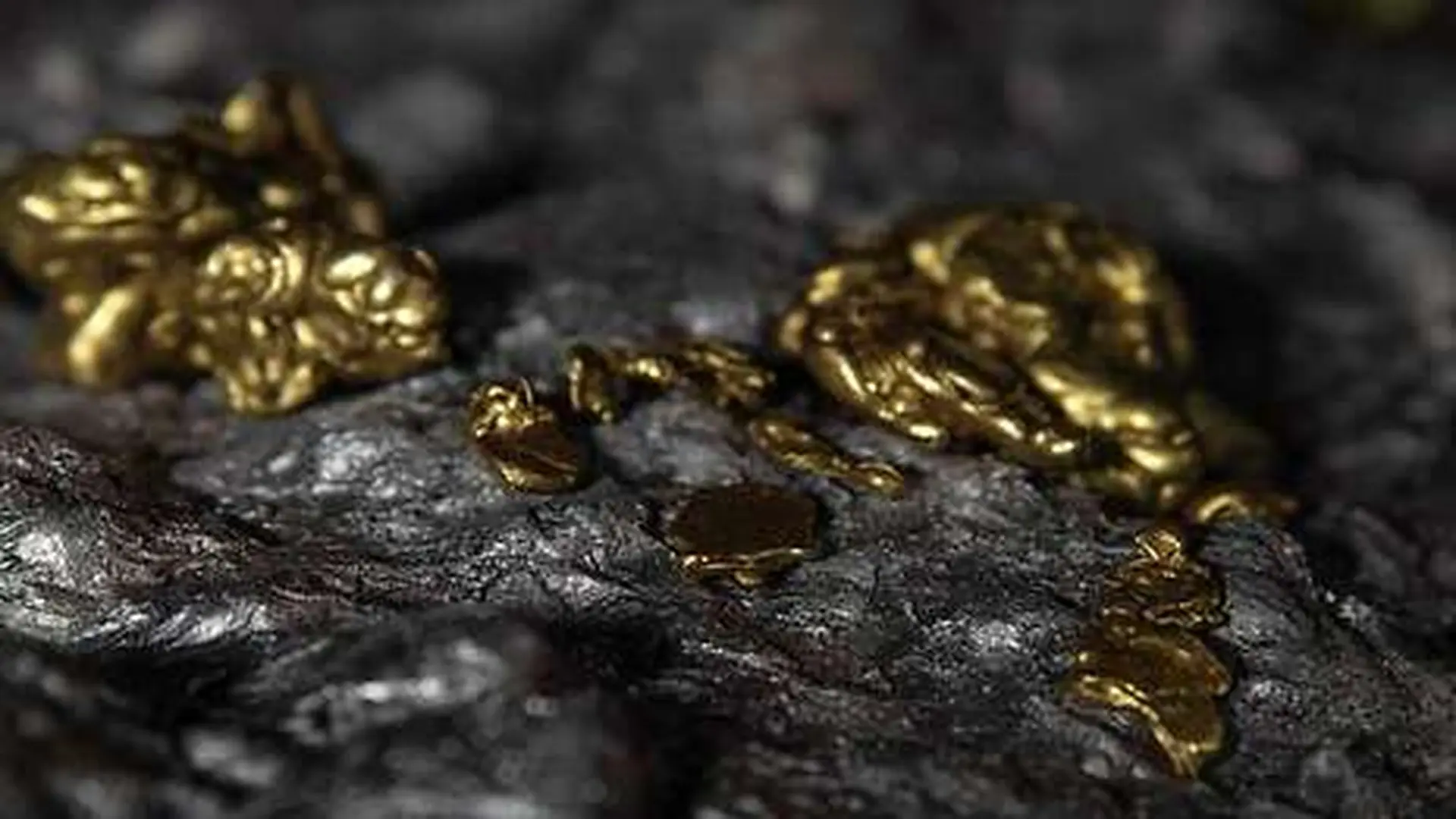
Gold has long been treasured for its ability to survive the ages, staying bright while other metals corrode—iron rusts, copper verdigris, silver blackens. Chemists have traditionally explained this by calling gold a “noble” metal that simply does not react with oxygen. Yet the story is more nuanced: bulk gold barely oxidises, but particles only a few nanometres across can accelerate oxygen‑driven reactions, the very chemistry that produces rust and tarnish elsewhere. A team at Tulane University tackled this paradox with quantum‑mechanical simulations that probe how oxygen molecules engage two of the metal’s most common surface facets.
Atomic Rearrangement Forms a Protective Skin
Oxidation normally starts when an O₂ molecule splits into two atoms that attach to a metal surface. The Tulane researchers found that gold makes this step exceptionally hard, not because it is uniformly indifferent to oxygen, but because the outermost atoms re‑organise themselves when a fresh surface is created—by cutting, scratching, or natural crystal faceting. This re‑ordering, known as surface reconstruction, forces the surface atoms into a denser hexagonal lattice that blocks the approach of oxygen atoms.
“People have generally thought gold doesn’t tarnish simply because it doesn’t interact strongly with oxygen,” said Matthew Montemore, associate professor of chemical engineering at Tulane and co‑author of the study. “What we show is that for two of the most common gold surface types, the surface atoms actually rearrange themselves in a way that makes the gold much more resistant to oxidation.”
In simulations of unreconstructed gold, the atoms sit in a square‑like arrangement that leaves enough space for O₂ to dissociate. Once the atoms shift into a tighter hexagonal pattern, the same reaction becomes dramatically slower, effectively sealing the metal against oxygen attack.
A Billion‑Fold Slowdown in Oxygen Splitting
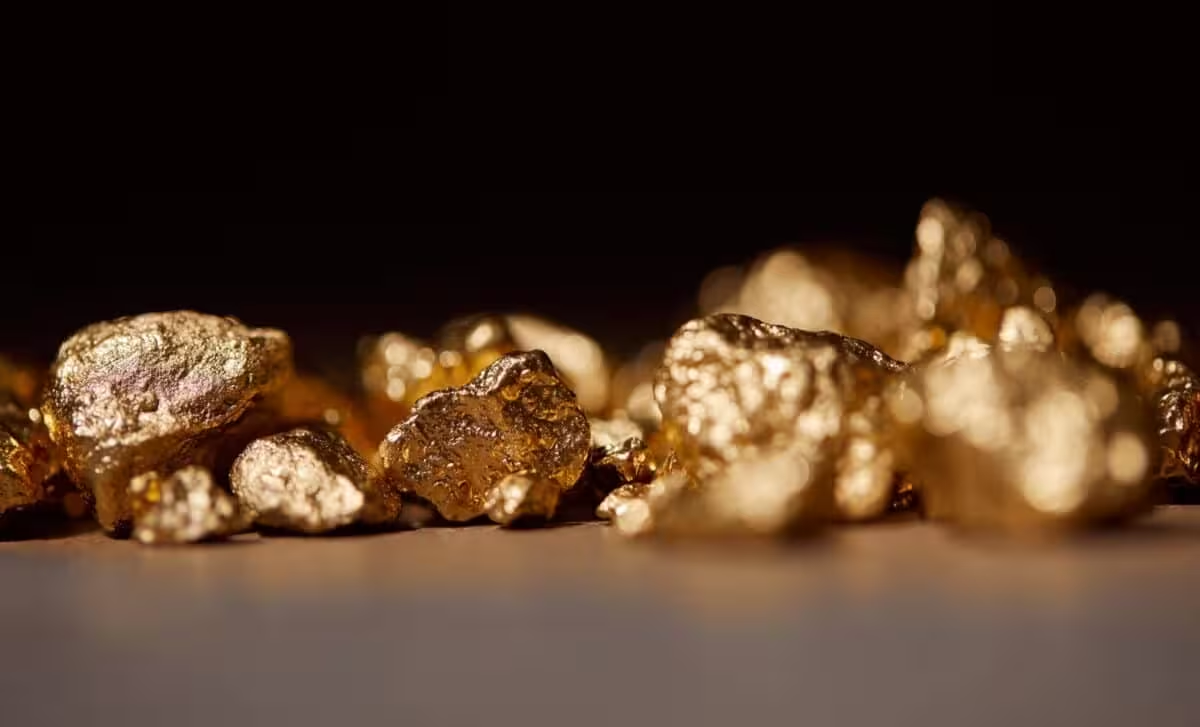
The computational results revealed an astonishing magnitude: oxygen dissociation on reconstructed gold surfaces is slowed by a factor of one billion to one trillion compared with the unreconstructed counterpart. Montemore told Science News that the degree of resistance was “definitely a surprise,” estimating that the oxidation rate drops by roughly a billion to a trillion times once the surface has settled.
This insight reshapes the conventional view of gold’s durability. Instead of a blanket reluctance toward oxygen, the metal’s surface adopts a low‑energy geometry that also happens to be the hardest for oxygen atoms to access. The protection is not absolute—gold oxide is intrinsically unstable and a thin oxide layer could still form on the more open square facets—but the dominant, tightly packed configuration offers a powerful barrier.
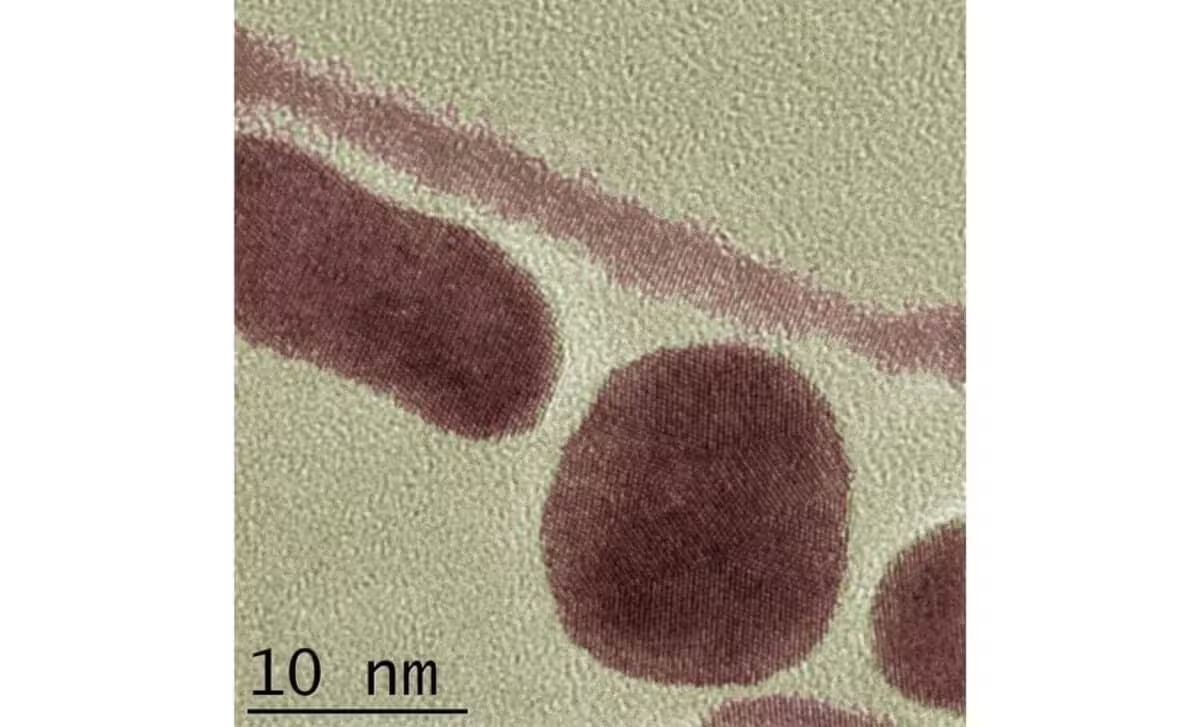
The same geometric reasoning helps explain why gold nanoparticles behave so differently from bulk gold. When particles are small, a larger fraction of their surface remains in the less‑ordered, square‑like arrangement, or the reconstruction may be incomplete, leaving sites where O₂ can still dissociate. This partial exposure accounts for the catalytic activity first reported in the 1980s.
From Ancient Ornament to Modern Catalyst
Beyond explaining why gold jewelry and coins survive for centuries, the findings suggest new routes for industrial catalysis. Many manufacturing processes rely on oxygen activation—converting carbon monoxide to carbon dioxide, synthesising vinyl acetate for plastics, or producing propylene oxide, a key feedstock. Existing gold‑based catalysts already play roles in some of these reactions, often combined with palladium or supported on oxide substrates.
Gold’s appeal lies in a delicate balance: highly reactive metals can activate oxygen readily but suffer from rapid corrosion or over‑binding, which generates unwanted by‑products. The intrinsic resistance of gold’s reconstructed surface could be harnessed if chemists learn how to temporarily disrupt or reverse that arrangement, allowing the metal to dissociate oxygen on demand.
“If you can trick gold into dissociating oxygen, it can actually become a very effective catalyst for certain reactions,” Montemore said. “Our work suggests a new strategy for potentially doing that by preventing or reversing these surface rearrangements.”
Earlier catalyst designs have focused on alloying gold with other metals or dispersing tiny particles on oxide supports. The Tulane study points to a complementary tactic: directly engineering the surface geometry. Stabilising the more open square or rectangular atomic patterns—rather than letting the metal settle into its hexagonal, oxidation‑resistant layout—could boost reactivity while preserving gold’s long‑standing advantages. In other words, the same atomic ordering that protects a golden heirloom may also limit its usefulness as a catalyst, and tweaking that order could transform one of the least reactive elements into a highly selective chemical tool.
This article has been fact checked for accuracy, with information verified against reputable sources. Learn more about us and our editorial process.
Last reviewed on .
Article history
- Latest version
Reference(s)
- Biswas, Santu., et al. “Role of Reconstruction in the Inertness of Gold toward Oxygen.” Physical Review Letters, vol. 136, no. 20, May 21, 2026 American Physical Society (APS), doi: 10.1103/g3bc-t1qv. <https://journals.aps.org/prl/abstract/10.1103/g3bc-t1qv>.
- Conover, Emily. “Physics explains why gold stays pristine.”, May 22, 2026 Science News Magazine <https://www.sciencenews.org/article/physics-explains-gold-shiny-oxidize>.
Cite this page:
- Posted by Bilal Abbasi