Scientists Create a Treasure Map That Could Reveal Hidden Rare Earth Deposits Beneath Earth’s Oldest Continents
Einige der wertvollsten Minerallagerstätten könnten in bisher übersehenen Gebieten liegen
Researchers have assembled a worldwide map that could reshape the hunt for rare earth mineralization. By tying atypical volcanic formations to the planet’s oldest and thickest continental sections, the study highlights a deep‑seated geological framework that governs where these strategic resources accumulate.
Rare earth elements underpin everyday technologies such as smartphones, electric vehicles and wind‑turbine generators. As nations work to secure supply chains and lessen reliance on imports, unraveling the genesis of these deposits has become an urgent scientific priority.
Geologists have long recognized that rare earth concentrations cluster in particular regions, yet the underlying cause has remained ambiguous. Prior investigations tended to focus on isolated basins or individual mines, leaving open the question of whether a planet‑wide rule applies.
In a paper appearing in Nature Geoscience, a team led by the University of Cambridge adopted a global perspective. Their approach merged chemical analyses of thousands of rock specimens with seismic tomography that visualises structures deep beneath Earth’s surface.
Unusual Volcanic Rocks Offer Clues
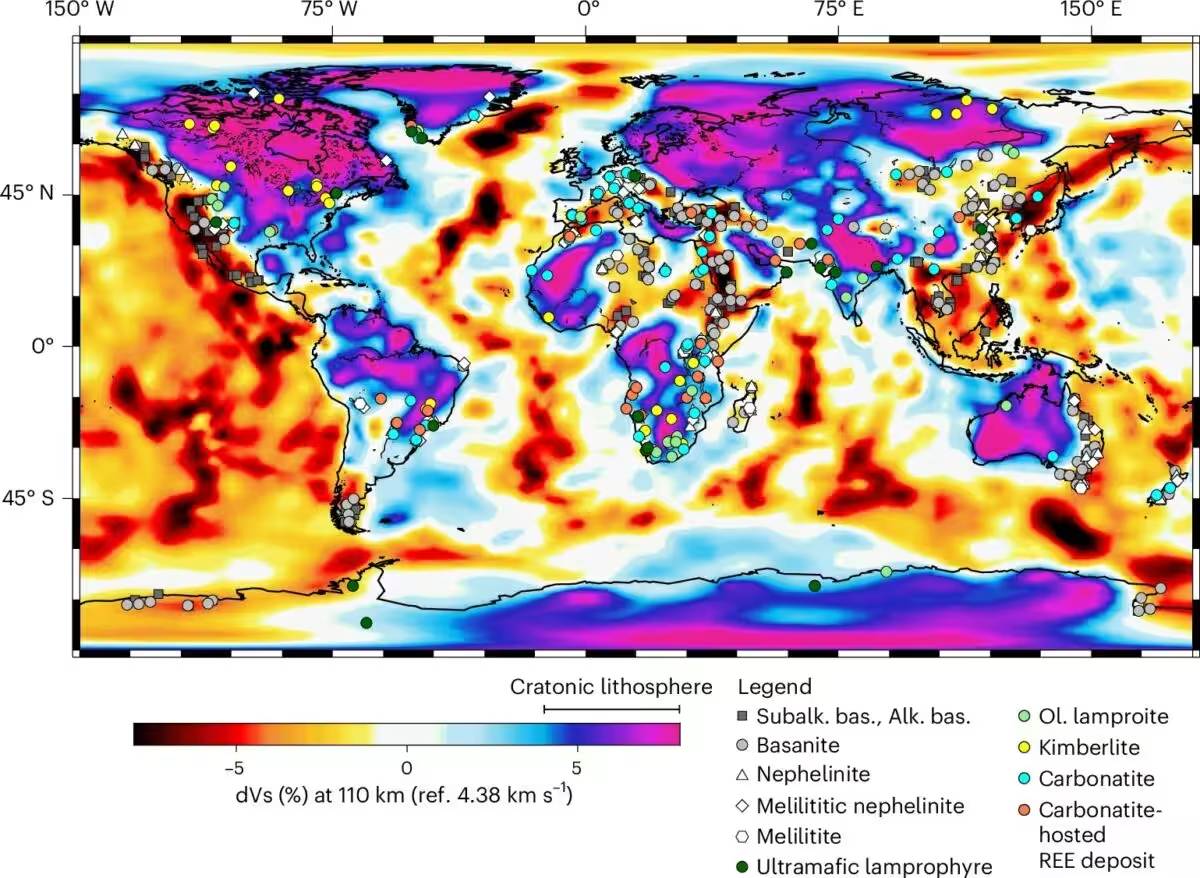
The investigation began with a collection of CO₂‑rich igneous rocks, known to form under conditions favorable to rare earth enrichment. Lead author Dr. Emilie Bowman compiled compositional data from roughly 9,000 igneous samples gathered worldwide. All of the specimens shared elevated dissolved carbon dioxide levels.
Bowman explained that the aim extended beyond cataloguing these rocks; the team sought to determine whether their spatial distribution could serve as a predictor for rare earth occurrences.
“Our research is beginning to provide a kind of predictive power for where we can expect these rocks and, by extension, their associated rare earth element deposits, to form,” she said.
Co‑author Professor Sally Gibson noted that these rocks have long been treated as curiosities rather than resource indicators. Many were first described in the 19th and early 20th centuries, acquiring names tied to their discovery sites or mineralogy.
“The terminology is so sprawling that you could almost make a new language from these rock names,” she added. “This, and their scientific complexity, has added confusion, and people have tended to steer away from them.”
Seismic Imaging Reveals Hidden Correlation
To probe the subsurface, the team incorporated seismic tomography, which maps variations in lithospheric thickness and composition using earthquake‑generated waves. This technique provides an internal picture of the planet analogous to sonar.
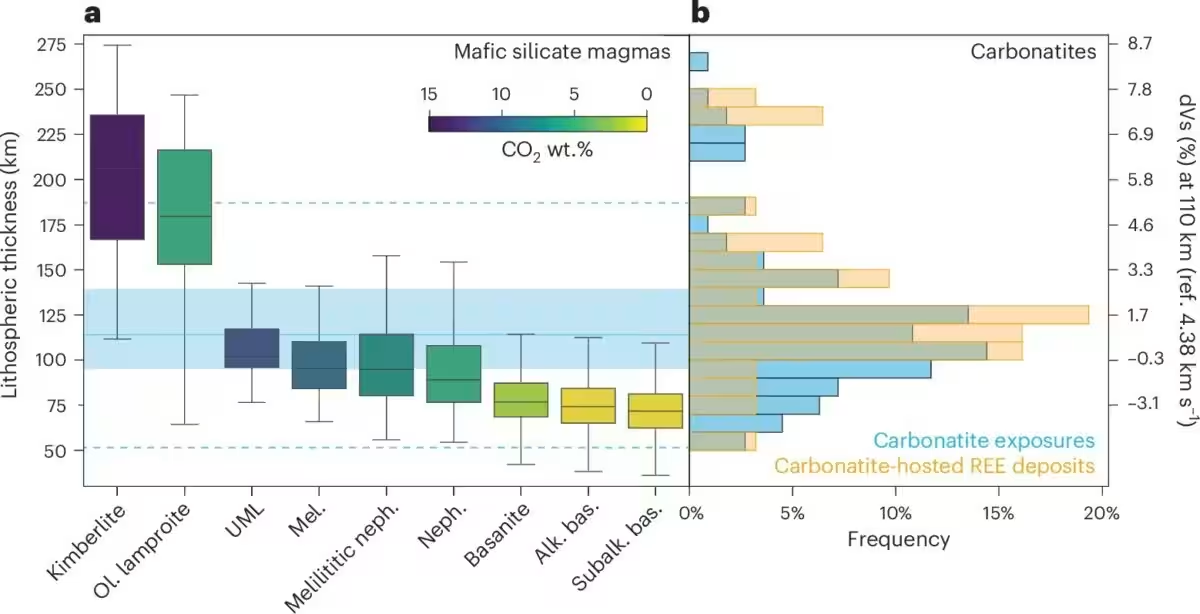
Rocks exhibiting the chemical signatures associated with rare earth enrichment clustered primarily along the steep margins of the thickest, oldest sections of continental lithosphere.
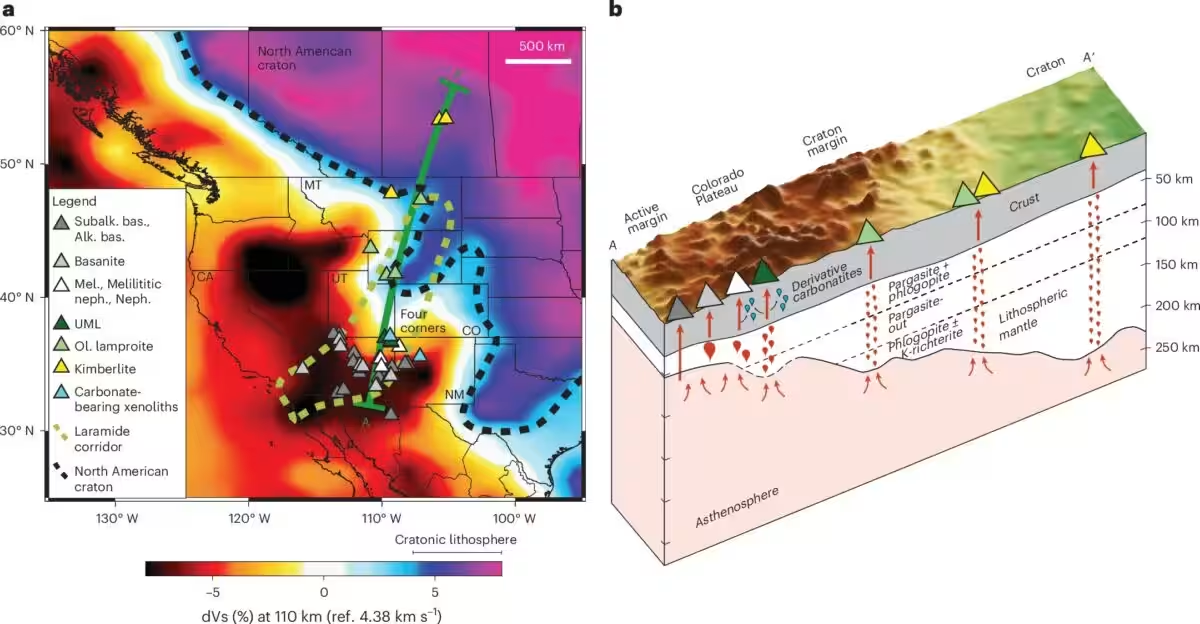
“We needed to put together these two pieces of the puzzle, the rock chemistry and seismic data, in order to make the connection,” Gibson said. “Rocks with the right chemistry for enrichment occur only in very specific places, mainly along the steep edges of Earth’s thickest and oldest lithosphere.”
Deep Lithospheric Controls on Rare Earth Formation
The authors propose that a robust lithospheric lid creates a high‑pressure, relatively cool environment in the underlying mantle, limiting melt production and generating only modest magma volumes at depth.
These isolated magma pockets can solidify into CO₂‑rich igneous rocks. Subsequent tectonic events may partially remelt these bodies, allowing rare earth elements to become progressively concentrated.
The initial analysis focused on rocks formed within the last 200 million years, as older specimens have often been overprinted by mountain‑building and continental‑splitting events that obscure their original chemistry. The team plans to extend the methodology to deeper time intervals that host many of today’s known rare earth deposits.
“Now we have established this systematic behavior exists, we can go back further in time. It’s going to be more challenging, but I’m hopeful that this will be a key step in predicting mineral occurrences,” he concluded.
This article has been fact checked for accuracy, with information verified against reputable sources. Learn more about us and our editorial process.
Last reviewed on .
Article history
- Latest version
Reference(s)
- “Emilie Bowman.” <https://www.jesus.cam.ac.uk/people/emilie-bowman>.
- “Sally Gibson | Department of Earth Sciences.” <https://www.esc.cam.ac.uk/people/sally-gibson>.
Cite this page:
- Posted by Bilal Abbasi