A Spacecraft Powered by Nuclear Heat Could Send Humans to Saturn in Just 220 Days, Bringing Titan Closer Than Ever
The machinery functions flawlessly. Upon arrival, the crew would be sightless, their skeletons too frail to support them. NASA’s own statistics suggest this expedition might exceed every possible threshold.

Space travel documents from NASA contain a subtle warning: a 375-day round trip may push astronauts beyond the acceptable cosmic radiation limit. Two engineers have now calculated the requirements for sending a crew to Saturn’s moon Titan, and their findings raise an unsettling discussion. A uranium-fueled rocket could complete the one-way journey in 220 days, while the full mission, including surface operations, would last nearly 1,000 days.
No human has spent that long in deep space. The record belongs to Valeri Poliakov, who logged 437 consecutive days aboard the Russian Mir station between 1994 and 1995. Mir orbited within Earth’s magnetosphere, shielding it from the galactic cosmic rays that would bombard a spacecraft beyond its reach. A Titan crew would need more than double Poliakov’s endurance, and they would do it without that protection.
William J. O’Hara and Dr. Marcos Fernandez-Tous presented their research at the Lunar and Planetary Science Conference 2025 in The Woodlands, Texas, this March. Their conference paper, published through the Universities Space Research Association, compared four nuclear propulsion systems against a target one-way transit of one to two years. The strongest contender, a nuclear thermal propulsion design called Copernicus, carries 172 metric tons of liquid hydrogen heated by a uranium-235 reactor. It would reach Titan in 220 days. Adding additional propellant tanks to the same vehicle would reduce the trip to 90 days.
The trade-off is weight. Every extra tank increases launch mass and cost, and the paper does not address the shielding gap that would leave a crew exposed to galactic cosmic rays for the entire journey.
The Propulsion Options, Sized for Saturn
Copernicus began as a 2013 NASA Glenn study led by Stanley K. Borowski, who optimized it for fast Mars transits. O’Hara and Fernandez-Tous extended that framework to Titan, which sits at 8.5 astronomical units from Earth, roughly 17 times farther than Mars at its closest approach.
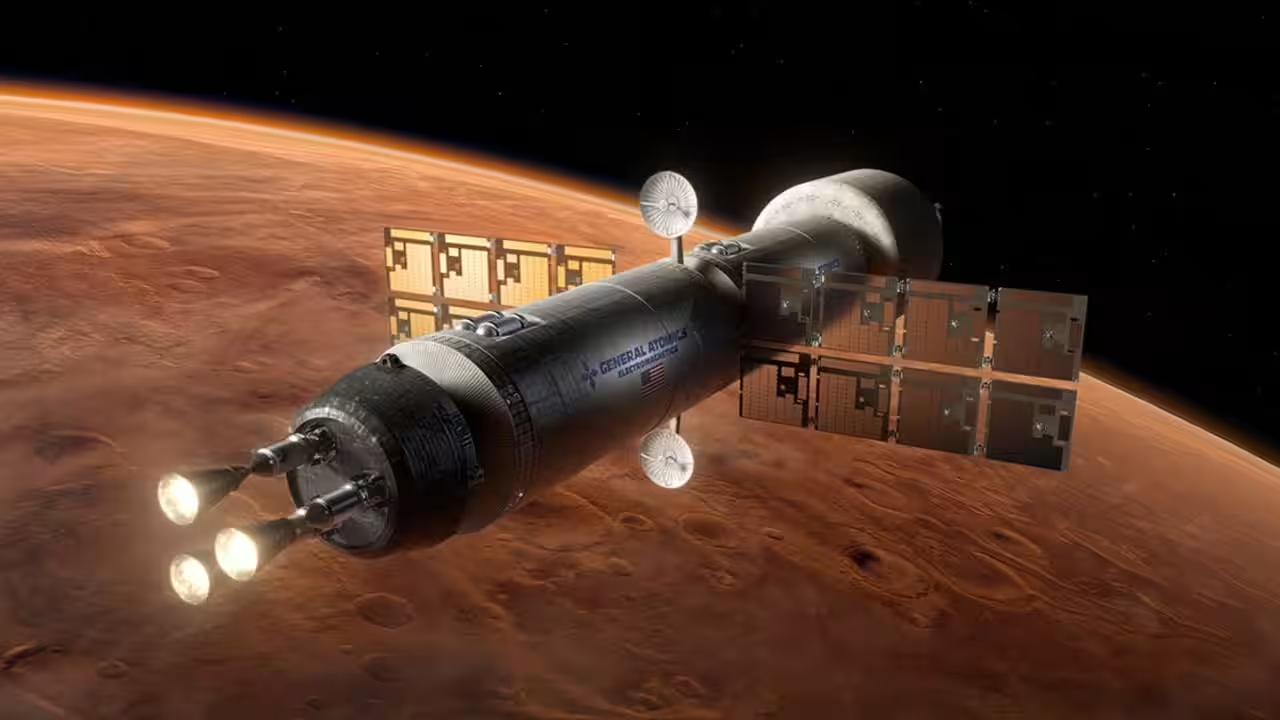
They also examined a nuclear-electric competitor. The VASIMR plasma rocket, developed by Ad Astra, would cut the one-way journey to 149 days. A direct fusion drive, a technology still in early research, might push a robotic round trip to between two and 2.6 years.
Fernandez-Tous teaches space studies at the University of North Dakota. O’Hara splits his time between Blue Origin, where he leads lunar habitat formulation, and the nonprofit Explore Titan, which advocates adapting Mars-rated hardware for the outer solar system. A separate analysis published by Universe Today notes that the organization is pushing a “Mars-to-Titan” steppingstone strategy. The study describes nuclear propulsion as “the most critical element” for any crew attempting the journey.
Why Engineers Keep Looking at Titan
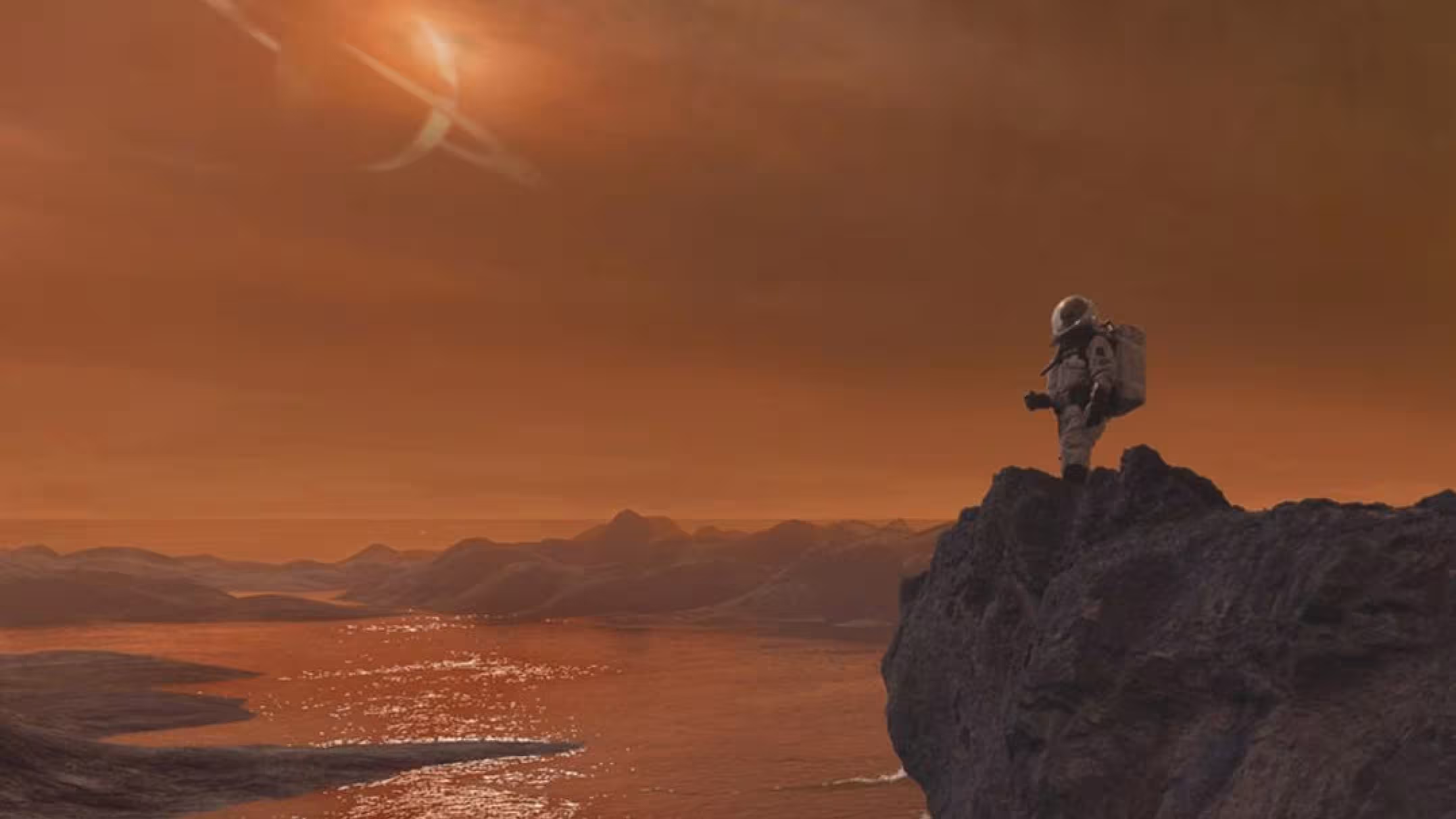
Titan’s surface presents a daunting list of challenges. Temperatures sit at minus 179 degrees Celsius. Sunlight is 0.1 percent of what reaches Earth. Gravity is one-seventh of Earth’s, weak enough that bone and muscle would degrade even while standing on solid ground.

The moon also brings three advantages Mars cannot offer. Its nitrogen atmosphere is six times thicker than Earth’s, dense enough that a lander can aerobrake from orbital speed without firing retro-rockets. The ground is soaked in liquid methane and ethane, compounds a crew could pump and refine into fuel. And that thick blanket of air, once the crew is on the surface, blocks the cosmic radiation that pours through the spacecraft hull during transit.
The atmosphere does not make Titan easy. It makes landing and surface operations possible in ways the red planet does not allow.
What 1,000 Days in Deep Space Does to a Body
Radiation damage begins accumulating the moment a spacecraft leaves Earth’s magnetosphere. NASA’s own Mars design reference architecture acknowledges that cosmic ray exposure on a 375-day round trip may already exceed career limits.
A crewed mission to Titan would last nearly three times that long. No lightweight shielding material has been tested in orbit against the high-energy atomic nuclei that slice through spacecraft walls. The paper offers no solution for this.
Microgravity inflicts its own predictable harm. Bone density erodes at roughly one percent per month. Muscle wastes. Fluids that normally pool in the lower body shift upward, pressing the optic nerve and flattening the back of the eyeball.
Some astronauts return from six-month station rotations with permanent vision loss. No data exists for what two and a half years of continuous exposure produces, because no one has attempted it. The study notes psychological strain from isolation and confinement but stops short of measuring it. Poliakov’s 14 months remains the outer limit of human experience, and a Titan crew would pass that marker with no abort option shorter than several months.
Dragonfly Will Test the Assumptions First
A robotic scout will gather the first hard data years before any astronaut straps into a nuclear rocket. NASA’s Dragonfly quadcopter, managed by the Johns Hopkins Applied Physics Laboratory, is scheduled to launch in 2034 and arrive at Titan after a seven-and-a-half-year cruise.
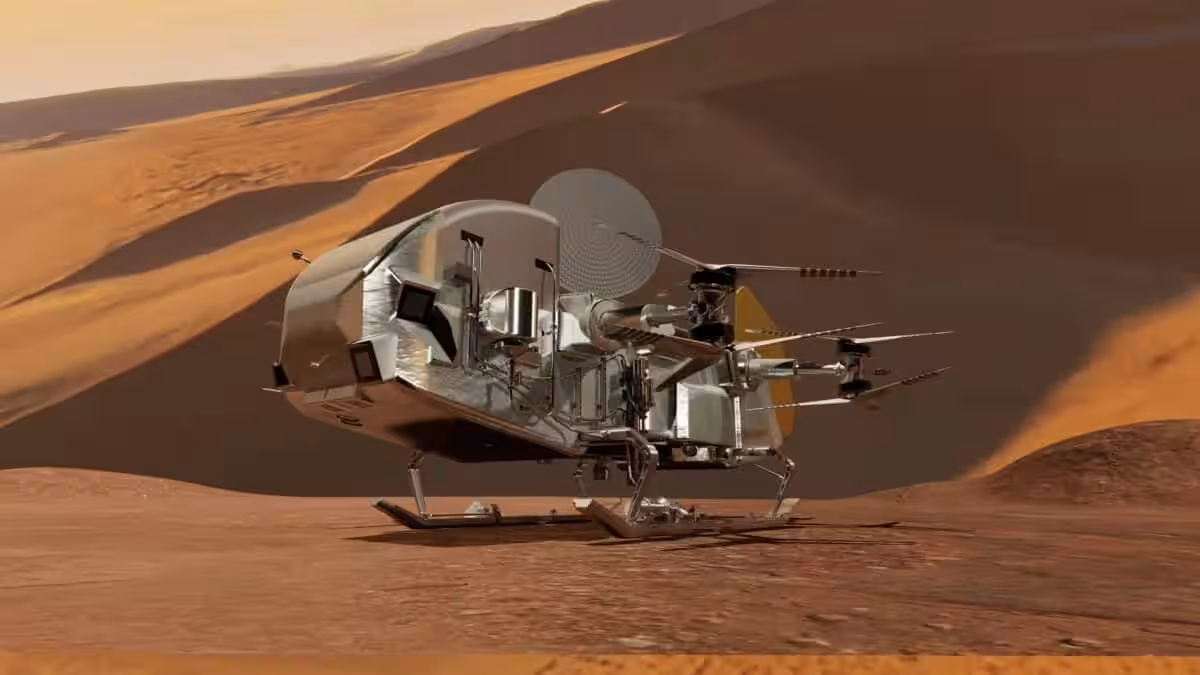
The nuclear-powered rotorcraft will sample surface chemistry, map terrain stability, and measure radiation at ground level. Those readings will confirm whether a human lander could function in the conditions the propulsion study assumes, or force a redesign before hardware gets cut.
The engine math is the least uncertain part of the plan. A reactor can push a spacecraft to Titan. Nobody has yet shown that a human body can stand up and walk off the lander when it gets there.
This article has been fact checked for accuracy, with information verified against reputable sources. Learn more about us and our editorial process.
Last reviewed on .
Article history
- Latest version
Reference(s)
- Siddiqi, Asif. “Valery Vladimirovich Polyakov | Russian, Spaceflight, Record.”, September 19, 2007 Encyclopedia Britannica <https://www.britannica.com/biography/Valery-Vladimirovich-Polyakov>.
- “Marcos Fernandez-Tous.” <https://campus.und.edu/directory/marcos.fernandeztous>.
- “1120.” <https://www.hou.usra.edu/meetings/lpsc2025/pdf/1120.pdf>.
- Williams, Matthew. “A Nuclear-Powered Spacecraft Could Send Humans to Titan to Look for Signs of Life.”, April 18, 2025 Universe Today <https://www.universetoday.com/articles/a-nuclear-powered-spacecraft-could-explore-titan-for-signs-of-life>.
- “Titan Multi.” <https://www.universetoday.com/article_images/titan_multi.jpg>.
- <https://dragonfly.jhuapl.edu/>.
Cite this page:
- Posted by Bilal Abbasi