Three Solar Prominence Eruptions Caught in Five Hours by Proba-3 Twin Spacecraft
No article content available to summarize.
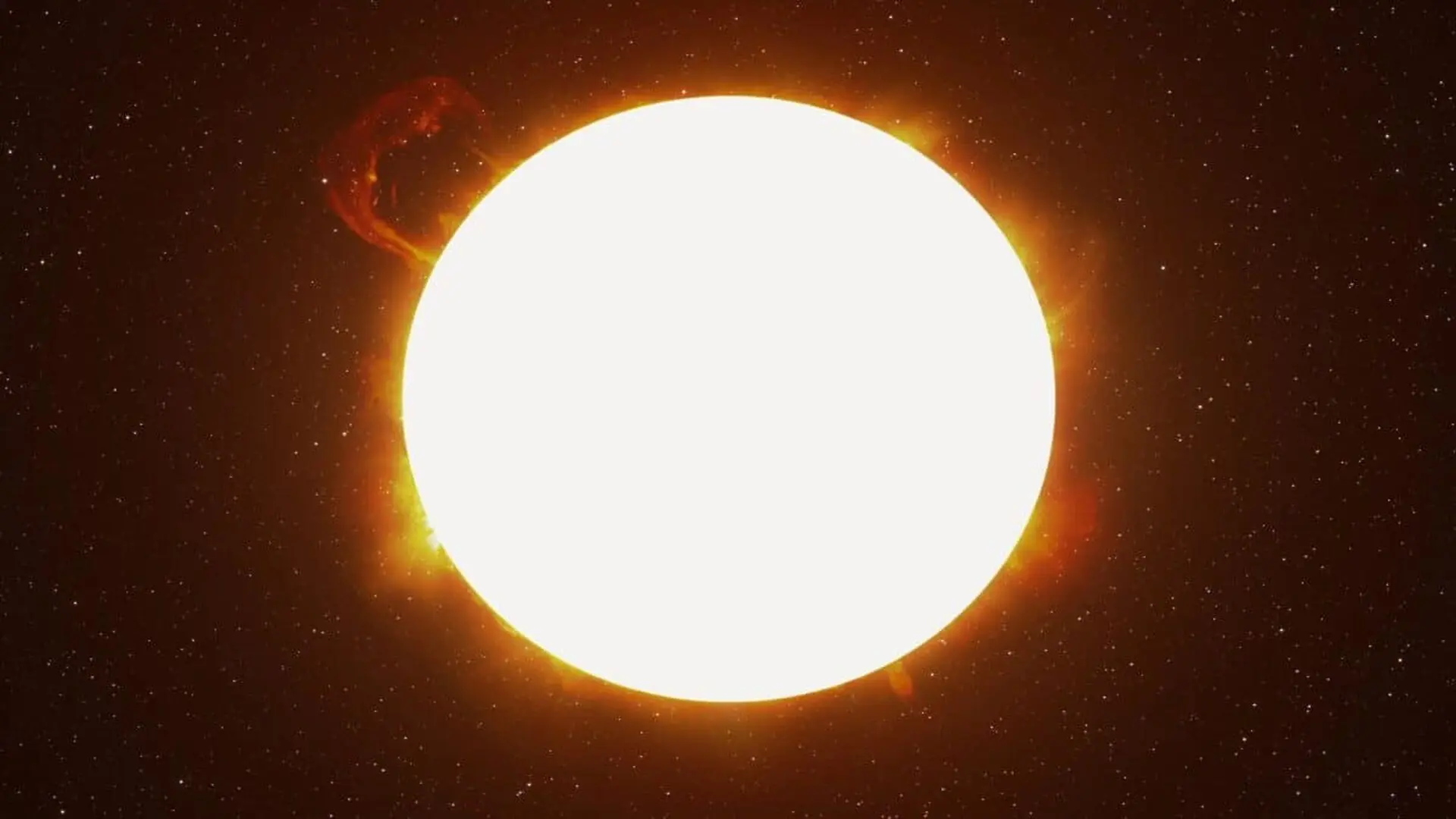
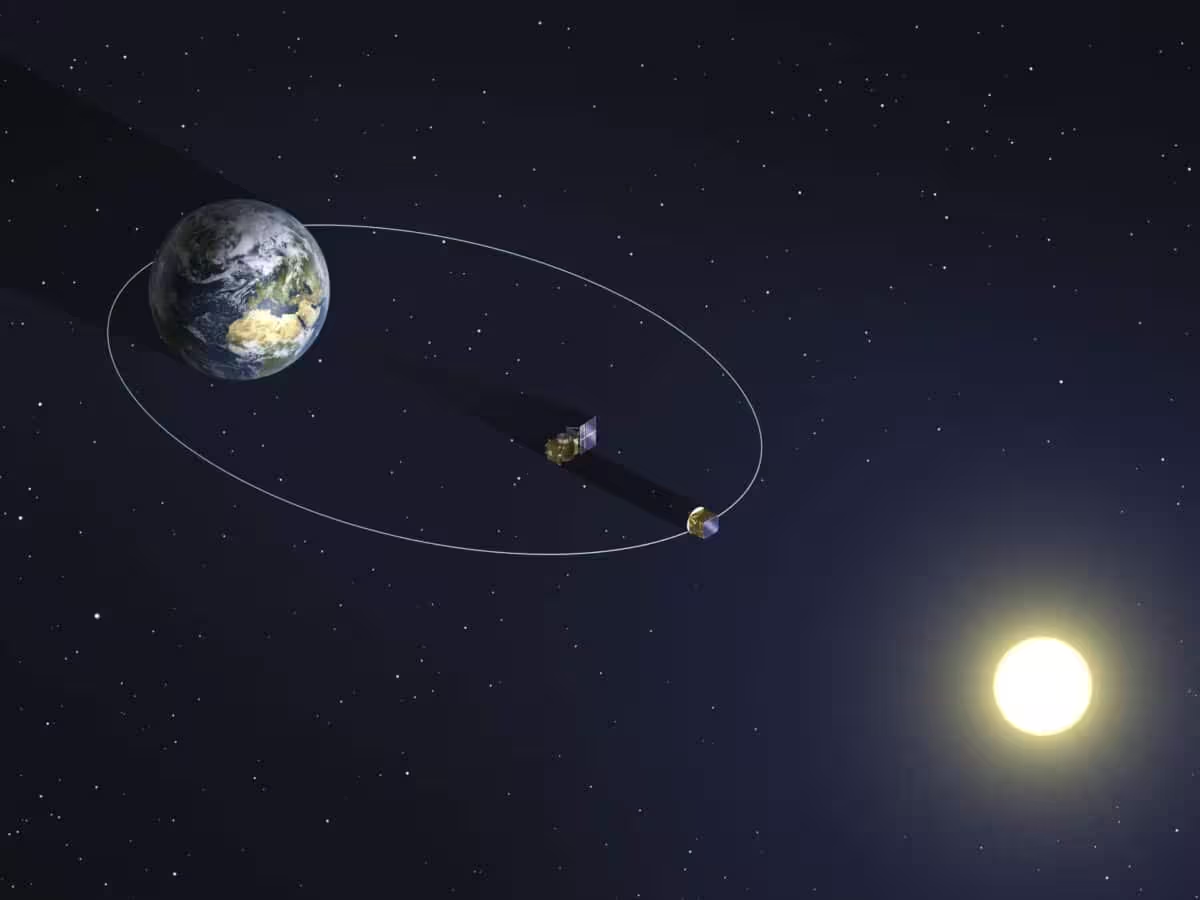
The European Space Agency’s Proba‑3 mission has recorded a remarkable series of three solar‑prominence eruptions within the Sun’s inner corona, a region that is normally hidden from view. By positioning two spacecraft in a precise formation that mimics a total solar eclipse, the mission succeeded in revealing faint coronal structures that are otherwise washed out by the bright solar disk.
In this tandem configuration, one satellite acts as an occulting disc while the second observes the surrounding atmosphere, allowing scientists to isolate the inner corona—the hottest layer of the Sun’s outer atmosphere—where many dynamic solar phenomena originate.
The event took place on 21 September 2025, a day of heightened solar activity. The ASPIICS coronagraph aboard Proba‑3 captured images at five‑minute intervals, documenting three distinct prominence eruptions over a span of roughly five hours.
Three Prominence Outbursts Captured in a Single Observation Window
An animation built from ASPIICS data, together with observations from NASA’s Solar Dynamics Observatory and its Atmospheric Imaging Assembly, shows the solar disk as a dark orange disc surrounded by a faint yellow halo that marks the inner corona.
Prominences—large arches of relatively cool plasma suspended above the Sun—stand out against the surrounding million‑degree coronal plasma, which can reach temperatures near one million Kelvin, whereas the prominence material remains close to ten thousand Kelvin.
These structures can expand outward before destabilizing and ejecting plasma in multiple directions. Andrei Zhukov, principal investigator for ASPIICS at the Royal Observatory of Belgium, notes that it is unusual to see so many eruptions in such a brief period.
“Seeing so many prominence eruptions in such a short timeframe is rare, so I’m very happy we managed to capture them so clearly during our observation window,” Zhukov said.
The sequence provides researchers with a detailed look at how these cooler plasma formations evolve while embedded in the surrounding extreme‑heat corona.
Helium Emission Illuminates the Inner Corona
ASPIICS employs a suite of narrow‑band filters that isolate specific spectral lines, each corresponding to light emitted by a distinct element in the solar atmosphere.
The prominence eruptions recorded by Proba‑3 were observed through a helium‑line filter, which renders the solar atmosphere in a soft yellow hue comparable to what the human eye perceives during a total eclipse with a yellow filter.
According to the European Space Agency, the gentle yellow glow surrounding the Sun in these images originates from visible‑light photons scattering off free electrons in the corona.
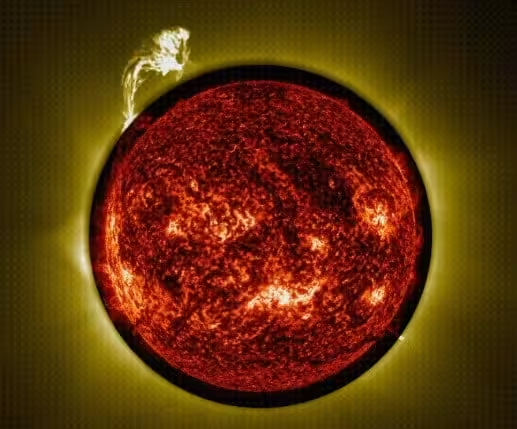
By merging ASPIICS data with simultaneous observations from AIA, scientists can compare multiple perspectives of the same solar event, as AIA also records helium emissions while ASPIICS focuses on the faint structures that fringe the solar disk.
Artificial Eclipse Technique Opens a New Solar Window
Proba‑3 relies on advanced formation‑keeping technology to keep its two spacecraft aligned, effectively creating an artificial eclipse that blocks the Sun’s bright surface and exposes the surrounding corona for detailed study.
“The corona is extremely hot, about 200 times hotter than the sun’s surface,” explained Zhukov.
This capability fills a long‑standing observational gap, delivering consistent access to the Sun’s inner atmosphere—a region traditionally obscured by the intense brightness of the solar disk.
The latest imagery demonstrates how artificial eclipses can transform solar‑physics research, enabling scientists to track prominence eruptions in real time and deepen our understanding of solar dynamics.
This article has been fact checked for accuracy, with information verified against reputable sources. Learn more about us and our editorial process.
Last reviewed on .
Article history
- Latest version
Cite this page:
- Posted by Karan Das