Euclid Uncovers 31 Ancient Quasars, Including Two Record-Breaking Trillion‑Sun Beacons
Euclid discovers 31 ancient quasars, including two from 670 million years after the Big Bang, shedding light on early black holes and galaxy formation.
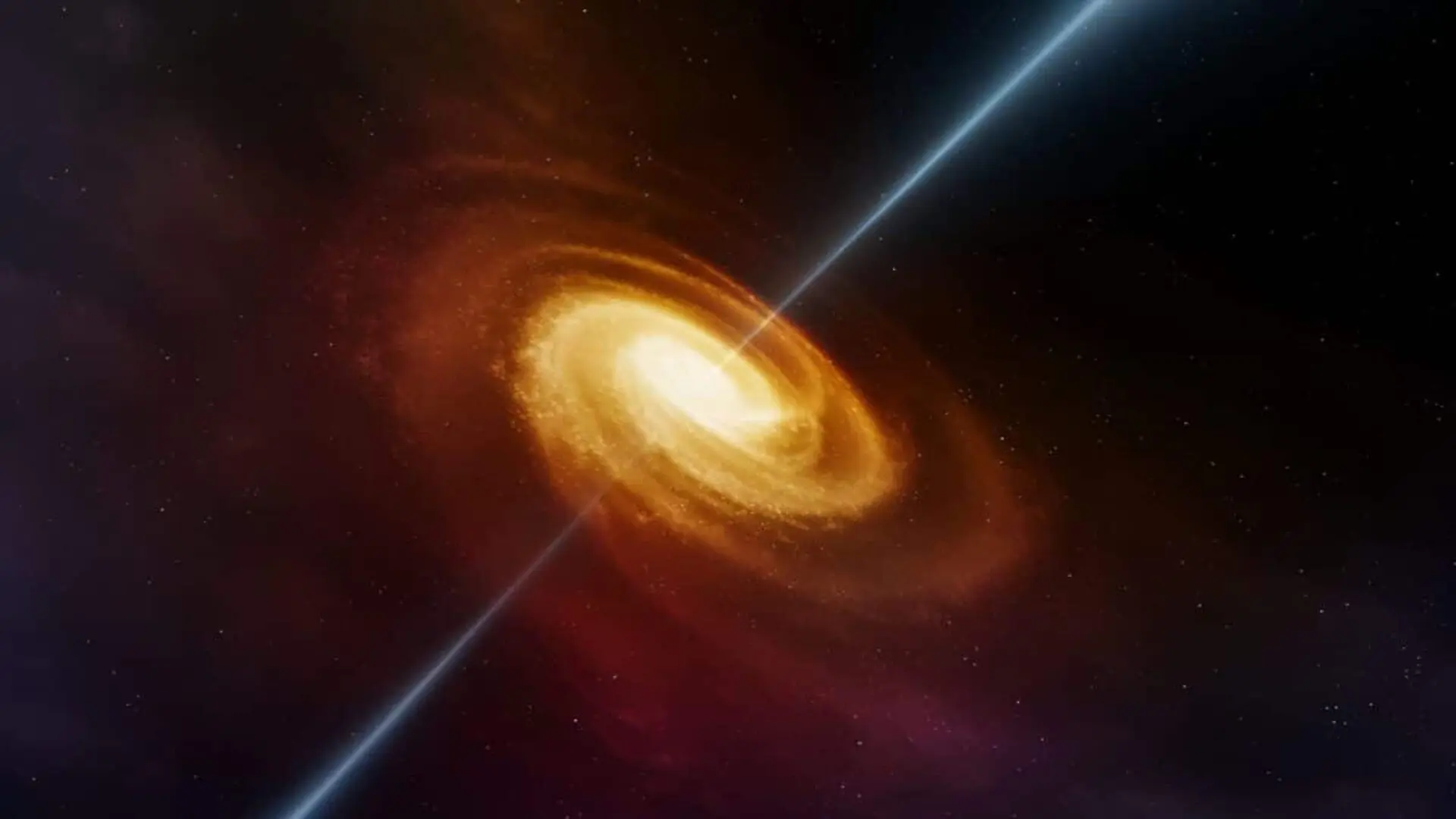
The ESA Euclid mission has added 31 previously unknown quasars to the cosmic record, among them two objects that now hold the title of the earliest quasars ever detected. These luminous galactic nuclei were already blazing when the universe was merely five percent of its present age.
Designated EUCL J172902.75+641018.1 and EUCL J125308.55+705432.3, the pair shine with the power of roughly a trillion suns. Their redshifts of 7.77 and 7.69 translate to distances just over 13 billion light‑years, capturing the universe as it appeared around 670 million years after the Big Bang.
Euclid’s Wide‑Field Infrared Survey Redefines Early‑Quasar Hunting
Quasars emerge when matter spirals into a supermassive black hole, heating up into a radiant accretion disk that outshines the combined light of all the stars in the host galaxy. Detecting such objects from the first billion years of cosmic history has long been hampered by their extreme distance and the faint, redshifted signals they emit, which can masquerade as ordinary stars.
Prior to Euclid, astronomers had catalogued only a handful of the most luminous, easily spotted quasars at these epochs, limiting insight into the broader population. The Euclid telescope, with its ability to image vast swaths of sky in the infrared, now allows scientists to probe much larger volumes and uncover far fainter, more typical examples.
According to Daming Yang of Leiden University, the lead author of the discovery paper, Euclid’s survey capabilities made it possible to identify over a dozen quasars with redshifts of seven or higher in a single year—a task that previously required more than a decade of observations.
What These Ancient Beacons Reveal About Early Galaxy Growth
The newly uncovered quasars illuminate a formative era when the first galaxies and black holes were rapidly assembling. By studying the light from these distant nuclei, astronomers can trace how massive structures emerged just a few hundred million years after the universe’s birth.
One of the objects, examined in depth by Silvia Belladitta and collaborators, resides within a host galaxy rich in gas and dust and undergoing vigorous star formation. This configuration offers a direct glimpse of the symbiotic relationship between a feeding black hole and its surrounding stellar nursery.
![Noema 1.3 Mm Continuum And [c Ii] Maps Of Quasar Eucl J1253+7054 ©astronomy & Astrophysics](https://www.bioscience.com.pk/images/dc6cc49090.avif)
These quasars also shed light on the epoch of reionization, a pivotal phase when intense radiation from early stars, galaxies, and black holes ionized the pervasive hydrogen fog, rendering the universe transparent to ultraviolet light.
All 31 objects emerged from the Euclid Wide Survey, which aims to map more than one‑third of the celestial sphere. As the mission continues to accumulate data, the survey is expected to expand the inventory of distant quasars and provide fresh insight into the large‑scale structure of the cosmos.
For the astronomical community, the burgeoning catalog of early quasars opens a new window onto how supermassive black holes grew to colossal sizes during the universe’s formative epochs.
This article has been fact checked for accuracy, with information verified against reputable sources. Learn more about us and our editorial process.
Last reviewed on .
Article history
- Latest version
Reference(s)
- “Daming Yang.” Leiden University <https://www.universiteitleiden.nl/en/staffmembers/daming-yang>.
- <https://www.aanda.org/articles/aa/full_html/2026/07/aa59319-26/aa59319-26.html>.
- <https://www.researchgate.net/profile/Silvia-Belladitta>.
Cite this page:
- Posted by Karan Das