New Physics Study Shows How Early Universe Might Have Avoided a Zero-Size Collapse
Researchers find that scalar-tensor gravity models can suppress quantum decay channels, keeping primordial static states stable against collapse.
Cosmologists have long debated whether our universe began with a sharp singularity or existed in a timeless state before expanding. In standard cosmic models, mathematical proofs suggest the universe must have been incomplete in the past, pointing back to an initial bang. To bypass this fiery beginning, researchers proposed the Emergent Universe scenario, where space originates from a past-eternal, unchanging condition known as the Einstein static state before transitioning into inflation and the hot Big Bang. Although previous work showed that such static states can be classically stable under small perturbations when using alternative gravity frameworks, questions remained about whether quantum effects could trigger a decay.
To investigate whether quantum mechanics destroys these static beginnings, researchers Pedro Labraña and Juan Ortiz examined the problem using Jordan–Brans–Dicke theory, an alternative framework where gravity’s strength is modulated by an evolving scalar field. Their study was recently published in The European Physical Journal C. By setting up a quantum mechanical description using the Wheeler–DeWitt equation in minisuperspace, the authors analyzed the effective potential governing the cosmos to see if quantum tunneling could cause the universe to shrink down to a zero scale factor.
Testing Quantum Stability Against Shrinking Radii
Earlier arguments by researchers Mithani and Vilenkin suggested that even classically stable static universes could be vulnerable to quantum decay, tunneling toward a state of vanishing size. To test this hypothesis in the Jordan–Brans–Dicke framework, Labraña and Ortiz analyzed specific trajectories where either the scale factor or the Brans–Dicke scalar field varies while the other remains fixed. Using a WKB approximation, which is a mathematical method used to estimate quantum tunneling probabilities, they calculated the exponential suppression factors for these paths.
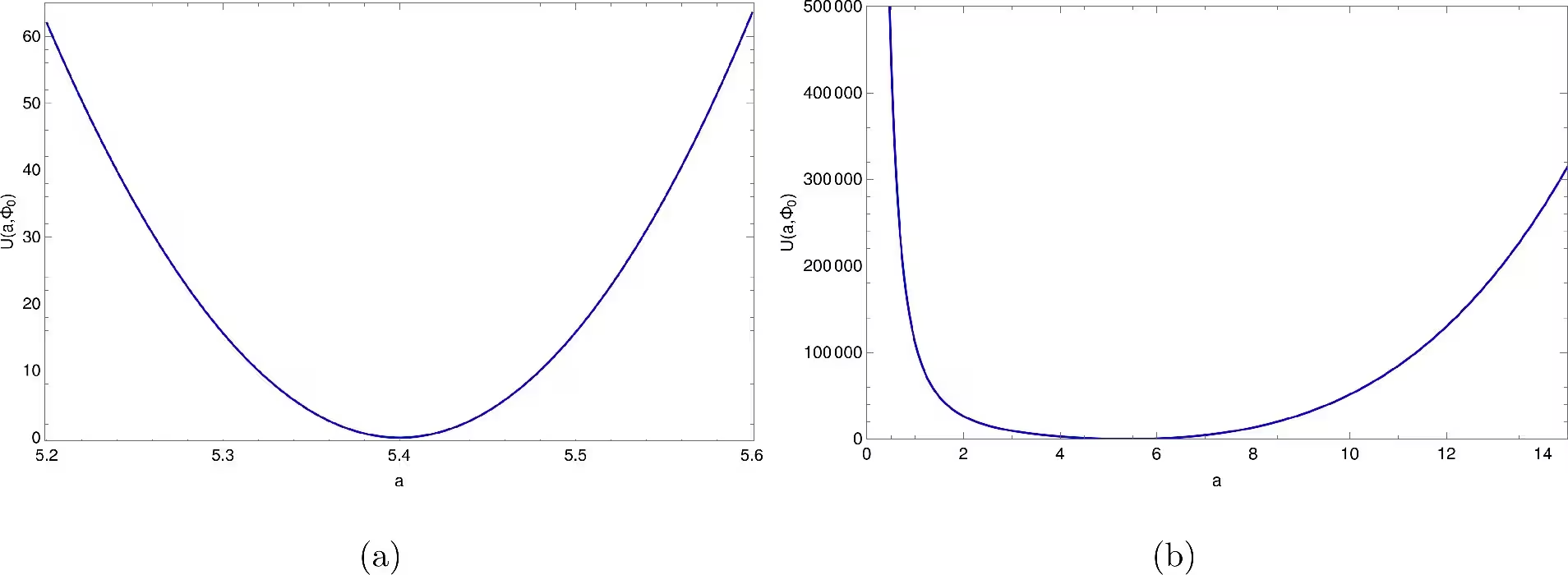
Their calculations indicate that when the effective potential diverges as the scale factor or the scalar field approaches zero, the tunneling probability becomes heavily suppressed. For a class of scalar field potentials featuring an inverse power-law behavior near zero, the exponential barrier grows infinitely high. This suggests that the quantum instability identified in earlier studies is not a universal rule and can be successfully avoided in certain parameter spaces of scalar-tensor gravity.
Global Structures and Future Explorations
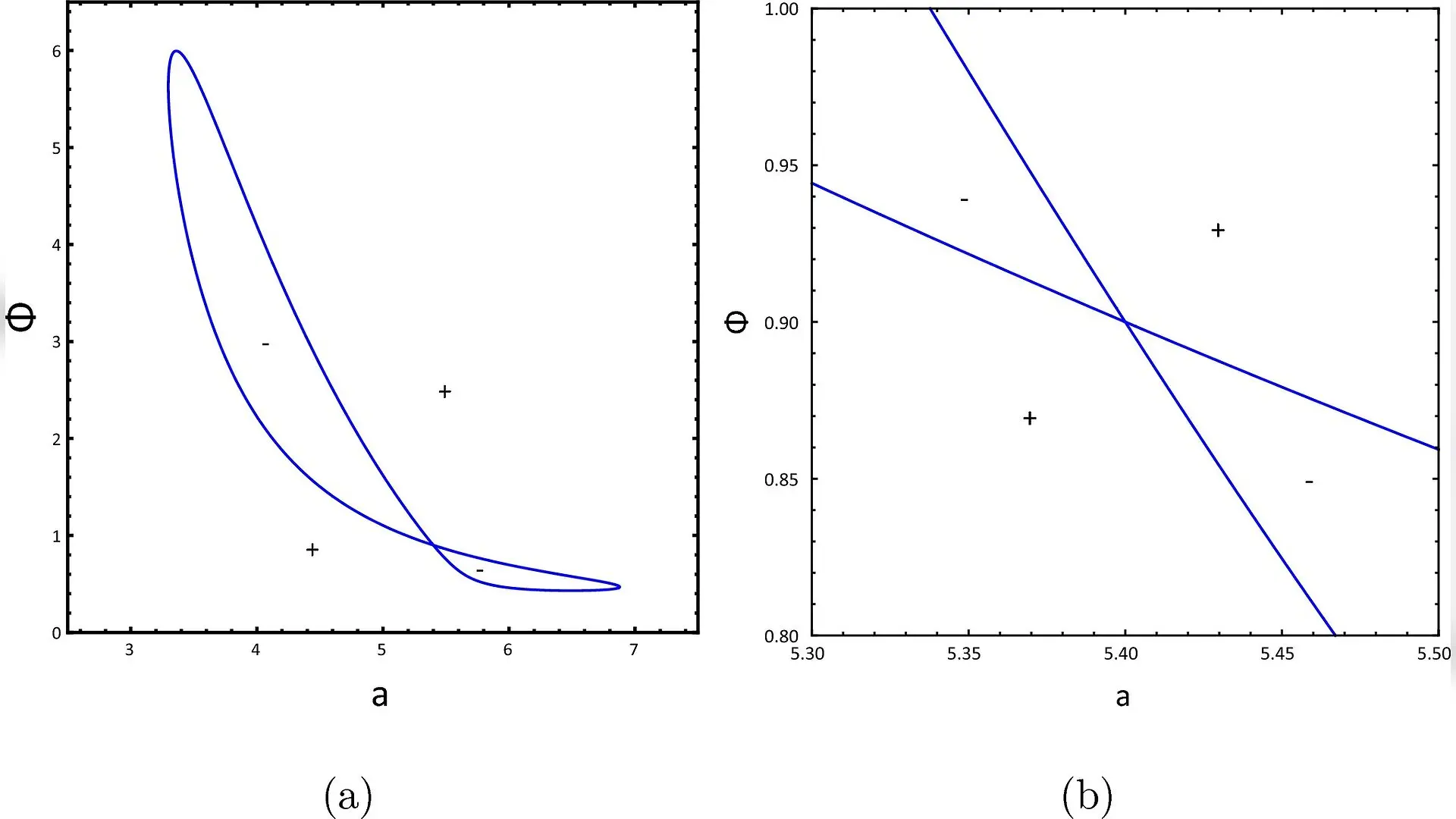
The researchers also mapped the global zero loci of the Wheeler–DeWitt potential, which mark the configurations where kinetic energy vanishes. By analyzing these continuous curves in minisuperspace, they demonstrated that the Einstein static universe sits precisely at the intersection of these zero-potential paths. Because the potential climbs to infinity as the universe approaches a zero radius, those singular points cannot act as valid endpoints for the tunneling channels originating from the static state.
Despite these promising findings, the authors emphasize that their WKB calculations apply to restricted trajectories rather than a full global variational analysis. Proving absolute quantum stability across all conceivable multi-dimensional paths will require solving the full Hamilton–Jacobi equation for the system. Nevertheless, these insights show that modified gravity models can provide a robust mathematical foundation for a universe that avoids an initial physical singularity.
The research was published in The European Physical Journal C on November 6, 2026.
This article has been fact checked for accuracy, with information verified against reputable sources. Learn more about us and our editorial process.
Last reviewed on .
Article history
- Latest version
Reference(s)
- Labraña, Pedro., et al. “Classical and semiclassical stability of emergent universes in Jordan–Brans–Dicke theory.” The European Physical Journal C, vol. 86, no. 11, November 6, 2026 Springer Science and Business Media LLC, doi: 10.1140/epjc/s10052-026-16559-2. <https://doi.org/10.1140/epjc/s10052-026-16559-2>.
Cite this page:
- Posted by Nida Rehman