Space Radiation Deep Inside the Moon Creates Hidden Electrical Risks
Fresh analysis reveals that current computer models of lunar soil charging rely on unverified assumptions about how electric charges remain trapped underground.
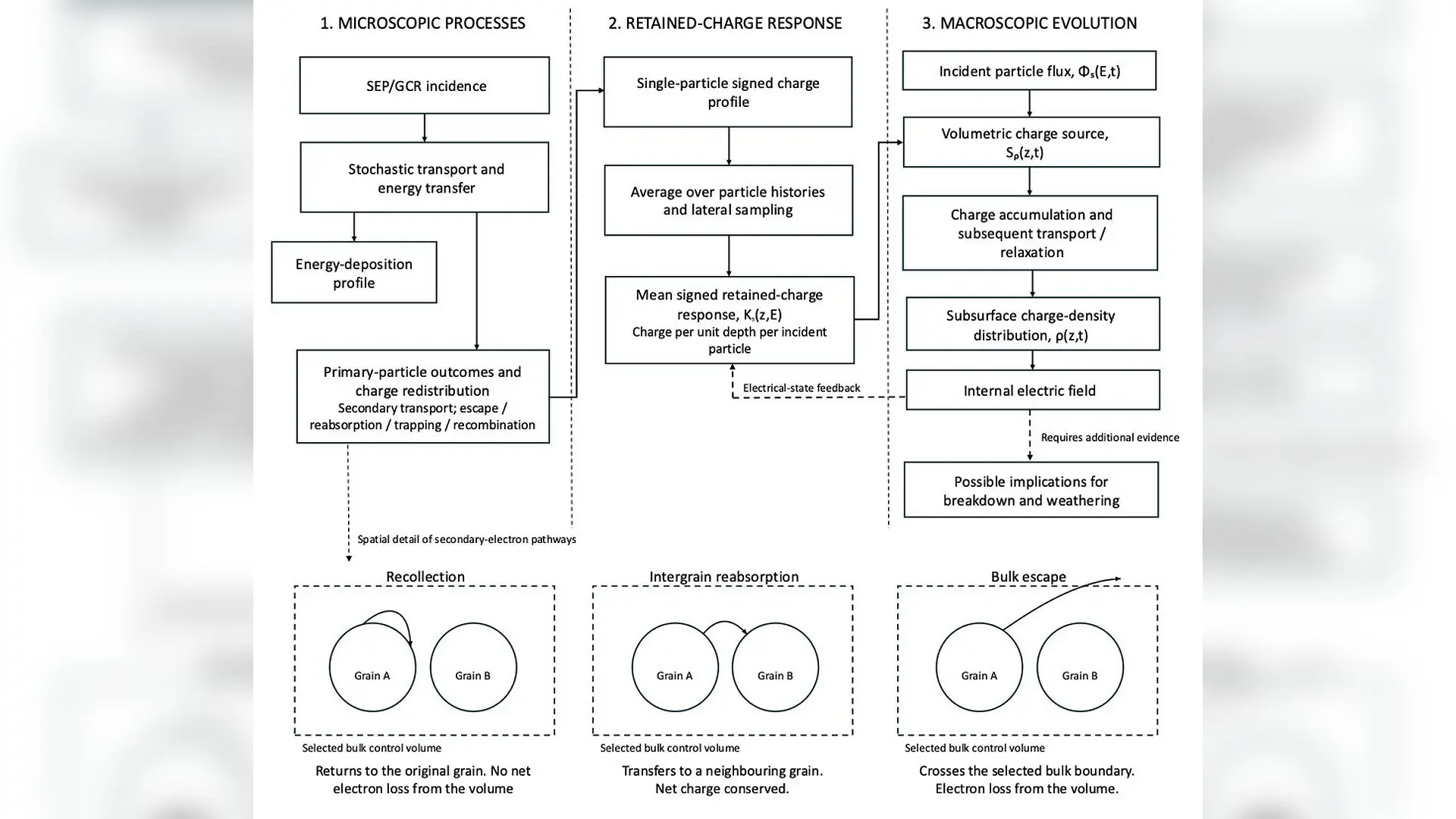
High-energy particle radiation from space continuously bombards the airless Moon, deeply charging its powdery soil in ways scientists are only beginning to understand. Researchers examining how microscopic particle interactions translate into large-scale electrical fields report that current models rely on unverified assumptions about how electric charges stay trapped beneath the lunar surface.
Because the Moon lacks a thick atmosphere and a global magnetic field, solar energetic particles from active sunspots and galactic cosmic rays from deep space penetrate directly into the lunar soil, known as regolith. In permanently shadowed craters near the lunar poles, temperatures drop so low that the soil becomes an extremely poor conductor of electricity. Previous computer models suggest that charges deposited by intense solar storms could linger for weeks, building up internal electric fields strong enough to trigger miniature electrical breakdowns similar to lightning.
To investigate how microscopic collisions build up to macroscopic forces, researchers Ashley Daeun Jung and Hyun Jung Kim analyzed the chain of physical evidence connecting individual particle hits to bulk electrical charging. Their critical review, published in Physics of Plasmas, breaks down the problem into three distinct processes: energy deposition, net charge transfer across boundaries, and the spatial distribution of positive and negative excess charges within the porous regolith.
Why Surface Measurements Miss Deep Underground Charging
Scientists have long relied on laboratory experiments measuring electron emission from lunar soil samples to understand how charging works. However, these surface-level measurements only track electrons escaping into a vacuum, failing to reveal where charges redistribute internally. When energetic electrons or ions strike mineral grains, secondary electrons are often knocked loose, but many are immediately reabsorbed by neighboring particles in the porous soil structure.
The authors emphasize that a low rate of electron escape does not automatically mean internal charge separation is reduced. An electron jumping from one microscopic grain to another alters the local electrical balance while keeping the total net charge of that soil volume completely unchanged. Consequently, laboratory emission yields measured under non-cryogenic conditions using low-energy beams cannot simply be extrapolated to predict deep subsurface charging caused by high-energy cosmic rays.
How Internal Charge Shifting Alters Electric Fields
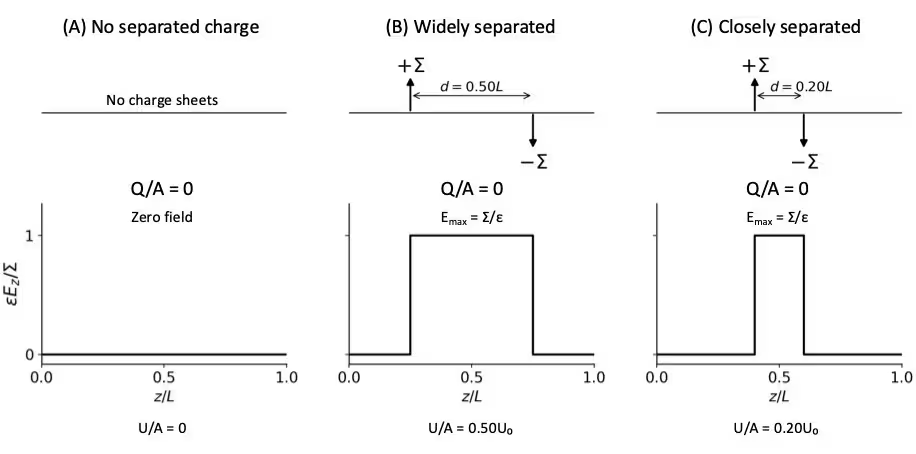
To test how internal charge movement affects predicted electric fields, the authors performed sensitivity calculations using a one-dimensional volumetric charging framework. By keeping the total net charge supply constant while shifting where electrons depart and arrive, the calculations demonstrate that the exact depth of charge transfer dramatically changes the resulting peak electric field.
When negative charges are moved closer to the surface, the cumulative charge supporting the positive field is reduced, dropping the predicted peak field by roughly twenty-one percent. Conversely, if internal transfers happen deeper within the soil layer, the peak field remains largely unaffected while deeper profiles change. These outcomes indicate that knowing the total amount of deposited charge is insufficient without precise tracking of spatial separation depths.
What Happens Next for Lunar Weathering Research
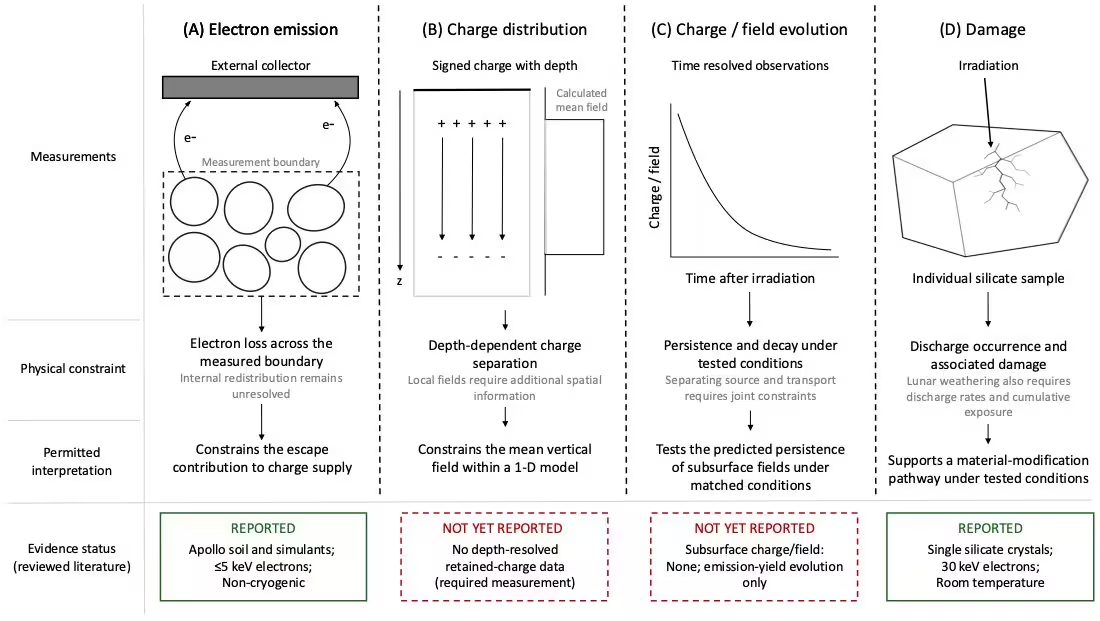
Connecting particle radiation to space weathering requires bridging multiple physical scales, from atomic interactions to macroscopic electrical failure. While laboratory tests on individual silicate crystals demonstrate that high-energy electron irradiation can cause physical damage and dielectric breakdown, researchers still lack direct measurements of depth-resolved charge retention in cryogenic, porous regolith simulants.
The study highlights that future progress depends on joint measurements that simultaneously constrain boundary charge budgets, spatial charge distributions, and temporal relaxation rates under realistic lunar conditions. Until such comprehensive data become available, the hypothesis that solar storms drive widespread electrical breakdown and structural weathering across the lunar poles remains an open question.
The study was posted to the arXiv preprint server on November 5, 2026.
This article has been fact checked for accuracy, with information verified against reputable sources. Learn more about us and our editorial process.
Last reviewed on .
Article history
- Latest version
Reference(s)
- Jung, Ashley. “Charge Retention in Lunar Regolith: Microscopic Processes and Constraints on Subsurface Charging.” arXiv.org <http://arxiv.org/abs/2611.08062v1>.
Cite this page:
- Posted by Karan Das