The Truth Behind the Philadelphia Experiment: Navy Degaussing, Not Invisibility
The USS Eldridge disappearance persists as a 20th‑century military myth, yet investigations find no proof of invisibility, teleportation or time travel.
In the summer of 1943, as Allied forces pressed their advantage in World War II, a seemingly ordinary Cannon‑class destroyer escort, the USS Eldridge, became the focal point of an extraordinary claim that would later capture the public’s imagination.
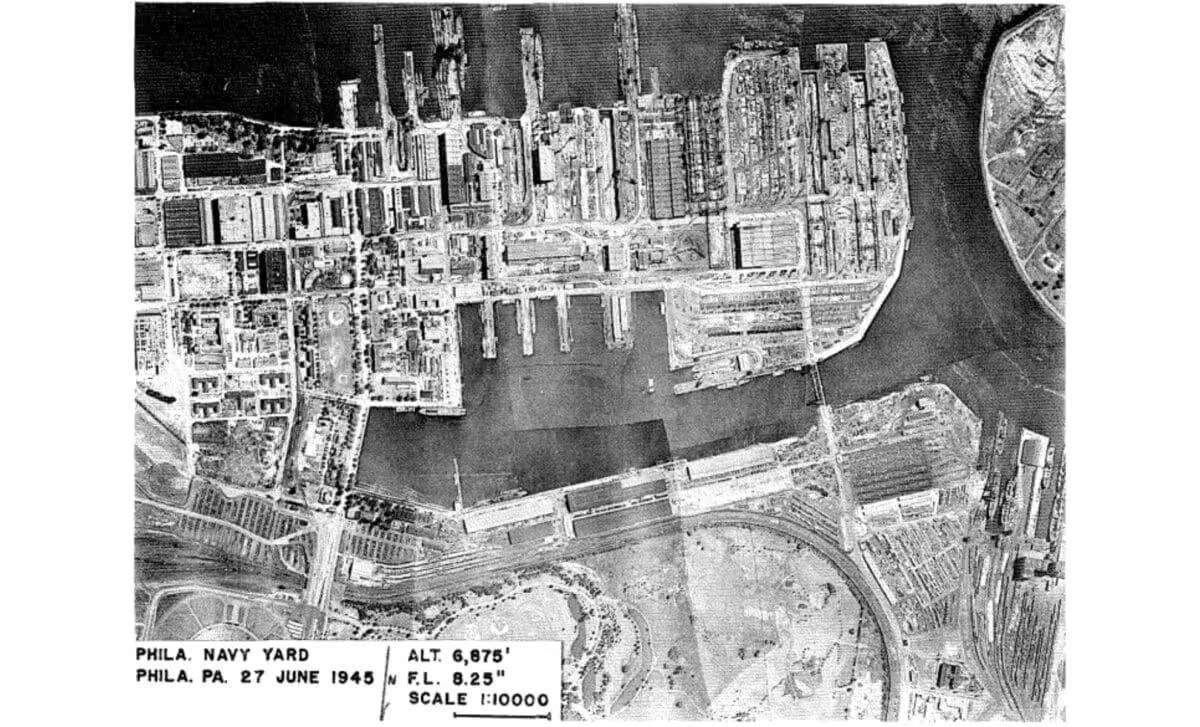
According to a persistent legend, the ship was subjected to a clandestine experiment at the Philadelphia Naval Shipyard that allegedly rendered it invisible, with subsequent reports describing impossible feats such as teleportation, temporal displacement, and crew injuries.
The story’s origins lie not in official naval archives but in the later assertions of Carl Allen, whose speculative writings on Albert Einstein’s “unified field theory” were linked to the myth after being attached as marginal notes to a book by amateur astronomer Morris Jessup. These annotations eventually reached the U.S. Navy’s Office of Naval Research.
USS Eldridge: A War‑Era Vessel Caught in a Mystery
The USS Eldridge was one of more than 500 destroyer escorts built by the United States during the conflict (source). The legend asserts that, while dry‑docked in 1943, the ship was equipped with a secret apparatus that emitted a green glow before vanishing from sight.
Proponents of the tale also claim that the civilian cargo ship SS Andrew Furuseth later sighted the Eldridge reappear at the Naval Operating Base in Norfolk, Virginia, describing the event as a teleportation and time‑travel experiment allegedly kept under wraps by the U.S. military.
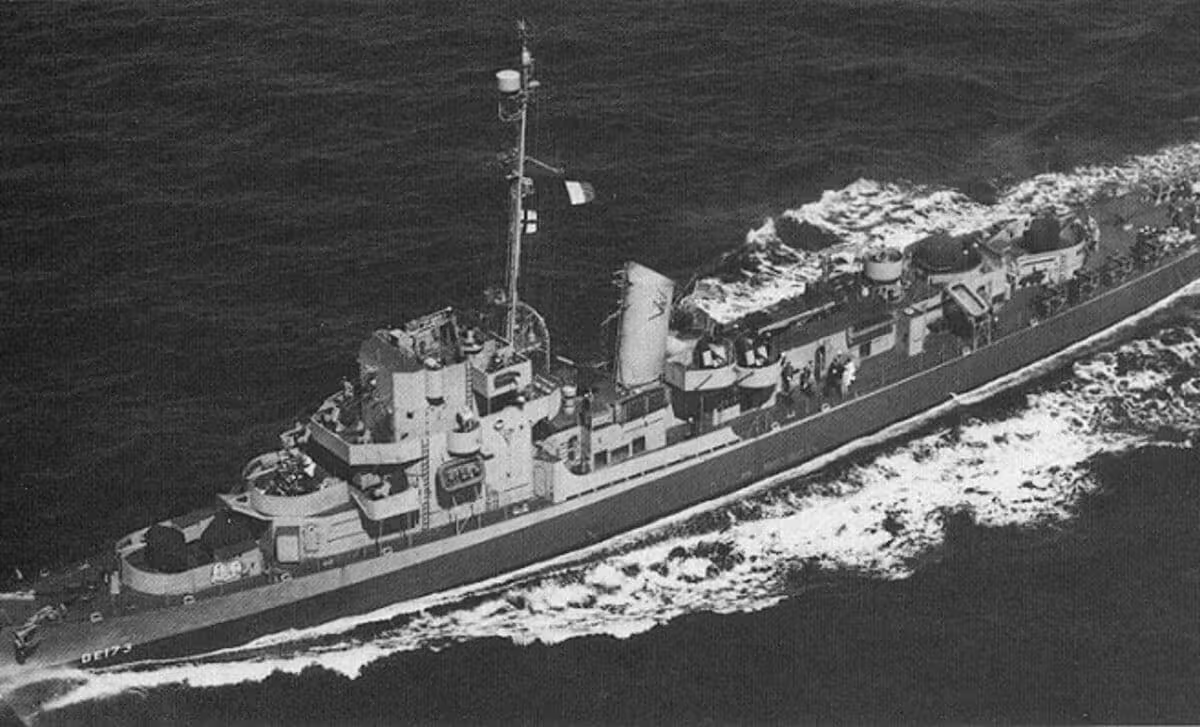
The Naval History and Heritage Command reports that official logs of the Eldridge’s movements and the SS Andrew Furuseth’s activities do not corroborate any of the alleged phenomena (source). A review of related documentation found no evidence of experiments involving invisibility or temporal displacement.
What the Navy Actually Tested: Degaussing, Not Invisibility
Supporters of the Philadelphia experiment often point to the Eldridge’s alleged cutting‑edge technology, but the real system installed was a degaussing coil—a device designed to lessen a ship’s magnetic signature.
According to the same Naval History and Heritage Command source, degaussing rigs were fitted to the hulls of U.S. Navy vessels to protect them from magnetic mines, especially in shallow waters. While the system altered how mines detected a ship, it never rendered a vessel invisible to the naked eye, radar, or sonar.
The presence of degaussing equipment may have fueled confusion, but its purpose was to reduce magnetic detectability—not to make a ship vanish.
From Debunked Claim to Enduring Urban Legend
Interest in the story surged after Allen’s annotations were linked to Jessup’s UFO manuscript. The Office of Naval Research later circulated more than a hundred copies of the annotated book, helping the narrative merge with broader conspiracy theories (source).
Despite repeated refutations by military archives and historians, the tale persisted, its blend of secret science, a vanished ship, and time‑travel speculation resembling a science‑fiction plot that eventually inspired a 1984 Hollywood film (source).
French researcher Jacques Vallée analyzed why the story endured in his 1994 paper “Anatomy of a Hoax: The Philadelphia Experiment Fifty Years Later” (source). Vallée noted that myths anchored to specific locations, dates, and extraordinary claims are far more likely to survive than vague anecdotes.
Thus, the legacy of the Philadelphia experiment rests less on any hidden technology and more on the power of a detailed mystery to capture public imagination for decades after it has been conclusively debunked.
This article has been fact checked for accuracy, with information verified against reputable sources. Learn more about us and our editorial process.
Last reviewed on .
Article history
- Latest version
Reference(s)
- “Classes of Destroyer Escorts — USS SLATER.” USS SLATER <https://ussslater.org/classes-of-destroyer-escorts>.
- “Philadelphia Experiment.” <https://www.history.navy.mil/research/library/online-reading-room/title-list-alphabetically/p/philadelphia-experiment.html>.
- <https://www.imdb.com/fr/title/tt0087910/>.
- “ValleeAnatomyHoaxPhilaExp.” <https://rexresearch1.com/Books/ValleeAnatomyHoaxPhilaExp.pdf>.
- Posted by Karan Das