NASA Teams With Private Companies to Deploy Four Lunar Landers By 2028 for Moon Base Buildout
NASA pushes forward with Moon Base plans as commercial partners develop next‑gen lunar landers and surface tech, accelerating future lunar habitats.

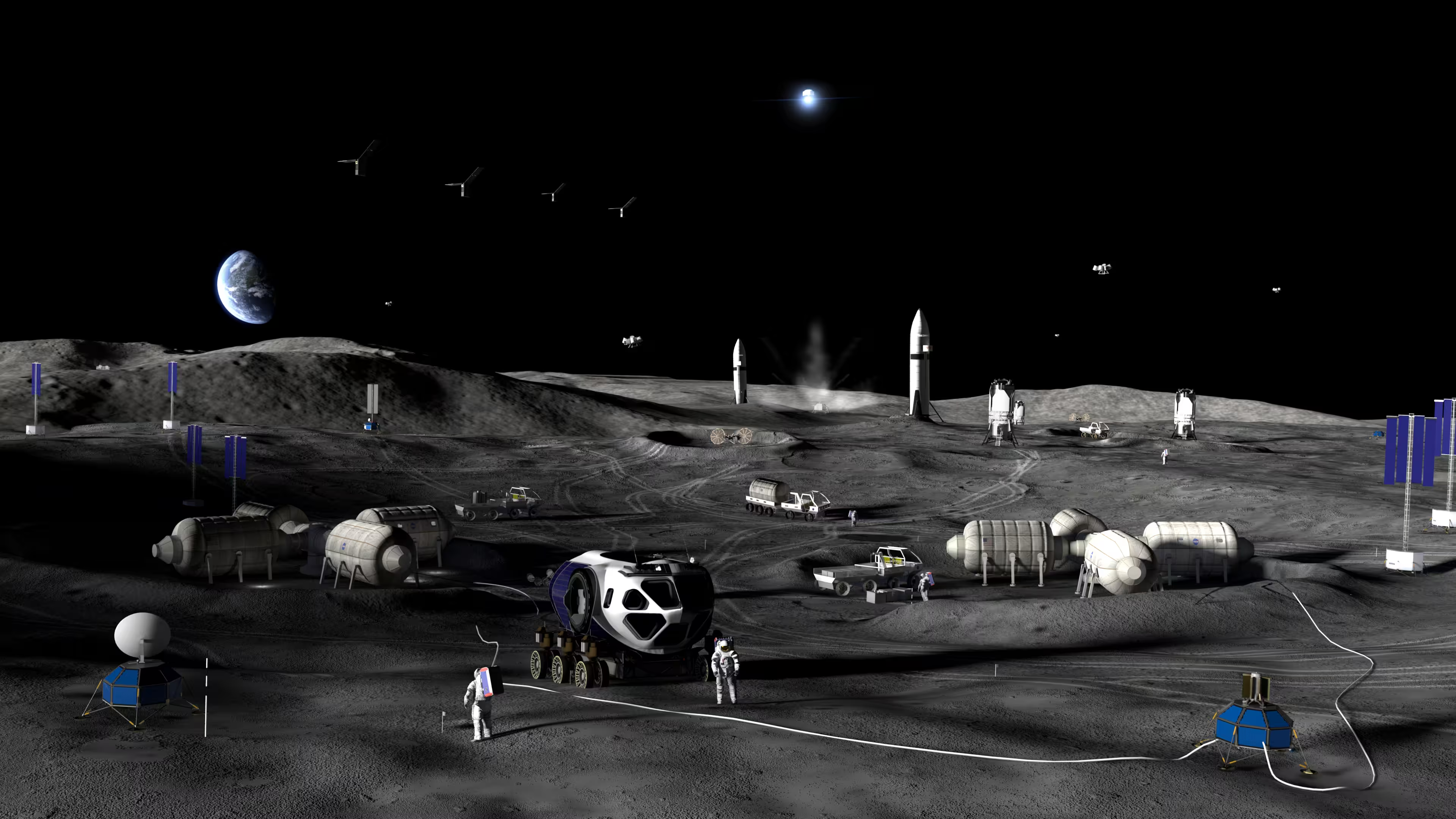
NASA’s roadmap for a permanent lunar outpost is now anchored by a quartet of commercial firms tasked with delivering landers and technology demonstrations to the Moon’s South Pole region by the end of the decade. The agency’s strategy emphasizes a cascade of robotic missions that will build the infrastructure required for future crewed operations.
Private Launch Vehicles Form the Backbone of Lunar Infrastructure
Under the Commercial Lunar Payload Services (CLPS) program, companies are granted recurring opportunities to ferry scientific instruments, prototype hardware, and operational systems to the lunar surface. This framework encourages private development while aligning with NASA’s long‑term exploration objectives.
Blue Origin advances precision‑landing capabilities with its Blue Moon MK1
Blue Origin’s next‑generation lander, dubbed Blue Moon MK1, has undergone a series of environmental assessments at NASA’s Johnson Space Center, including thermal‑vacuum trials that mimic the harsh conditions of space and the Moon. Core components such as the propulsion module, avionics suite, and structural frame have been integrated, and communication checks with the Tracking and Data Relay Satellite System and the Deep Space Network have been completed.
The upcoming mission, named Endurance, will test high‑precision descent techniques, gather data on the lunar environment, and validate autonomous operations that could support a future base. Success will feed into a broader logistics network envisioned for repeated surface deliveries.
Firefly targets the far side with an expanded Blue Ghost Mission
Firefly Aerospace is preparing a dual‑craft configuration for its Blue Ghost Mission 2, pairing the Blue Ghost lander with the orbital vehicle Elytra. At roughly 22 feet tall, the combined system exceeds the size of the original Blue Ghost Mission 1 hardware launched in 2025, enabling simultaneous orbital activities and surface deliveries.
If successful, the mission will become the first United States effort to land on the Moon’s far side, a region shielded from direct Earth‑based communication. The flight will probe lunar geology and explore conditions tied to the early “cosmic Dark Ages,” while carrying three NASA payloads for scientific and technology‑validation purposes.
Intuitive Machines readies Nova‑C for Reiner Gamma exploration
Intuitive Machines’ third lunar venture, designated IM‑3, will launch the Nova‑C lander carrying the Trinity spacecraft. Final integration steps include internal wiring verification, engine assembly, and system checks ahead of launch. Alongside the lander, the mission will release Altus‑1, the company’s inaugural lunar data‑relay satellite, to support communications.
The target area is the Reiner Gamma magnetic swirl, an enigmatic feature that has long intrigued scientists. By deploying robotic tools and scientific instruments, the mission aims to deliver the first high‑resolution study of this magnetic anomaly.
Voyager’s Griffin‑1 slated to deliver the largest commercial payload yet
Voyager Technologies is advancing its Griffin‑1 lander through environmental qualification at NASA’s Jet Propulsion Laboratory. Planned for a late‑2026 launch, Griffin‑1 is classified as an infrastructure‑class vehicle and is set to carry the most massive commercial cargo to date.
The payload suite includes five NASA experiments mounted on the Astrolab FLEX Lunar Innovation Platform (FLIP) rover, intended to showcase novel mobility concepts, surface‑operation techniques, and long‑duration exploration capabilities. Recent mass‑property tests have refined navigation and guidance parameters, with additional environmental trials scheduled before the vehicle returns to Voyager’s Pittsburgh facility for final assembly.
NASA develops survivability tech for the lunar night
In parallel with the commercial lander pipeline, NASA is collaborating with Northrop Grumman on three demonstration payloads derived from the Gateway HALO module. These experiments will evaluate systems capable of enduring the Moon’s prolonged night, during which temperatures plunge and sunlight disappears for weeks.
The demonstrations also include shared surface‑power architectures designed to support multiple assets simultaneously, laying groundwork for future habitats, scientific stations, and robotic platforms near the South Pole.
Together, the expanding roster of private landers and NASA‑led technology tests signal a shift toward a partnership model in which government and industry jointly construct the foundation for sustained lunar presence.
This article has been fact checked for accuracy, with information verified against reputable sources. Learn more about us and our editorial process.
Last reviewed on .
Article history
- Latest version
Cite this page:
- Posted by Karan Das