Chandra’s 10‑Year X‑Ray Watch Reveals M87* Jet Shifts at Near‑Light Speed
Chandra captures unprecedented detail of M87*’s jet, revealing dynamic structures and extreme particle motion at unmatched resolution.
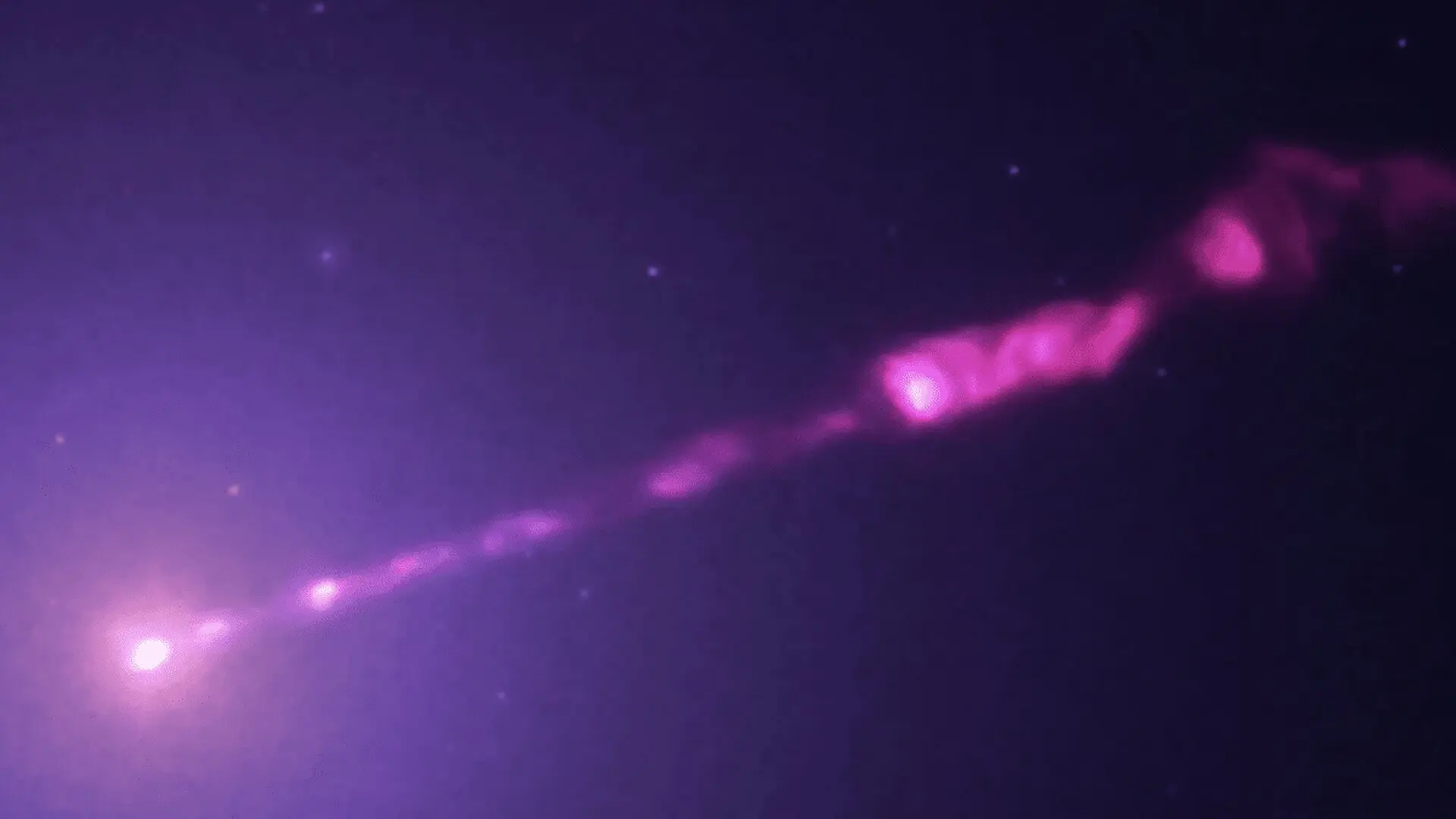
NASA’s Chandra X‑ray Observatory has produced the sharpest X‑ray portrait yet of the relativistic jet streaming from the supermassive black hole M87*, reigniting interest in the object that first revealed a black‑hole shadow in 2019. Situated about 55 million light‑years away in the giant elliptical galaxy Messier 87, the black hole continues to ingest surrounding gas and launch a high‑energy beam that stretches across intergalactic space.
A Ten‑Year X‑Ray Chronicle Unveils Jet Evolution
The analysis, posted on arXiv, draws on more than a decade of Chandra observations. By stitching together countless imaging sessions, researchers could track minute shifts in the jet’s morphology that would be invisible in shorter studies. The long‑term dataset captures how plasma is accelerated away from the black hole’s poles, revealing zones where the flow brightens, fades, or re‑configures over time.
These findings highlight that the jet’s energy output is far from uniform, instead showing a highly variable pattern that only extended monitoring can resolve. Aligning observations across years allowed scientists to piece together a fuller picture of how energy travels from the immediate black‑hole environment into the surrounding cosmos.
Turbulent Knots and Rapid Motion Near Light Speed
Among the most striking results are the moving “knots” within the jet that appear to outrun light when projected onto the sky. This so‑called superluminal effect is a geometric illusion caused by plasma traveling close to light speed almost directly toward Earth, which amplifies its apparent velocity without breaking relativistic limits.
The jet is fed by gas spiraling into M87*, heating up and becoming magnetically guided along the black hole’s spin axis. Once launched, the outflow forms a narrow, high‑velocity beam that penetrates the host galaxy. X‑ray imaging shows the beam is riddled with filaments and bright knots that shift over time, suggesting ongoing energy injection and turbulence rather than a steady, smooth stream.
Decadal Changes in Structure and Brightness
Extended monitoring has now captured gradual yet pronounced transformations in the jet’s architecture. Certain segments grow brighter while others dim, indicating a constantly reshaped energy distribution. Earlier observations hinted at such variability, but lacked the resolution to isolate individual features. The new dataset, combined with Chandra’s heightened sensitivity, finally resolves these structures.
“We could already see changes in the jet, but never with this level of detail in X‑rays,” said Camille Poitras, a Ph.D. student at Laval University and lead author. “Features that previously blended together can now be distinguished, letting us trace the jet’s evolution across more than a decade of observations.”
Implications for Galactic‑Scale Energy Transfer
Jets like the one from M87* act as colossal conduits, ferrying energy from the black‑hole vicinity to far‑reaching regions of the galaxy and beyond. As the outflow interacts with interstellar and intergalactic material, it can influence star‑formation rates and overall galactic development. The new X‑ray insights clarify how energy released near the event horizon is converted into large‑scale astrophysical effects.
“These results demonstrate how uniquely powerful Chandra remains for tracking the evolution of extreme phenomena over long timescales,” noted Gerrit Schellenberger, an astrophysicist at the Center for Astrophysics | Harvard & Smithsonian. “They help us better understand how energy released near a supermassive black hole is carried through its jet and deposited into the surrounding galaxy.”
This article has been fact checked for accuracy, with information verified against reputable sources. Learn more about us and our editorial process.
Last reviewed on .
Article history
- Latest version
Cite this page:
- Posted by Karan Das