A Drone Gliding Over Greenland Captured a Massive Creature Bursting Through 60 Centimeters of Solid Ice
A drone mapping Greenland’s icy terrain captured an unexpected discovery. Beneath half a meter of unyielding ice, a colossal animal was poised to emerge.
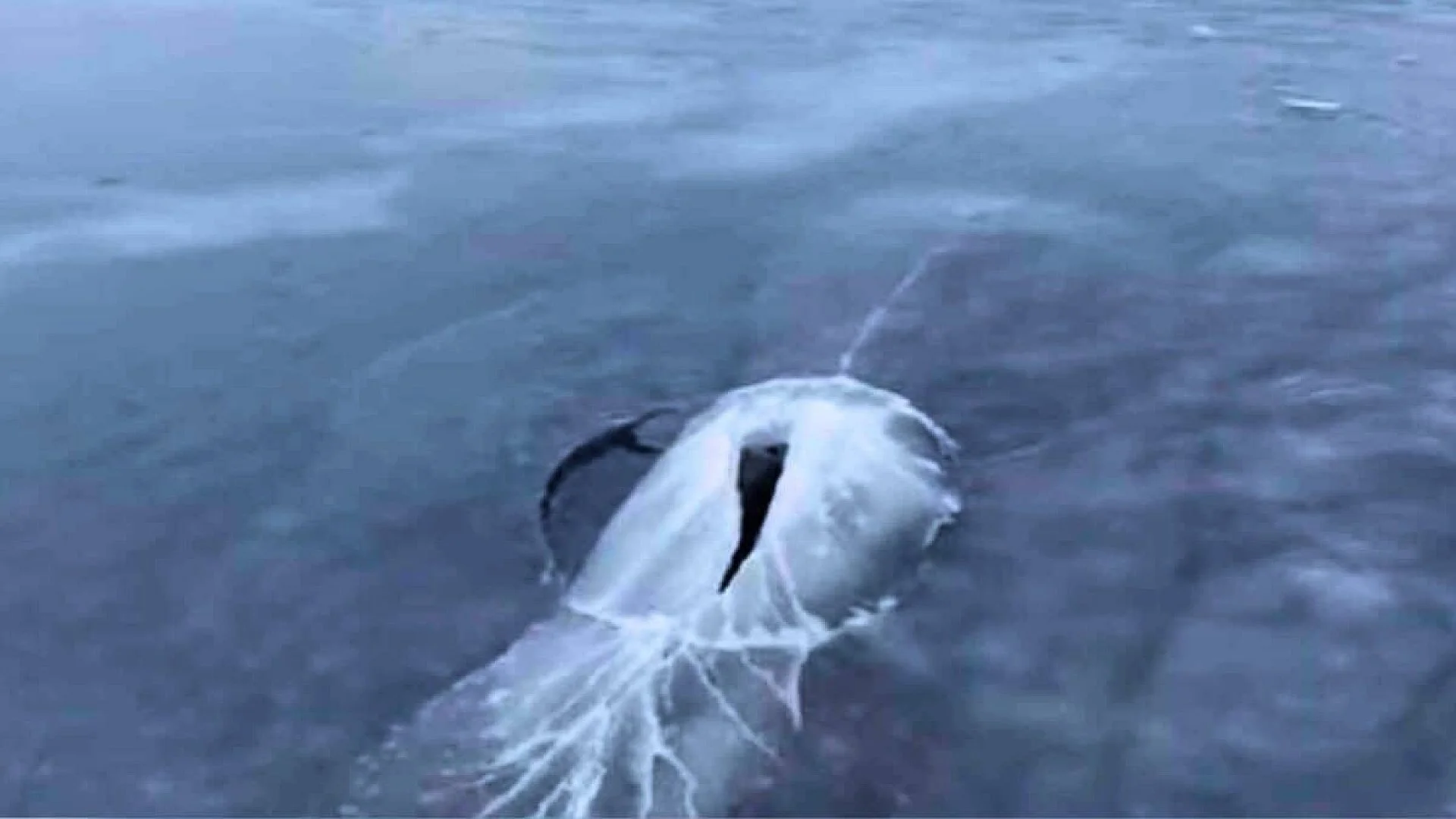
A research drone hovering above Disko Bay in western Greenland captured a rare and striking sight: a bowhead whale bursting upward through 24 inches of sea ice, shattering the frozen surface as it sought a brief moment to breathe before disappearing beneath the waves.
The footage is more than just a dramatic wildlife moment; it provides a crucial glimpse into a survival strategy that polar scientists are working to measure with increasing precision. This comes as the ice that these whales rely on is vanishing at an unprecedented rate, faster than ever recorded by satellites.
The bowhead whale is uniquely adapted for this feat. Its thick blubber layer, measuring 17 to 19 inches, is the heaviest insulation of any whale, and its arched skull can stretch up to 16.5 feet, roughly a third of its total body length. NOAA Fisheries notes that the species can break through 8 inches of sea ice to breathe, and Alaska Native whalers have recorded animals surfacing through 2 feet. The Disko Bay observation falls within these known limits.
A Scientific Analysis From 200 Feet Up
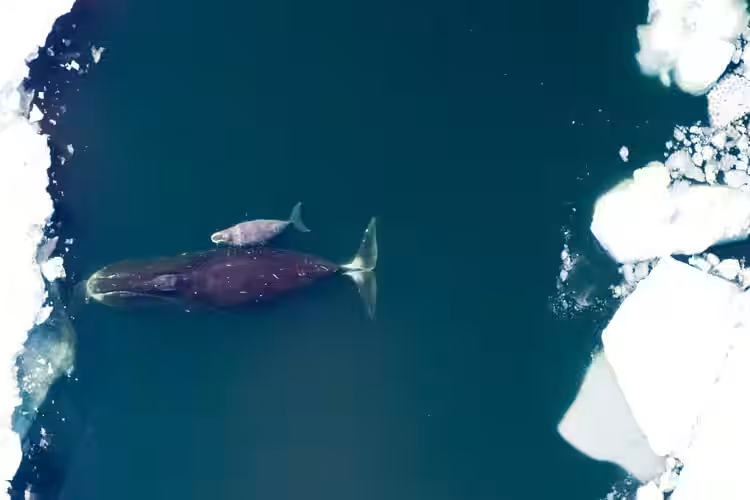
The significance of this footage lies not in the breach itself but in the precise measurements that researchers can extract from it. Dr. Fredrik Christiansen of Aarhus University and his team have been employing drone photogrammetry to assess bowhead body size and condition in Disko Bay. During their spring fieldwork in 2022, they collected 232 measurements from 154 adults and 50 from juveniles, work later published in Polar Biology.
From aerial images, the team calculates body length, width, and height, then converts these figures into estimates of blubber volume. Their findings are striking: adult bowheads in the bay added roughly 82 to 163 pounds of blubber per day, equivalent to 44 to 88 liters of stored energy. This matters because bowheads are capital breeders, relying on reserves built up during feeding season to fuel migration and reproduction later.
“The behavior happens frequently during the colder winter and spring months in Disko Bay,” Christiansen told Discover Wildlife.
To sustain this level of energy intake, bowheads must consume an enormous amount of prey. Bioenergetic modeling tied to drone measurements indicates that adult bowheads require roughly 1,017 to 2,174 kilowatt-hours of energy per day, equivalent to consuming about 225 to 481 pounds of prey daily, almost entirely small zooplankton filtered through baleen. Juveniles eat less but still take in an estimated 37 to 49 pounds daily.
The primary prey in Disko Bay are Calanus copepods, lipid-rich crustaceans that spend winter and early spring dormant in dense layers near the seafloor. Bowheads dive to reach them, descending 50 to 100 meters and sometimes beyond 400 meters, with dives lasting up to 40 minutes.
The Whale That Dominates a Food Chain
A 2021 study published in Frontiers in Marine Science modeled the predator-prey dynamics. If bowheads focus on the densest copepod patches, they likely consume between 26 and 75 percent of the Calanus standing stock in Disko Bay each year. To maintain a net energy gain, the whales must be highly efficient at locating these patches; any inefficiency would render the entire foraging effort a loss.
This study also found that the whales’ annual consumption rivals the combined estimates for three major zooplankton predator groups: jellies, chaetognaths, and predatory copepods. The pressure on the prey base is high enough that any sustained increase in whale numbers might force the population to spread into new feeding territory.
Not all Calanus copepods in Disko Bay originate there. Particle-tracking simulations indicated that some are carried by currents from Baffin Bay or the Greenland shelf, traveling hundreds or even thousands of kilometers before pooling in the bay’s deep basins. This journey inserts a 6- to 10-month gap between the distant phytoplankton bloom that feeds the copepods and the moment bowheads consume them. Disko Bay functions less like a contained pantry and more like a collection point for energy produced far away.
The Ice Is Melting, the Predators Are Thriving
The frozen surface that bowheads breach for air is itself shrinking. NASA satellite records show that September Arctic sea ice extent has declined by 12.2 percent per decade compared with the 1981 to 2010 average. Thinner, less predictable ice can scramble where and when copepods concentrate. It also opens the Arctic to more ship traffic, industrial noise, and the risk of vessel strikes or fishing gear entanglement.
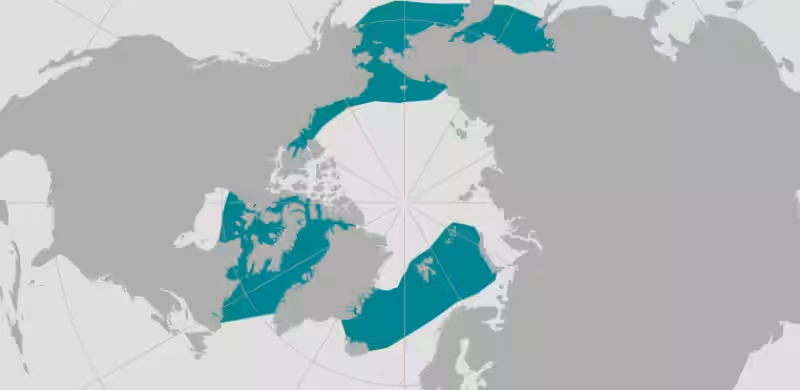
NOAA Fisheries lists climate change, ocean noise, pollution, and entanglement among the leading threats to the Western Arctic stock of bowheads. The most recent stock assessment estimates that population at about 15,229 individuals.
Killer whale predation has climbed as a threat as well. Scars from orca attacks appear on roughly 8 percent of subsistence-hunted bowheads, and that rate has risen each decade, according to NOAA Fisheries. Aerial surveys conducted between 2009 and 2018 identified killer whale attacks as the primary cause of death for bowhead carcasses found in the region.
A single drone clip cannot confirm whether the Disko Bay bowhead group is thriving or losing ground. Stacked against years of photogrammetry records, energy models, and sea ice data, however, each breath at an ice hole turns into a measurable signal. Researchers can track whether body condition trends upward or downward across seasons, offering a detection tool more sensitive than waiting for population counts to shift. For the bowhead whale, a breath through the ice is now a data point, and the ice itself carries the fingerprints of a system under strain.
This article has been fact checked for accuracy, with information verified against reputable sources. Learn more about us and our editorial process.
Last reviewed on .
Article history
- Latest version
Reference(s)
- “Bowhead Whale.”, November 16, 2018 NOAA <https://www.fisheries.noaa.gov/species/bowhead-whale>.
- Banas, Neil. “Reconciling Behavioural, Bioenergetic, and Oceanographic Views of Bowhead Whale Predation on Overwintering Copepods at an Arctic Hotspot (Disko Bay, Greenland).” Frontiers in Marine Science, vol. 8, May 26, 2021, pp. 614582 Frontiers, doi: 10.3389/fmars.2021.614582/full. <https://www.frontiersin.org/journals/marine-science/articles/10.3389/fmars.2021.614582/full>.
- Velev, Kalina. “Arctic Sea Ice Minimum Extent - Earth Indicator - NASA Science.”, September 26, 2025 NASA <https://science.nasa.gov/earth/explore/earth-indicators/arctic-sea-ice-minimum-extent/>.
Cite this page:
- Posted by Karan Das