Massive 6,000-Kilometer Wave on Venus Finally Explained by Newly Discovered Phenomenon
Scientists have identified the origin of Venus’ enigmatic atmospheric wave, spanning an impressive 6,000 kilometers.
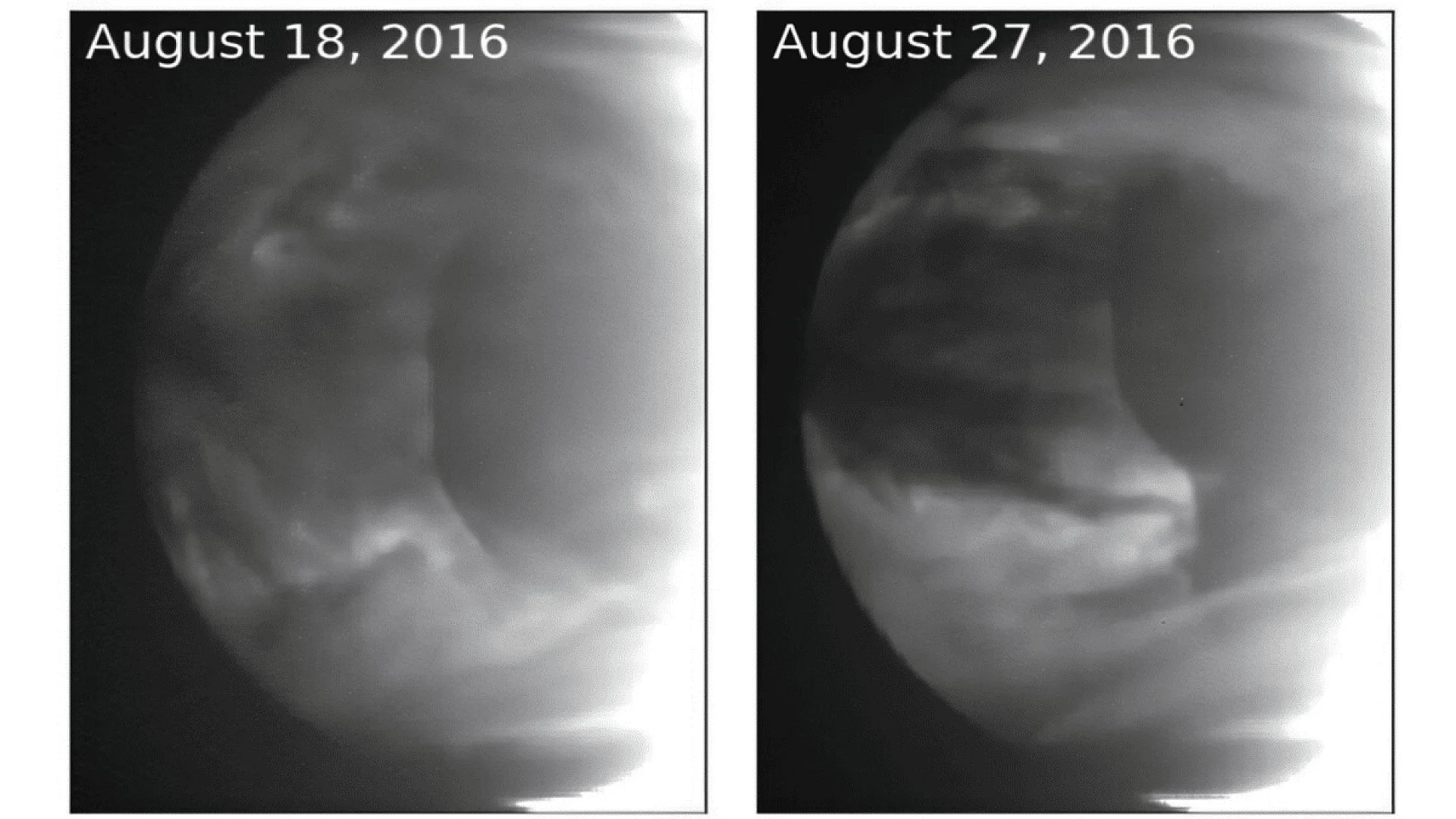
The enigmatic planet of Venus has long captivated scientists with its dense clouds, extreme temperatures, and mysterious weather patterns. However, a recent breakthrough published in the Journal of Geophysical Research: Planets has brought us closer to understanding one of the planet’s most mysterious atmospheric phenomena: a colossal 6,000-kilometer-wide wave that circulates around Venus’ equator. This wave, scientists now know, is the result of the largest hydraulic jump ever observed in the solar system.
The origin of this strange atmospheric wave had puzzled scientists for years, but after careful modeling and research by a team led by the University of Tokyo’s Professor Takeshi Imamura, the mystery has been solved.
Unlocking the Secrets of Hydraulic Jumps
In simple terms, a hydraulic jump is a sudden shift in the flow of a fluid, where it slows down and deepens. A familiar example is the way water from a tap behaves when it hits a sink: it starts as a fast-moving stream but suddenly spreads out into a wider, slower flow. On Venus, the hydraulic jump works in a similar way. The atmospheric wave, moving eastward through the lower cloud layers, reaches a critical point where its flow becomes unstable. As wind speeds rapidly slow down, a strong vertical updraft is generated, which carries sulfuric acid vapor high into the atmosphere.
The resulting cloud formation follows behind this updraft, creating the enormous atmospheric wave seen on Venus. This phenomenon, described as an enormous hydraulic jump, had never before been identified on any other planet.
Professor Imamura explains,
“We identified the phenomena, but for years we couldn’t understand it. However, thanks to this research, we’re now able to show that this cloud disruption is caused by the largest known hydraulic jump in the solar system.”
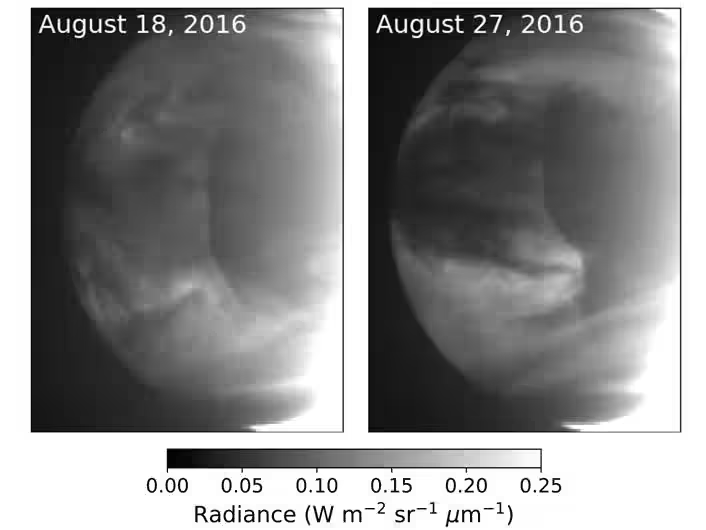
Credit: Journal of Geophysical Research: Planets (2026). DOI: 10.1029/2026je009672
New Insights into Venus’ Cloud Dynamics
Prior to this study, scientists relied on global circulation models (GCM) that simulated Venus’ weather based on similar models for Earth. However, these models did not account for the hydraulic jump identified in this new research. By using advanced fluid dynamics simulations and microphysical box models, the team demonstrated how the hydraulic jump is integral to understanding Venus’ cloud formation.
The study published in the Journal of Geophysical Research: Planets, also helps explain why Venus’ atmosphere exhibits superrotation, where winds move 60 times faster than the planet itself. This phenomenon had puzzled scientists for years, but the new research suggests that the wave induced by the hydraulic jump might play a key role in maintaining superrotation.
As Imamura puts it,
“Venus has three distinct cloud layers, and the dynamics of the lower and middle layers are not so well understood. Our discovery of a hydraulic jump on Venus connecting a very large-scale horizontal process with a strong localized vertical wave is unexpected, as in fluid dynamics these are usually disconnected.”
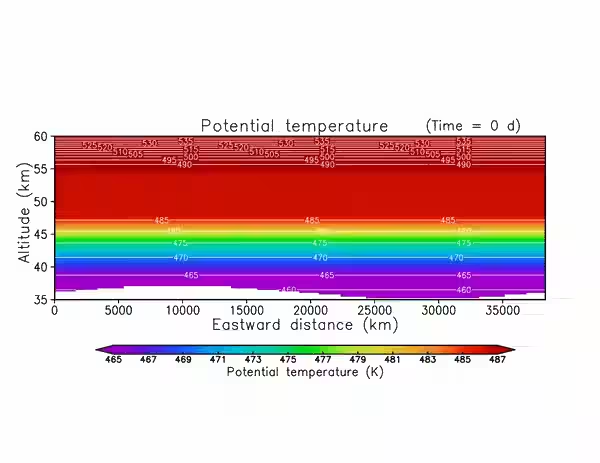
©T. Imamura, Y. Maejima, K. Sugiyama et al., 2026 CC-BY
Future Research and Challenges
With the hydraulic jump now identified, the next steps for the team involve refining their model to incorporate a broader range of atmospheric processes. This will require much more computational power, as the simulations are complex and require supercomputers to process. Despite these challenges, Imamura remains optimistic about the future.
“Our next step will be to test this discovery within a more inclusive climate model that includes other atmospheric processes. We will face some challenges due to the huge amount of processing power required to run such simulations. Even with modern supercomputers, it isn’t easy,” said Imamura.
This discovery also opens the door for further research on other planets, particularly Mars. As Imamura notes, “Under some circumstances, Mars’ atmosphere may also have the right conditions for a hydraulic jump.” This raises the possibility that future Mars missions might benefit from understanding how similar phenomena could occur on the Red Planet.
This article has been fact checked for accuracy, with information verified against reputable sources. Learn more about us and our editorial process.
Last reviewed on .
Article history
- Latest version
Reference(s)
- Imamura, Takeshi., et al. “A Planetary‐Scale Hydraulic Jump Driving Venus' Cloud Front.” Journal of Geophysical Research: Planets, vol. 131, no. 4, April 24, 2026 American Geophysical Union (AGU), doi: 10.1029/2026JE009672. <https://agupubs.onlinelibrary.wiley.com/doi/10.1029/2026JE009672>.
Cite this page:
- Posted by Karan Das