Webb and Hubble Unveil Black Eye Galaxy’s Counter‑Rotating Arms, Hinting at Ancient Collision
NASA’s Webb and Hubble image exposes Black Eye Galaxy’s turbulent past
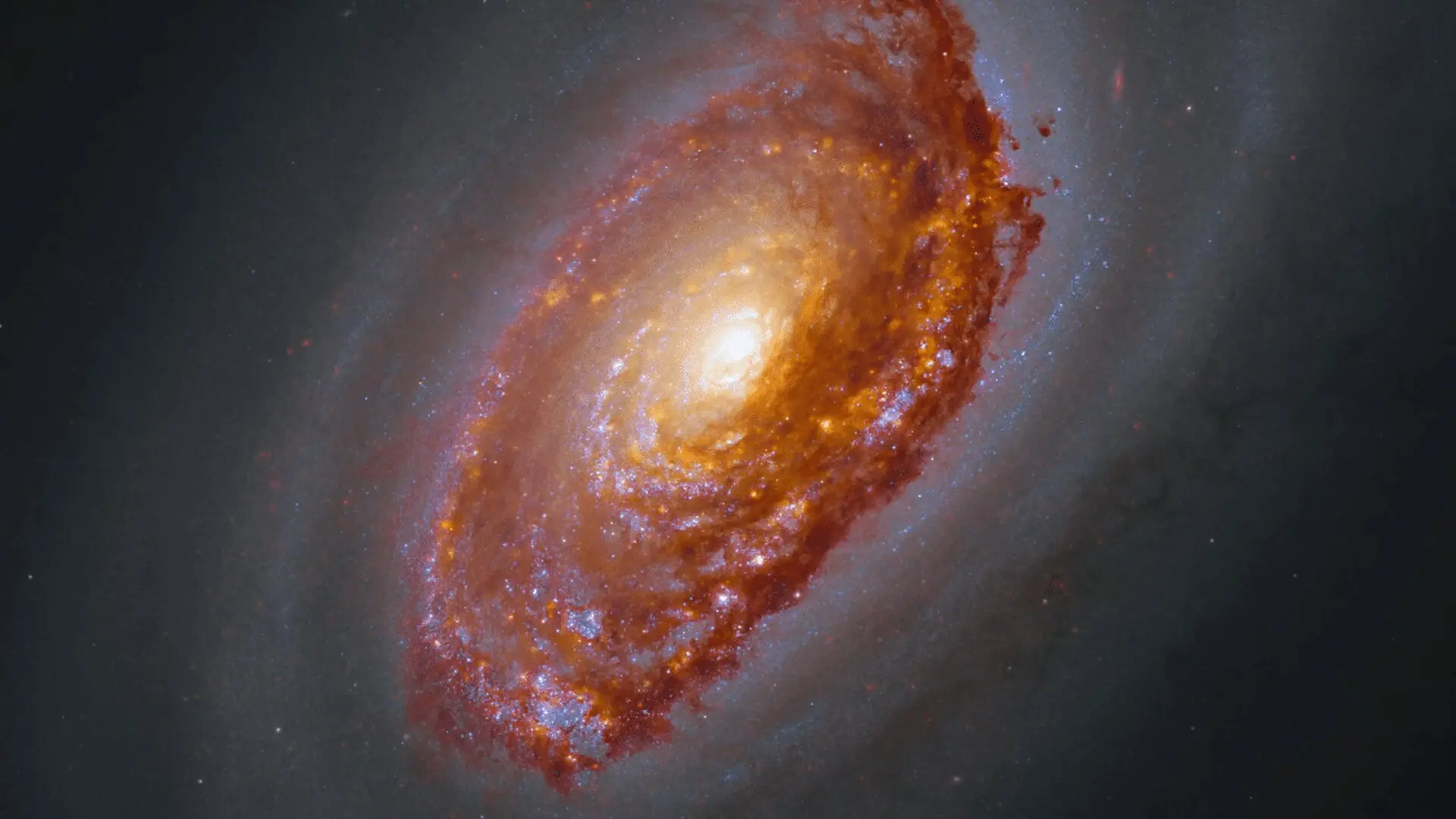
NASA has unveiled a striking new composite of Messier 64—commonly called the Black Eye Galaxy—created by merging data from the James Webb Space Telescope and the Hubble Space Telescope. The image captures the galaxy in unprecedented detail and highlights a rare dynamical feature: gas in its outer disk spins opposite to the material near the core, a pattern that likely traces back to an ancient galactic collision.
A Spiral Galaxy With an Unusual Spin Pattern
Located about 17 million light‑years away in the constellation Coma Berenices, Messier 64 is known for the dark dust lane that obscures part of its bright nucleus, giving rise to its “Black Eye” nickname. Beneath this eye‑catching silhouette, astronomers have identified a counter‑rotating component: the peripheral gas orbits the galactic centre in the opposite direction to the inner stars and gas. This phenomenon is exceedingly rare among spiral galaxies and provides a window into the galaxy’s tumultuous past.
Webb’s Infrared Vision Meets Hubble’s Multi‑Band Coverage
Webb surveyed the galaxy at near‑ and mid‑infrared wavelengths, cutting through dust clouds to reveal hidden structures, while Hubble contributed ultraviolet, visible and near‑infrared data that map youthful star clusters and energetic regions. Together the two observatories deliver a layered view that traces the distribution of dust, gas, and stars across the entire system.
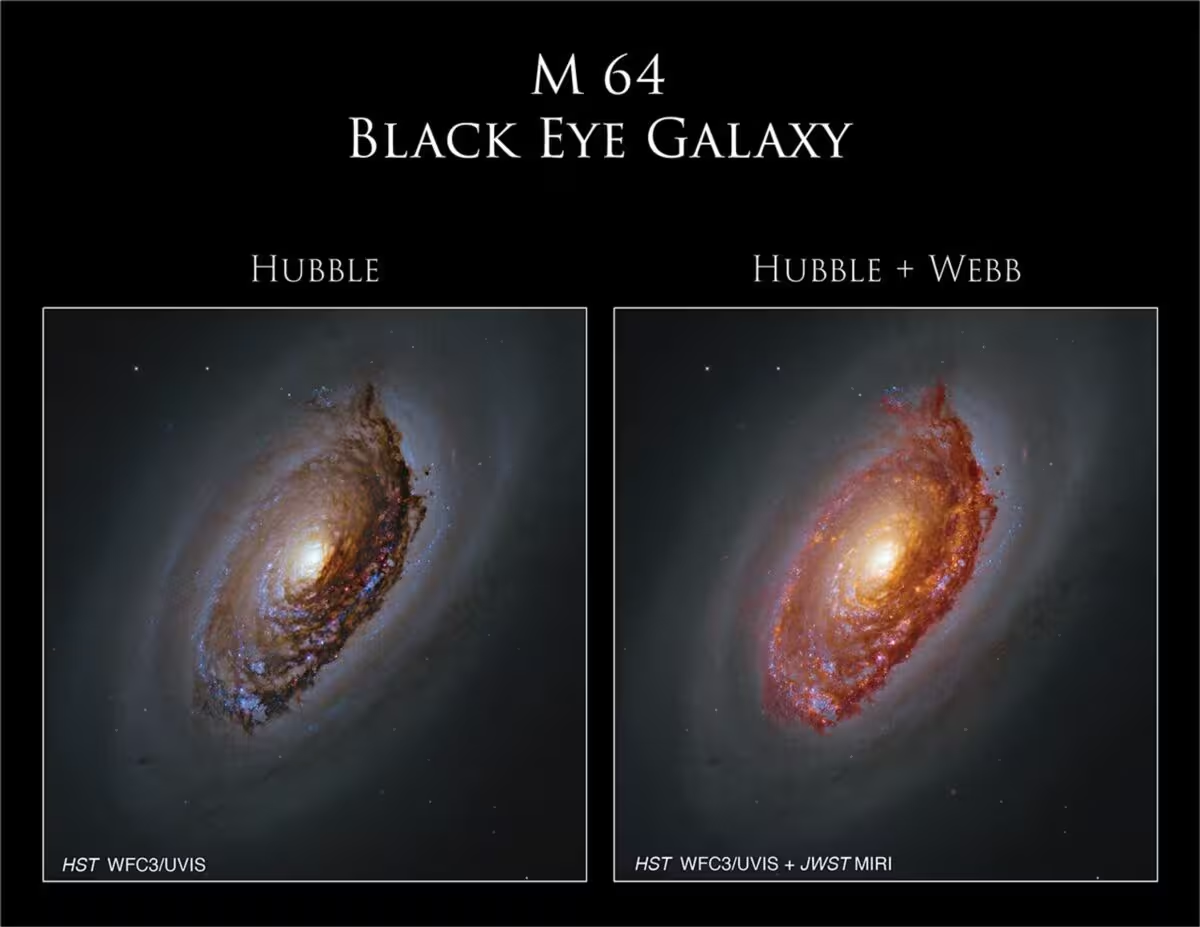
NASA, CSA, ESA, F. Belfiore (European Southern Observatory – Germany), J. Lee (Space Telescope Science Institute), A. Leroy (The Ohio State University), and D. Thilker (The Johns Hopkins University); Processing: Gladys Kober (NASA/Catholic University of America)
Clues Point to a Billion‑Year‑Old Merger
NASA’s analysis (source) suggests the counter‑rotating gas is a relic of a merger with a smaller satellite galaxy more than a billion years ago. During that encounter, material from the companion was assimilated into the outer disk of Messier 64, retaining its original angular momentum and establishing the opposite rotation observed today.
Why This Galaxy Matters for Cosmic History
Messier 64 serves as a natural laboratory for studying how galactic collisions reshape star‑forming environments, redistribute interstellar gas, and alter long‑term dynamics. Counter‑rotating structures like those seen here demonstrate that galaxies are not static islands but evolving systems continually molded by interactions. By probing such anomalies, researchers refine models of galaxy assembly and the large‑scale distribution of matter.
As infrared and optical observatories push the boundaries of resolution, more examples of complex kinematics are expected, deepening our understanding of how galaxies transform over cosmic time. The ongoing investigation of Messier 64, together with studies of early‑universe objects (the universe), will help piece together the full narrative of galactic evolution.
A Window Into an Ancient Cosmic Encounter
The combined Webb‑Hubble portrait does more than showcase a beautiful spiral; it records the lingering imprint of a dramatic event that likely reshaped the entire system billions of years ago. Each new dataset adds depth to the story, reminding us that even seemingly tranquil galaxies can harbor turbulent histories marked by merger‑driven upheaval and ongoing transformation.
This article has been fact checked for accuracy, with information verified against reputable sources. Learn more about us and our editorial process.
Last reviewed on .
Article history
- Latest version
Reference(s)
- “Black Eye Galaxy - NASA.” NASA <https://www.nasa.gov/image-article/black-eye-galaxy/>.
Cite this page:
- Posted by Karan Das