Stunning Daylight Shot Captures ISS Flying Beside Brilliant Venus
Stunning daylight shot shows the ISS passing Venus in a historic sky view, a rare capture of both space icons together.
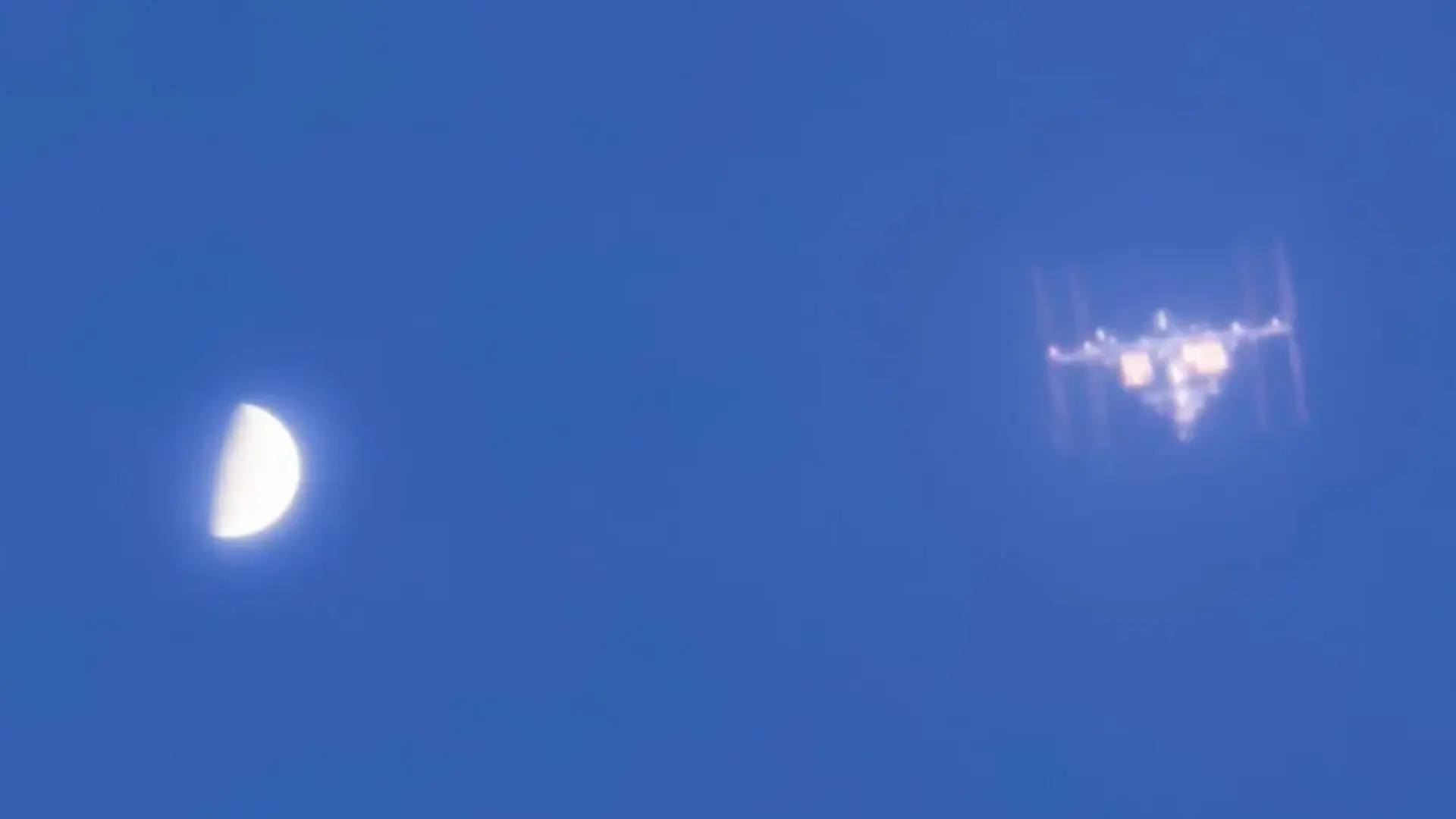
Photographer AJ Smadi has unveiled a striking image that places the International Space Station in the same view as the bright planet Venus, offering a visual bridge between humanity’s orbital outpost and a neighboring world.
When Low‑Earth Orbit Meets the Morning Star
In the picture, the ISS sweeps across the sky just as Venus shines nearby, juxtaposing a human‑made laboratory circling roughly 400 km above Earth with a planet that orbits the Sun at about 108 million km. The disparity in distance, luminosity, and speed makes such a pairing exceptionally rare.
The shot was captured under daylight conditions, demanding split‑second timing to freeze the fast‑moving station while also framing the luminous planet. Achieving balance between exposure and focus proved essential to render both subjects with clarity.
Beyond its aesthetic appeal, the image symbolizes the convergence of space‑flight engineering and planetary science. The ISS embodies decades of international collaboration in low Earth orbit, whereas Venus remains a focal point for researchers studying extreme atmospheres and volcanic history.
Images that clearly resolve both the station and Venus are scarce; most photographs feature one or the other, but few capture them together with sufficient detail to distinguish each object.
“Worlds Apart”: A Second Historic Capture
AJ Smadi announced that this picture marks only the second time the ISS and Venus have been resolved together, the first instance having earned a spot on NASA’s Astronomy Picture of the Day last April. He titled the new work “Worlds Apart,” underscoring the immense distance that separates the two bodies despite their apparent proximity in a single frame.
The name highlights the contrasting environments: the ISS serves as a platform for human research in near‑Earth space, while Venus is shrouded in dense clouds, subject to crushing atmospheric pressure and surface temperatures hot enough to melt lead.
Smadi’s portfolio often emphasizes rare celestial events and unconventional viewpoints, and this image exemplifies how meticulous planning and exact timing can expose fleeting connections across vastly different scales.
Technical Hurdles in Capturing the Pair
Because the ISS completes an orbit roughly every ninety minutes, its position shifts constantly, forcing photographers to calculate the precise moment it will intersect a chosen sky segment.
Venus adds another layer of difficulty; its brilliance outshines most night‑time objects, and under daylight the contrast with the surrounding sky intensifies, demanding careful exposure adjustments to retain detail in both subjects.
From the ground, the station appears as a tiny, fast‑moving point of light despite its size comparable to a football field, requiring specialized optics or timing to capture it with discernible structure.
Successfully merging the two in a single, sharp image depends on a blend of atmospheric clarity, precise camera settings, and an exact understanding of the ISS’s orbital path at the moment of exposure.
This article has been fact checked for accuracy, with information verified against reputable sources. Learn more about us and our editorial process.
Last reviewed on .
Article history
- Latest version
Cite this page:
- Posted by David Anderson