Mars Has a Giant Mystery Cloud That Forms Using Physics Scientists Thought Was Impossible
Scientists may have finally solved the mystery of a massive, recurring Martian cloud that has baffled weather models for years with an unexpected process.
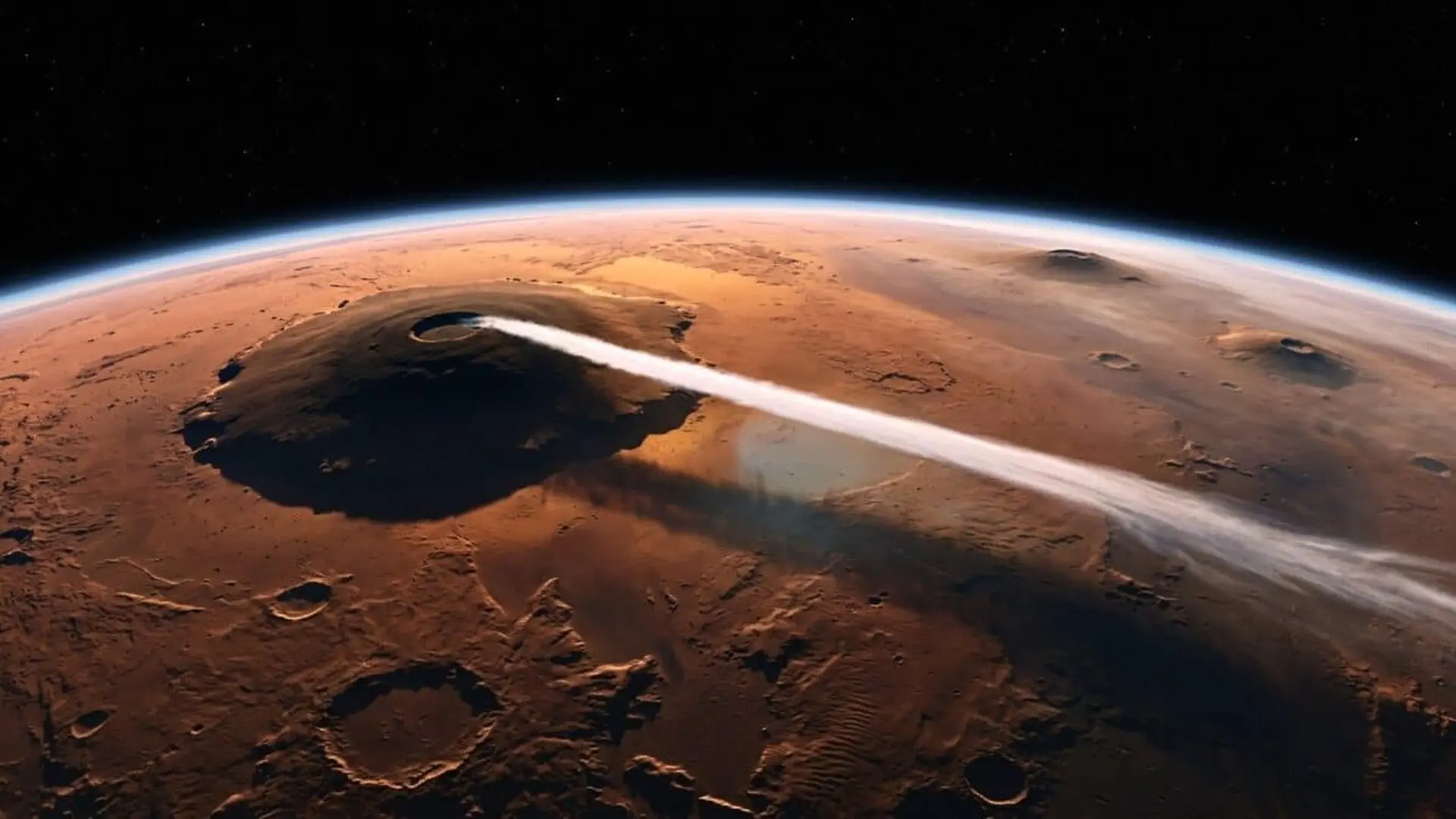
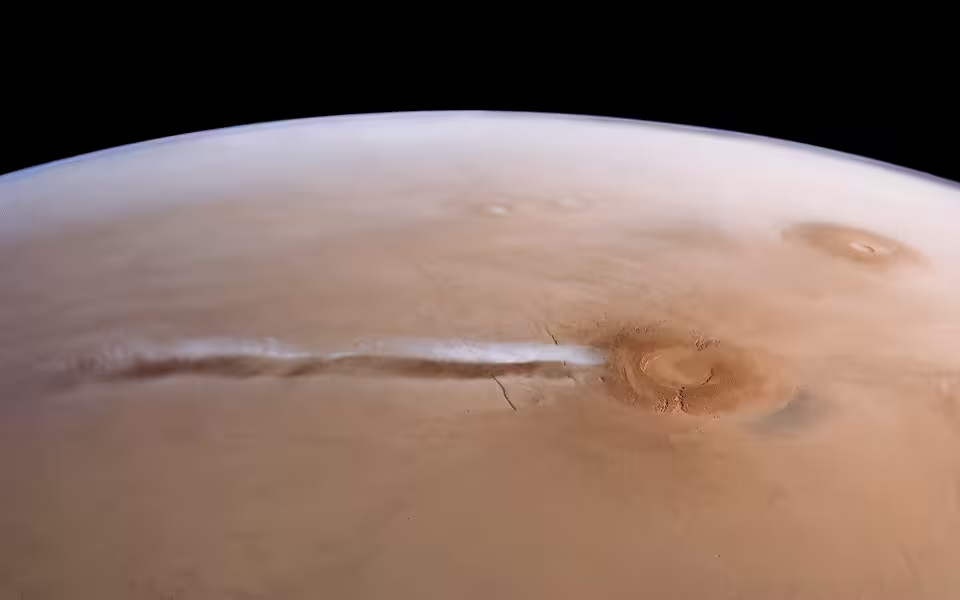
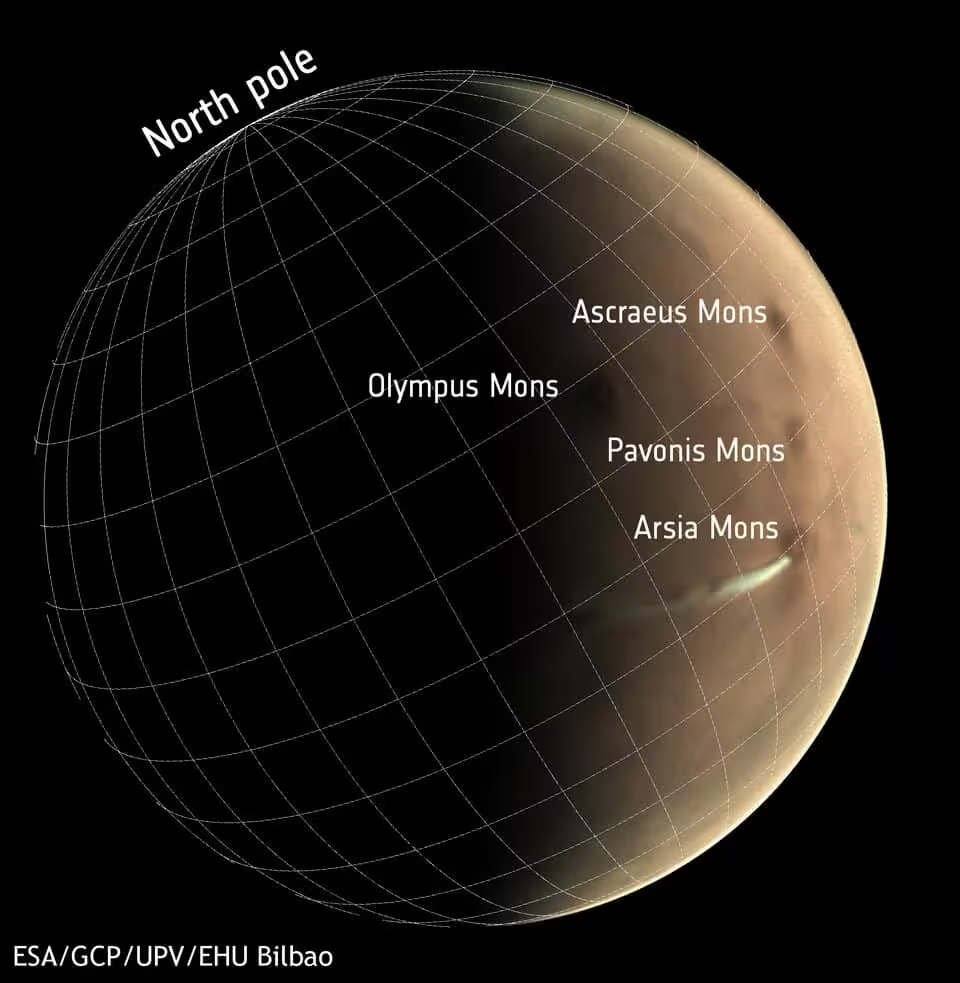
Each morning, as dawn approaches on the slopes of a massive Martian volcano, a distinct white plume emerges. Over the next two and a half hours, this formation stretches westward, spanning up to 1,800 kilometers—nearly twice the length of the United Kingdom—while moving at speeds exceeding 600 kilometers per hour. By mid-morning, the phenomenon dissipates. Known as the Arsia Mons Elongated Cloud (AMEC), this recurring event is considered by the European Space Agency to be the most visually striking atmospheric feature on the Red Planet. For years, however, the precise mechanism behind its creation remained a mystery that defied computer modeling.
An Atmospheric Phenomenon with Precision Timing
The cloud forms consistently during the Martian spring and summer, emerging downwind from Arsia Mons, a 20-kilometer-high volcano situated just south of the Martian equator. Research led by Jorge Hernández-Bernal, formerly of the University of the Basque Country, mapped the cloud’s routine in 2021, documenting its birth on the volcano’s western slope at an altitude of approximately 45 kilometers.
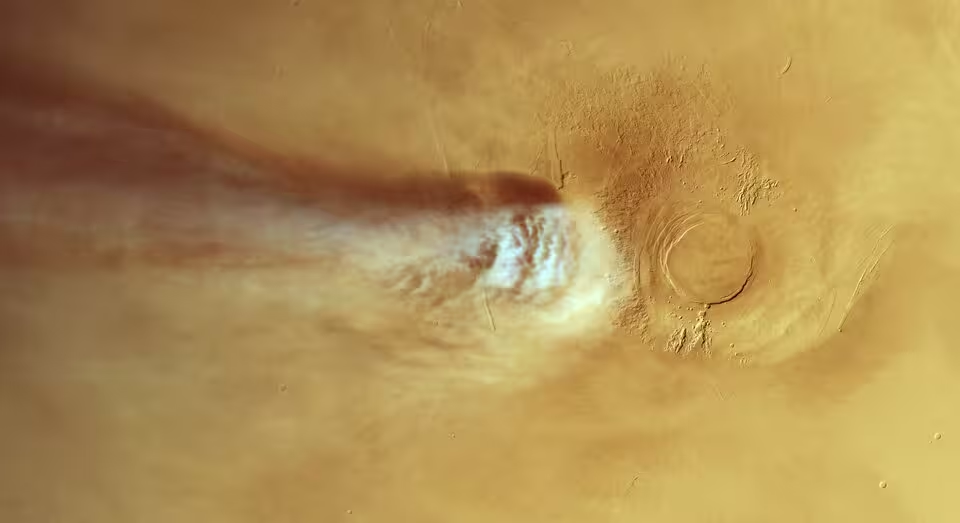
As the largest orographic cloud ever recorded on Mars, it functions similarly to terrestrial clouds that gather over mountain summits, forced upward by the terrain. Despite the presence of multiple volcanoes in the region, Arsia Mons is uniquely capable of producing this specific veil, a fact that largely escaped notice for decades because most orbiting spacecraft do not capture the region during the early morning hours.
Observational Challenges and Breakthroughs
The discovery of the cloud’s consistent schedule allowed the European Space Agency’s Mars Express and the ExoMars Trace Gas Orbiter to adjust their observation patterns. The Mars Express mission utilized its Visual Monitoring Camera, an instrument originally designed to confirm the separation of the Beagle 2 lander, to capture the scale of the structure. Since 2018, the mission has provided repeated, high-resolution documentation of the plume.
Early attempts to simulate the cloud using standard weather models consistently failed to replicate its size and tail, typically producing structures that were too thin. A new study, published in Nature Geoscience, suggests that the secret lies in a process known as homogeneous nucleation.
The Physics of Spontaneous Cloud Formation
On Earth, cloud formation usually relies on heterogeneous nucleation, where water vapor condenses onto particles like salt, dust, or pollen. The researchers discovered that the AMEC forms without such seeds. According to Hernández-Bernal, now at the Laboratoire de Météorologie Dynamique in Paris, water vapor transitions directly into ice crystals. This process requires extreme atmospheric conditions—specifically, relative humidity levels significantly higher than those observed on Earth—which are achieved when wind currents over the volcano trigger rapid, intense cooling of moist air.
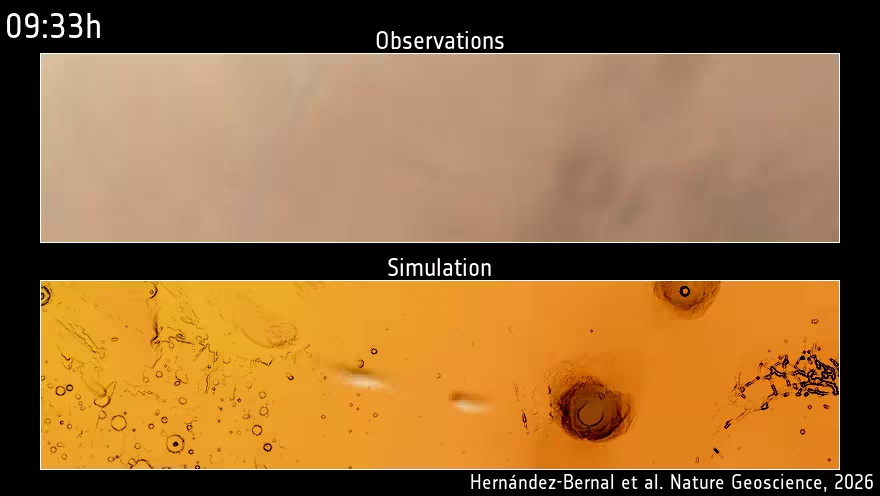
While homogeneous nucleation has long been discussed in scientific literature as a theoretical possibility in planetary atmospheres, this study marks the first time it has been observed in practice. The model successfully replicated the plume only after this “exotic physics” was incorporated into the simulation.
The research team intends to investigate whether this mechanism is exclusive to Arsia Mons or if it occurs in other atmospheric contexts on Mars. While not perfect, the current model’s ability to recreate the phenomenon represents a significant advancement in understanding the Martian climate. Archives have further confirmed the cloud’s long-standing presence, with data from NASA’s 1970s-era Viking 2 orbiter revealing that the structure was captured on camera long before its nature was understood.
This article has been fact checked for accuracy, with information verified against reputable sources. Learn more about us and our editorial process.
Last reviewed on .
Article history
- Latest version
Reference(s)
- Hernández-Bernal, J.., et al. “Homogeneous ice nucleation from water vapour suggested by elongated clouds on Mars.” Nature Geoscience, vol. 19, no. 10, October 7, 2026, pp. 1213-1217. Springer Science and Business Media LLC, doi: 10.1038/s41561-026-02089-9. <https://doi.org/10.1038/s41561-026-02089-9>.
Cite this page:
- Posted by Farah Siddiqui