NASA’s Lucy Mission Uncovers Contact-Binary Satellite Mystery
Many binary asteroids may have multiple moon generations forming unusual satellite shapes like contact binaries
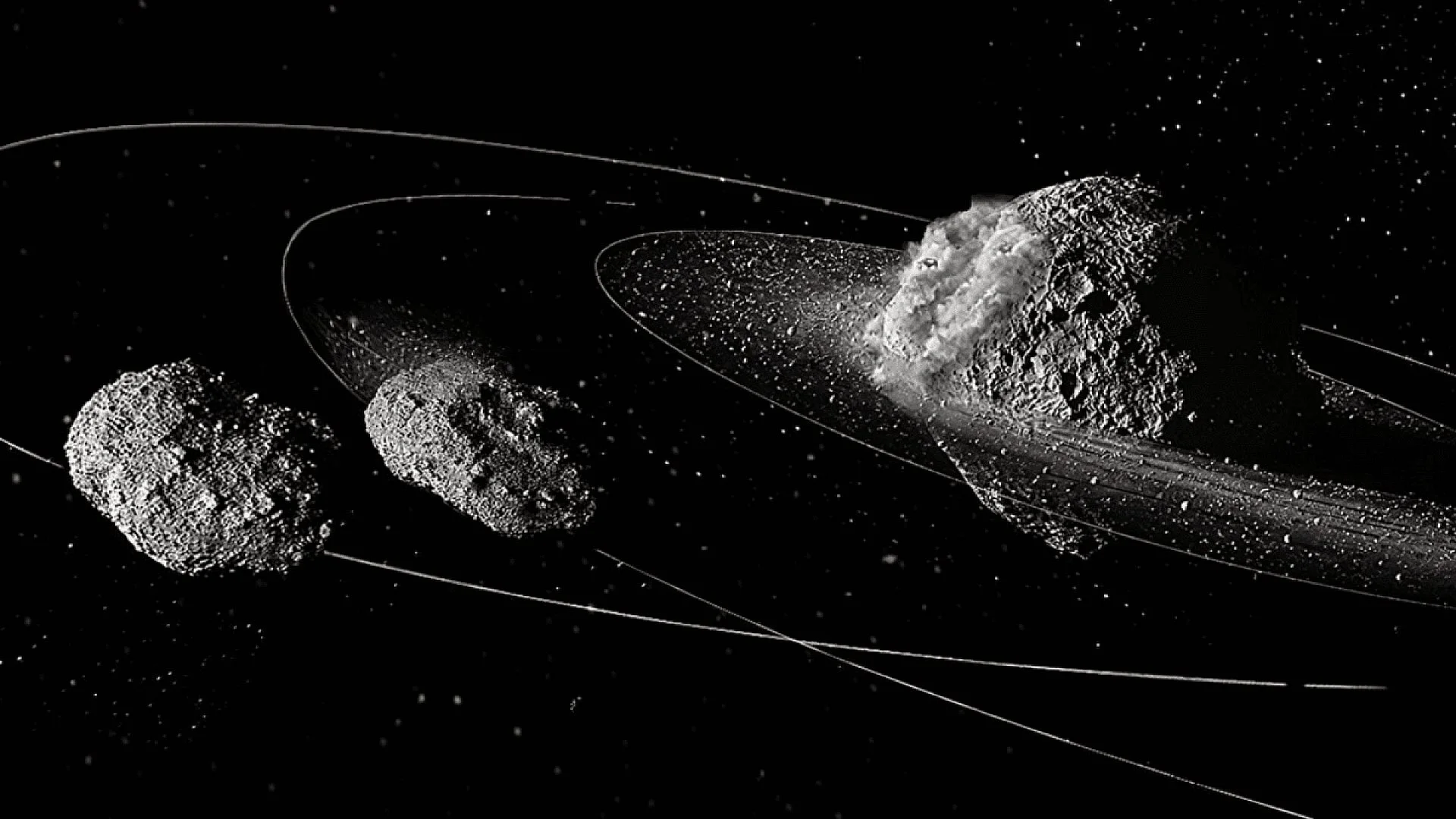
A new analysis of binary asteroid systems suggests that many of these small worlds have undergone intricate, multi‑stage evolution, with moons that form, interact, and sometimes merge over spans of millions of years. The research, appearing in Nature Communications, uses the puzzling double‑lobed satellite Selam around the asteroid Dinkinesh as a case study to illustrate how such complex configurations can arise.
Re‑examining Dinkinesh’s Twin‑Lobed Companion
When NASA’s Lucy spacecraft flew past Dinkinesh, the mission team discovered that its moon, Selam, does not fit the classic picture of a single, small satellite skimming the Roche limit of a fast‑spinning primary. Instead, Selam appears as a contact binary made of two nearly equal lobes, orbiting at a distance far beyond the range predicted by traditional models. This unexpected geometry prompted researchers to ask how such a satellite could have formed and why similar oddities are emerging in other asteroid pairs.
N-body simulation with 𝑀𝑑/𝑀𝑝 = 0.04 , 𝑎𝑠/𝑅𝑝 = 3.16 and 𝑀𝑠/𝑀𝑝 = 0.02.
Particles that are in contact with others are painted in light green.
Credit: Nature Communications
Repeated Debris Ejection Over Eons
The authors modeled the long‑term behavior of rubble‑pile asteroids, whose structural integrity allows them to survive many rotational shedding episodes. Their simulations show that an asteroid can lose material in several distinct events, each spawning fresh debris that may coalesce into new moons while older companions continue drifting outward under tidal and thermal influences. The overlapping of these generations creates a dynamic environment where collisions and gravitational encounters become inevitable.
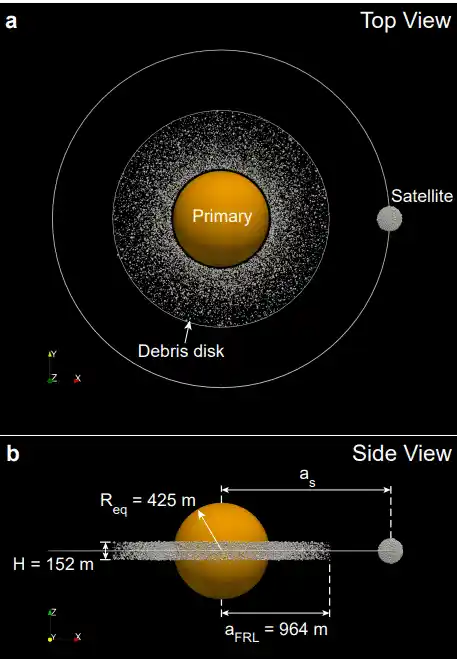
In the initial moment, the pre-existing satellite locates in a circular orbit with a semi-major axis of 𝑎𝑠. Surrounding the primary asteroid is the power-law distributed debris cloud, whose outer boundary and thickness are the fluid Roche limit 𝑎FRL = 2.54𝑅p = 964 m and 𝐻 = 0.4𝑅p = 152 m, respectively. The primary is set to be a sphere with a radii of 𝑅eq = 425 m, which matches the equatorial radii of Didymos.
Credit: Nature Communications
When Old and New Moons Collide
High‑resolution N‑body runs reveal three principal evolutionary pathways for binary asteroid systems. The “interaction regime” stands out as the most disruptive: a pre‑existing satellite that has migrated to a moderate orbit can be struck by fresh debris, leading to tidal breakup, low‑speed mergers, or scattering events. This mechanism naturally produces contact‑binary shapes like Selam and explains why some moons occupy unexpectedly distant orbits.
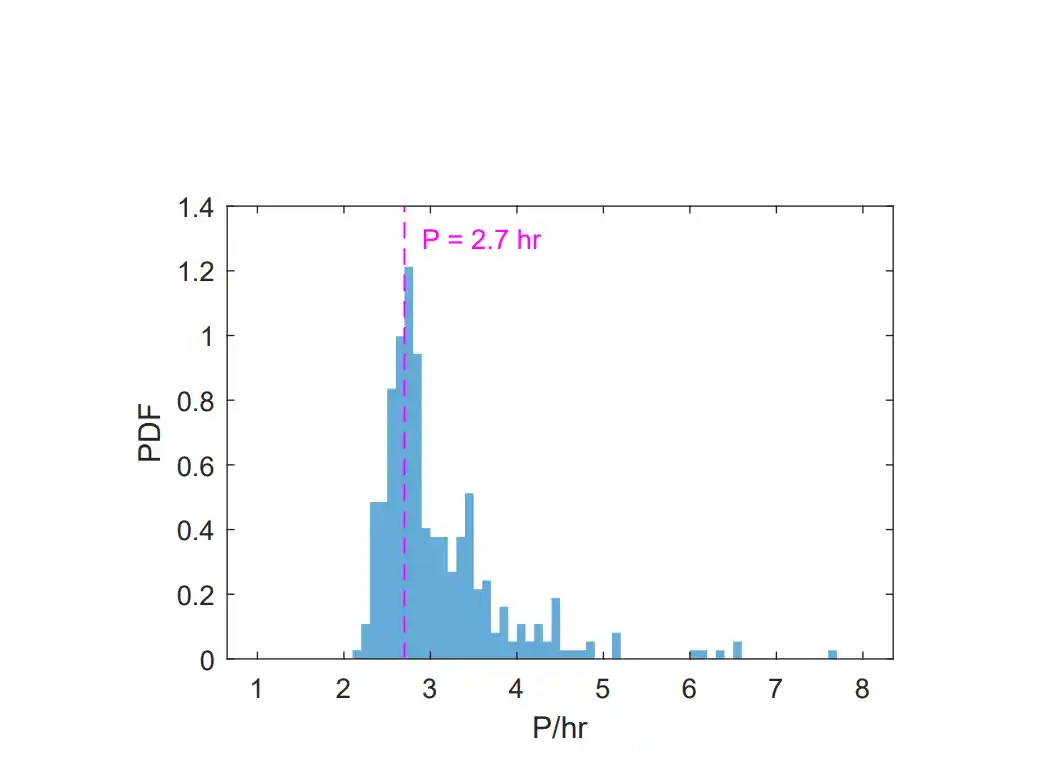
density function of the binary asteroid primary spin period 𝑃. The magenta dash line indicates the most probable value 𝑃 = 2.7 hr.
Credit: Nature Communications
Wider Patterns Across Small‑Body Populations
Beyond Dinkinesh, the authors point to several other asteroid groups that may share this multi‑stage history. Triple systems such as 2001 SN263 and Balam, as well as active bodies like 311P/PANSTARRS that repeatedly shed dust, fit the same interaction‑driven scenario on different scales. Statistical analysis suggests that roughly 44 % of observed binary asteroids display traits compatible with a multigenerational satellite past, implying that these complex formation pathways are common throughout the inner solar system.
The study is available in Nature Communications, and the Lucy mission details can be found in NASA’s Lucy mission coverage.
This article has been fact checked for accuracy, with information verified against reputable sources. Learn more about us and our editorial process.
Last reviewed on .
Article history
- Latest version
Reference(s)
- Dai, Wen-Yue. “Diverse configurations of binary asteroids explained by multi-generation satellites - Nature Communications.”, May 28, 2026 Nature, doi: 10.1038/s41467-026-73703-y. <https://www.nature.com/articles/s41467-026-73703-y>.
Cite this page:
- Posted by Karan Das