MIT’s Dual‑Mode Thruster Could Power CubeSats to Mars with a Single Fuel
MIT unveils hybrid propulsion merging chemical and electric thrust, promising tiny spacecraft can reach Mars and beyond in a single compact system
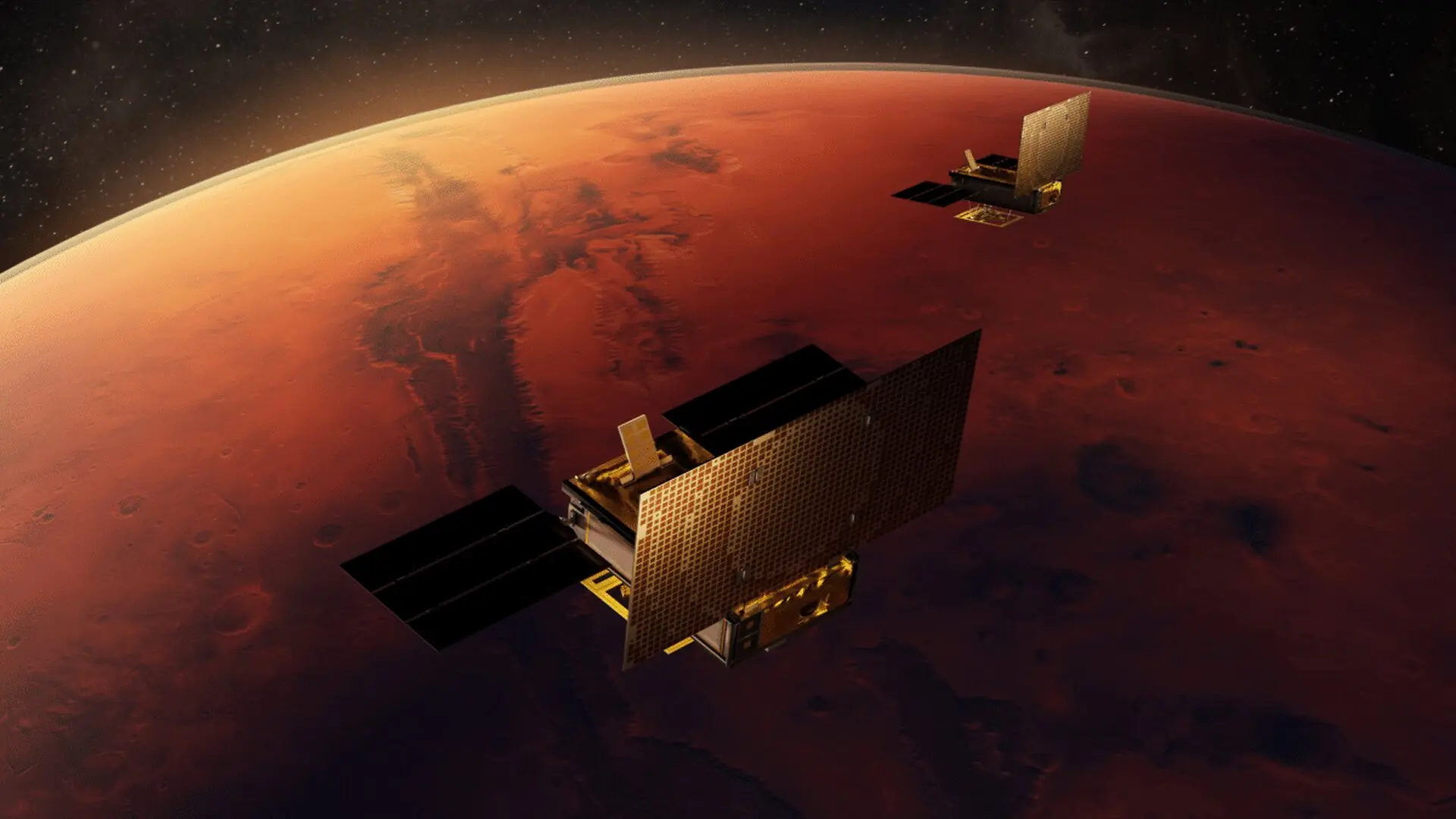
Engineers at the Massachusetts Institute of Technology have unveiled a propulsion concept that merges chemical thrust and electric efficiency into a single, compact system. Using one shared ionic‑liquid fuel, the design could let CubeSats—tiny, low‑cost satellites—venture far beyond Earth orbit, opening pathways to Mars, the asteroid belt, and other deep‑space destinations.
Uniting Power‑Intensive and Efficient Propulsion
Traditional spacecraft propulsion forces designers to choose between high‑thrust chemical rockets, which provide rapid maneuverability, and low‑thrust electric engines, prized for their fuel economy over long distances. MIT’s dual‑mode architecture sidesteps this compromise by feeding both a chemical thruster and an electrospray electric thruster from the same propellant tank.
MIT researchers say the approach yields a lightweight package that fits within the strict volume limits of small satellites while delivering a versatility normally reserved for larger spacecraft.
“If you can have chemical and electrical propulsion in one small package, it’s the best of both worlds,” says Amelia Bruno, a former postdoctoral researcher in MIT’s Department of Aeronautics and Astronautics (AeroAstro). “This opens the door for small satellites to do even more science, more observations, and more interesting missions, all on a smaller and cheaper platform.”
CubeSats are praised for their affordability, yet their diminutive size limits the amount of hardware they can carry. By eliminating the need for separate fuel systems, the new dual‑mode design frees up precious mass and volume for payloads, communications gear, or additional scientific instruments.
Electrospray Thrusters: Miniature Engines for the Outer Solar System
At the heart of the concept lies an electrospray thruster, an electric propulsion device that ionizes a liquid propellant and accelerates the charged particles to produce thrust. Although each thruster generates only a modest force, its fuel efficiency is exceptionally high, making it ideal for missions that require steady acceleration over months or years.
The technology, developed by MIT’s Space Propulsion Laboratory, packs the thrusters into modules roughly the size of a thumbnail, yet they can operate continuously for extended periods, gradually building velocity for deep‑space trajectories.
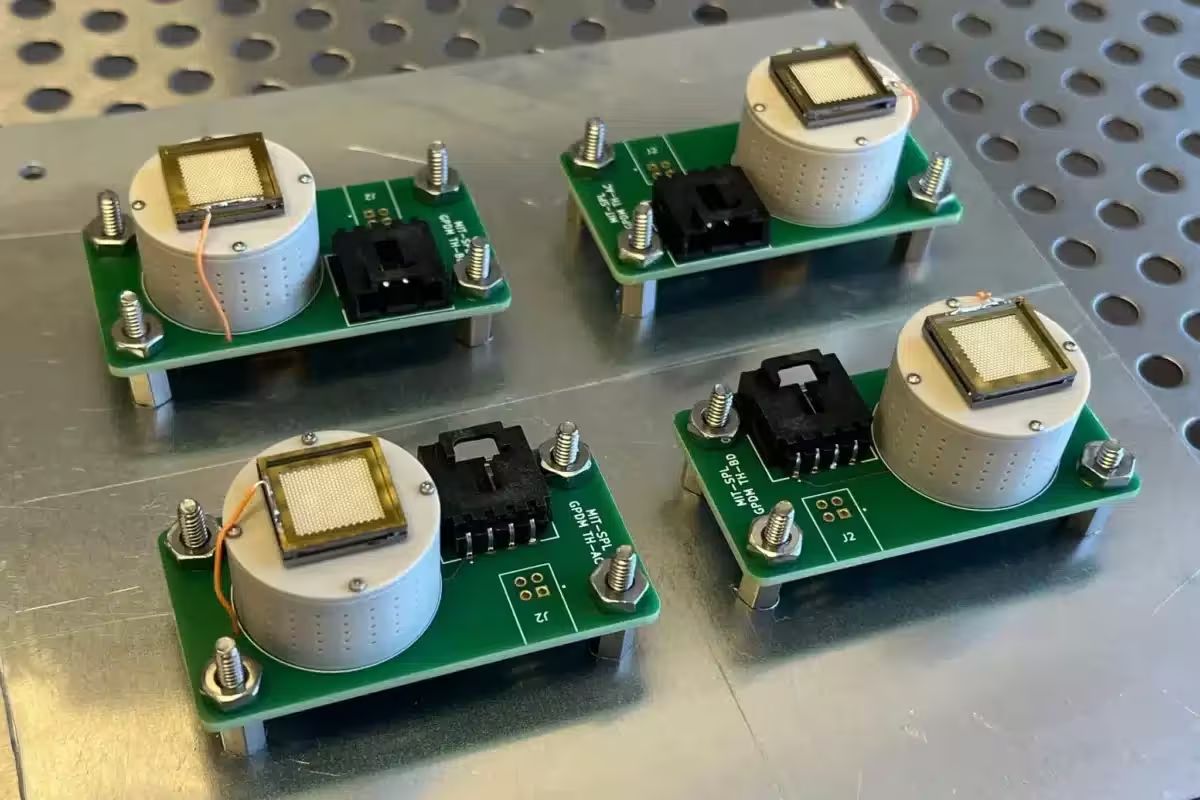
Credit: Amelia Bruno
“Ionic liquids are very stable and can even remain a liquid in space, which not a lot of materials can do,” Bruno says. “And it’s basically a sea of ions, which is why we base our technology around it, so we can pull those ions out into an electrospray.”
The stability of ionic liquids provides a reliable medium for electric thrust while supporting long operational lifetimes—an essential attribute for future interplanetary missions.
ASCENT: A Non‑Toxic Fuel for Dual‑Mode Operation
The propellant at the core of the MIT concept is ASCENT (Advanced SpaceCraft Energetic Non‑Toxic propellant). Initially created by the U.S. Air Force as a safer alternative to hydrazine, ASCENT is itself an ionic‑liquid mixture, making it compatible with both chemical combustion and electrospray acceleration.
“ASCENT happens to be an ionic liquid mixture,” Bruno says. “And we said, hey, that’s the stuff we typically use. Theoretically, this should work. Let’s go figure out how.”
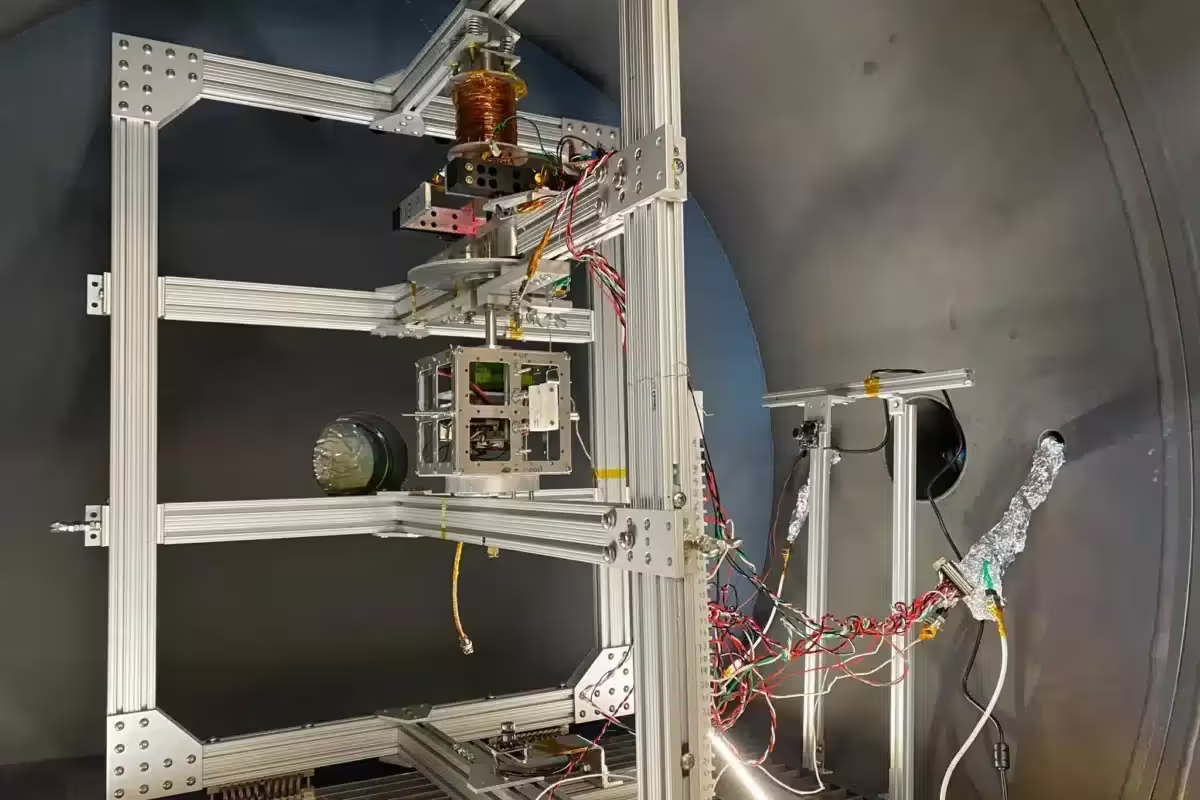
Credit: Matthew Corrado
Laboratory tests placed the ASCENT‑fed electrospray thrusters on a magnetic‑levitation platform inside a vacuum chamber that mimics space conditions. The setup produced enough thrust to spin a CubeSat‑sized mock‑up and sustained operation for up to 100 hours.
Performance matched that of conventional electrospray propellants while retaining suitability for chemical burns, confirming the feasibility of a single‑fuel dual‑mode architecture. The results were detailed in the Journal of Propulsion and Power.
A Pathway to Mars and the Asteroid Belt for Small Satellites
The dual‑mode system envisions a cruise phase powered by the low‑thrust electrospray engine, followed by rapid chemical burns for fine‑tuned maneuvers near scientific targets.
“We could send CubeSats to Mars, or the asteroid belt, where they could make the journey slowly, using electrospray thrusters,” says study co-author Paulo Lozano, the Miguel Alemán Velasco Professor of Aeronautics and Astronautics at MIT. “You could then use your chemical thrusters to quickly move to look at interesting features. You could have a lot more flexibility to do a lot more things.”
Because the approach relies on a single propellant tank, mission designers can allocate more mass to scientific payloads instead of fuel storage, reducing overall costs and enabling swarms of CubeSats to conduct coordinated observations across the solar system.
NASA’s Green Propulsion Dual‑Mode Flight Test
NASA plans to validate the concept with the upcoming Green Propulsion Dual Mode mission. The CubeSat will carry one chemical thruster and four electrospray thrusters, all drawing from a shared ASCENT tank.
“This will be the first time that a satellite will have a shared propellant tank,” says Lozano, highlighting the novelty of the integrated propulsion architecture.
Beyond deep‑space exploration, the technology could benefit Earth‑observation constellations by allowing rapid repositioning in response to weather events while maintaining efficient long‑term station keeping.
“Say there’s a storm coming, and you’d want to deploy your constellation of small satellites to observe over one location,” he says. “You could choose to send them quickly or slowly depending on the nature of the observation. And the only way to do that is if you have two propulsion systems, which is now possible.”
Looking Ahead: Scaling Up Small‑Satellite Propulsion
Follow‑up testing showed that ASCENT delivers thrust levels comparable to traditional electrospray fuels, giving researchers confidence that further refinements could boost performance even more.
“Compared to our normal electrospray propellants, ASCENT can provide similar performance in terms of thrust,” Bruno notes. “Now that we know our thrusters work with ASCENT, we can start thinking of all the ways we can make them even better.”
As launch costs continue to decline and satellite capabilities advance, propulsion remains a decisive factor for mission success. MIT’s dual‑mode system offers a compact, flexible solution that could transform CubeSats from low‑Earth‑orbit tools into versatile explorers of the broader solar system.
This article has been fact checked for accuracy, with information verified against reputable sources. Learn more about us and our editorial process.
Last reviewed on .
Article history
- Latest version
Reference(s)
- Bruno, Amelia R.., et al. “Performance Characterization of Electrospray Thrusters with Energetic Ionic Liquid Monopropellant.” Journal of Propulsion and Power, May 31, 2026, pp. 1-13. American Institute of Aeronautics and Astronautics (AIAA), doi: 10.2514/1.B40175. <https://arc.aiaa.org/doi/10.2514/1.B40175>.
Cite this page:
- Posted by Karan Das