Tiny Kuiper Belt Object 2002 XV93 May Harbor a Whisper‑Thin Atmosphere
Astronomers spot an unexpected phenomenon around a distant icy body beyond Neptune, sparking fresh questions about the outer solar system.
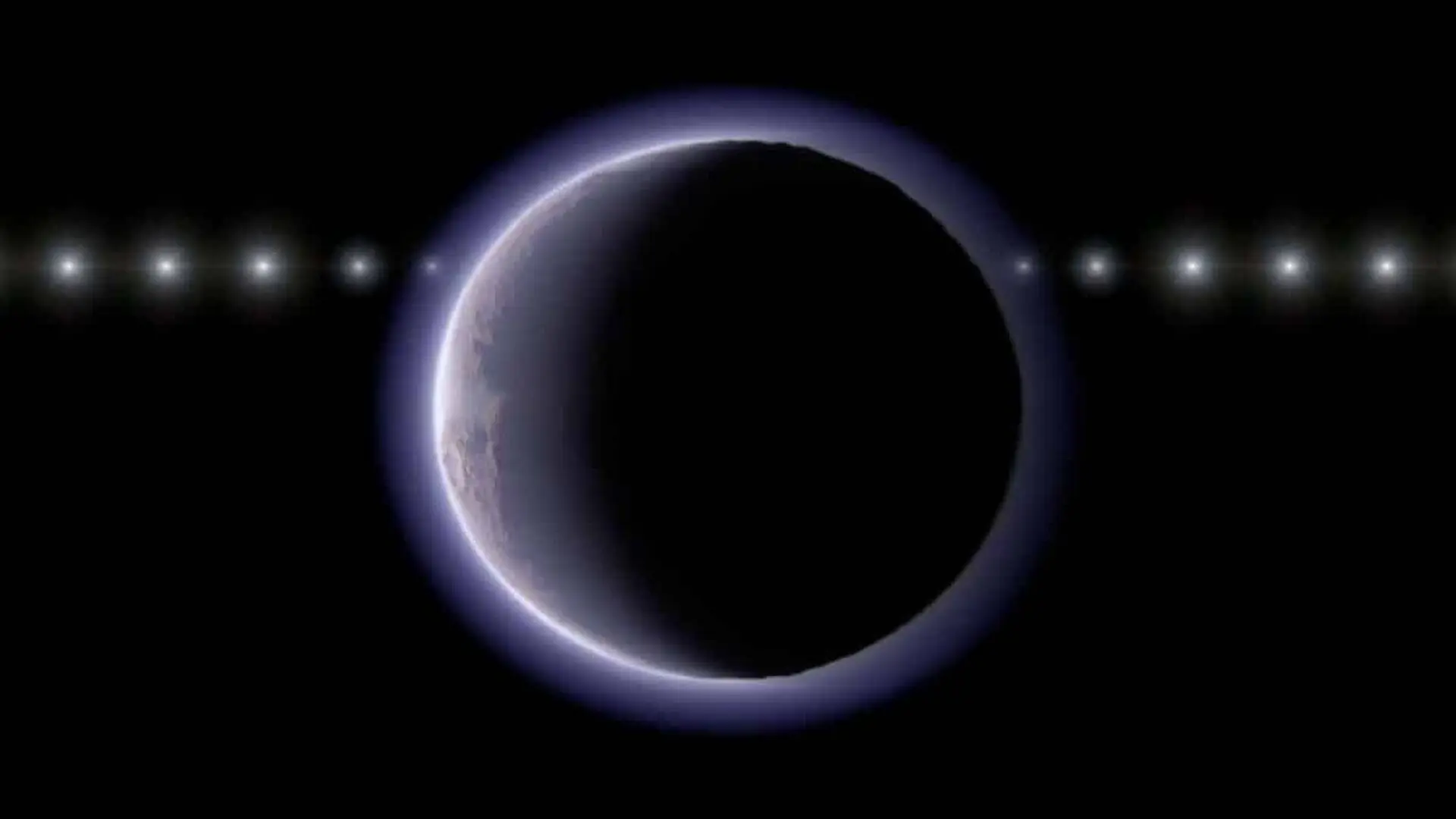
Astronomers have detected a subtle dimming of a background star as a remote icy body, catalogued as 2002 XV93, passed in front of it, suggesting the presence of a faint gaseous envelope around the object. The phenomenon, captured by a network of Japanese observatories, was reported in Nature Astronomy and raises the prospect that even a modestly sized Kuiper‑belt object could retain a tenuous atmosphere.
Pluto remains the only confirmed world beyond Neptune with a long‑lasting atmosphere, so any indication of atmospheric activity on a body only about 470 km across immediately attracts attention.
Gradual Light‑Curve Decline During a Stellar Occultation
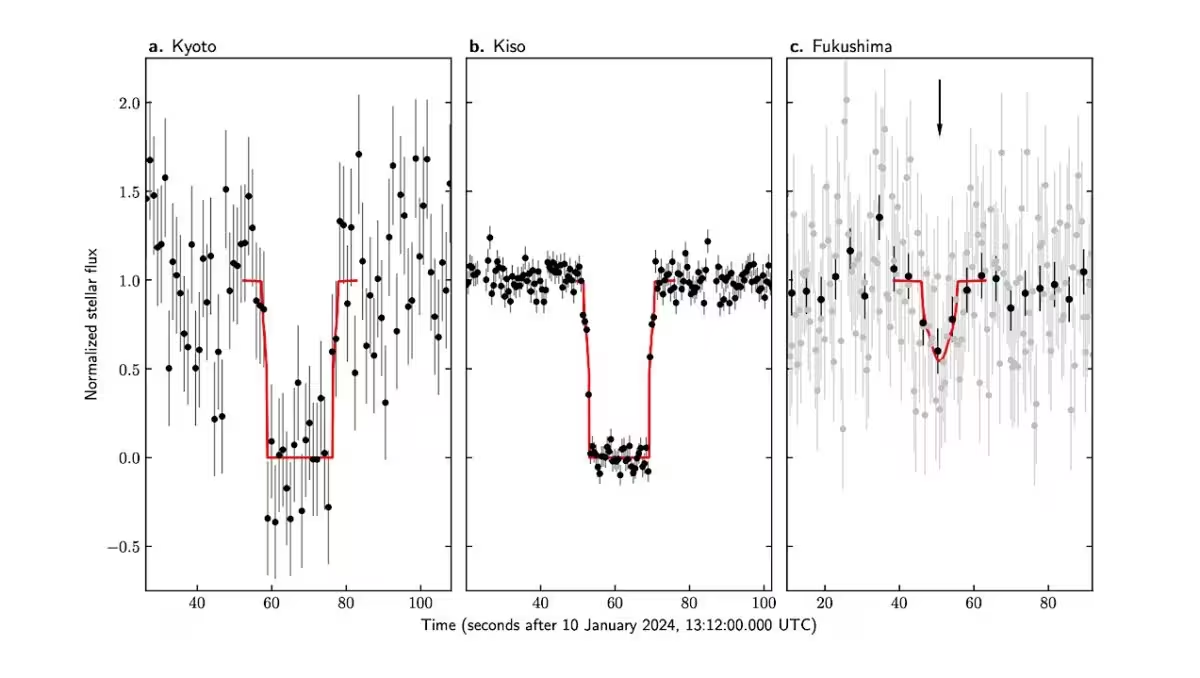
On 10 January 2024, 2002 XV93 occulted a distant star, an event recorded simultaneously from three sites in Japan—Fukushima, Kiso and Kyoto. Rather than an abrupt “on‑off” signal, the star’s brightness tapered off and rose again over roughly 1.5 seconds, a behavior more consistent with light being refracted through a thin surrounding medium.
In the absence of any envelope, an airless object would block the starlight almost instantaneously. The smooth transition observed hints at either a gaseous layer or a fine dust veil that altered the incoming photons.
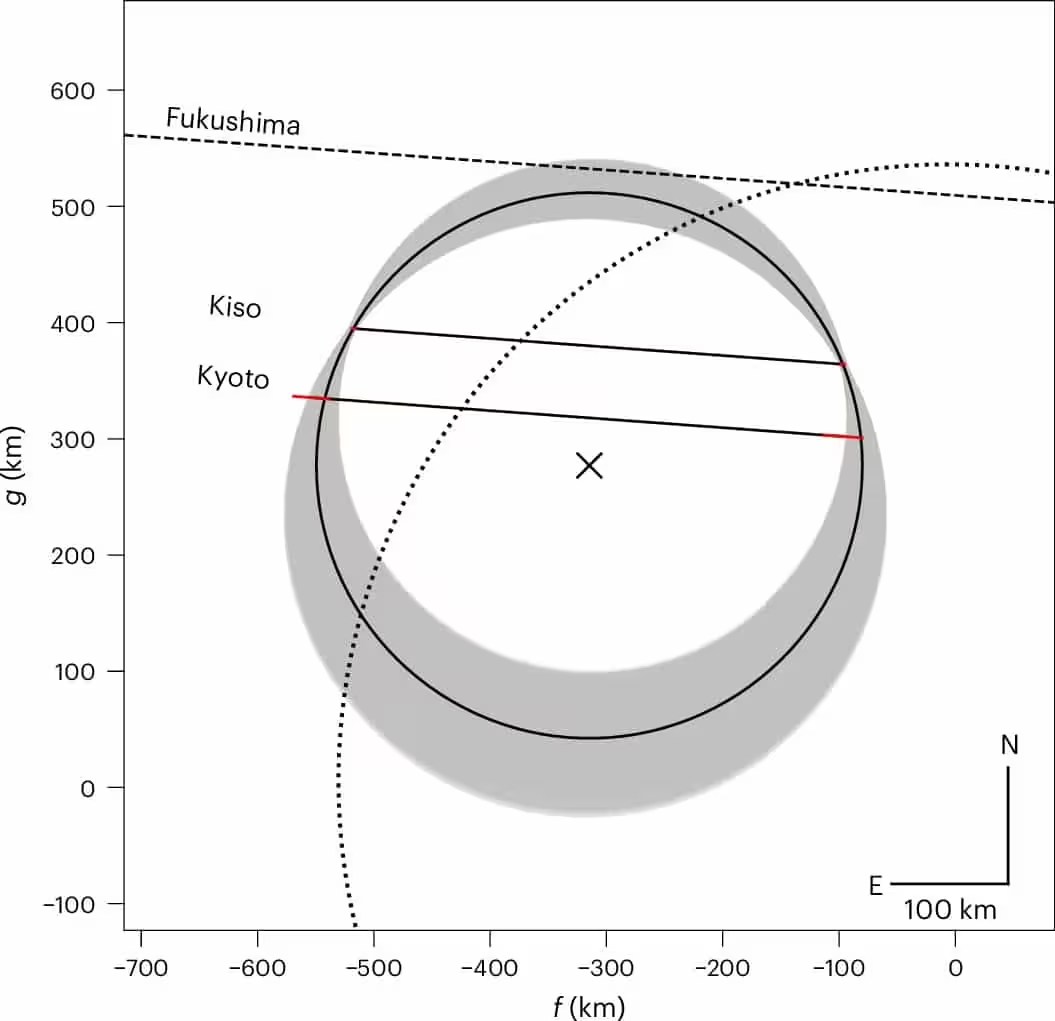
The research team, whose findings appear in Nature Astronomy, interprets the gradual dimming as evidence for an extremely thin atmospheric layer. The observation relied on a dedicated multi‑telescope configuration built to capture fleeting events that last only seconds.
Ko Arimatsu of the National Astronomical Observatory of Japan remarked that the result was “genuinely surprising,” given the object’s modest size—roughly 500 km in diameter compared with Pluto’s 2,377 km.
“2002 XV93, has a diameter of approximately 500 km. For reference, Pluto’s diameter is 2,377 km,” the authors noted.
Gravity on an object of this scale is generally thought to be insufficient to hold onto a permanent atmosphere, prompting questions about how such a layer could be maintained.
Estimating the Pressure of a Near‑Vacuum Envelope
If the interpretation holds, the surface pressure would be on the order of one ten‑millionth of Earth’s—essentially a whisper of gas. The conclusion rests on the observed smooth decline in the light curve rather than a sharp cutoff, a signature consistent with refraction through a low‑density medium.
Because the detection stems from a single occultation, the result remains provisional; repeated observations would be needed to confirm the feature and to characterize its composition or vertical extent.
The data do not yet reveal what the putative atmosphere is made of, nor how high it extends above the surface.
Possible Origins: Impact Debris, Cryovolcanism, or Dust?
Several mechanisms could generate a transient veil around the body. A recent collision with another icy fragment might have lofted material that briefly surrounds the object. Alternatively, internal processes such as cryovolcanic outgassing could release volatile compounds, forming a thin exosphere.
A more conservative explanation points to a fine dust cloud rather than gas; such particles could scatter starlight in a way that mimics an atmospheric signature.
“Observations by the NASA/ESA/CSA James Webb Space Telescope show no signs of frozen gases on the surface of 2002 XV93 that might sublimate to form an atmosphere,” the authors added.
The authors emphasize that the current dataset cannot definitively separate a gaseous envelope from a dusty veil, underscoring the need for follow‑up observations.
This article has been fact checked for accuracy, with information verified against reputable sources. Learn more about us and our editorial process.
Last reviewed on .
Article history
- Latest version
Reference(s)
- Arimatsu, Ko. “Detection of an atmosphere on a trans-Neptunian object beyond Pluto - Nature Astronomy.”, May 4, 2026, pp. 1-8. Nature, doi: 10.1038/s41550-026-02846-1. <https://www.nature.com/articles/s41550-026-02846-1>.
- “Ko ARIMATSU | Kyoto University|The Hakubi Project.” <https://www.hakubi.kyoto-u.ac.jp/en/mem/arimatsu/>.
Cite this page:
- Posted by Karan Das