Simulations Show Turbulence Seals Europa’s Ice Cracks Blocking Ocean Access
Simulations show water rising through Europa’s fractures cools, freezes and blocks its path, challenging shallow reservoirs as ocean access points.
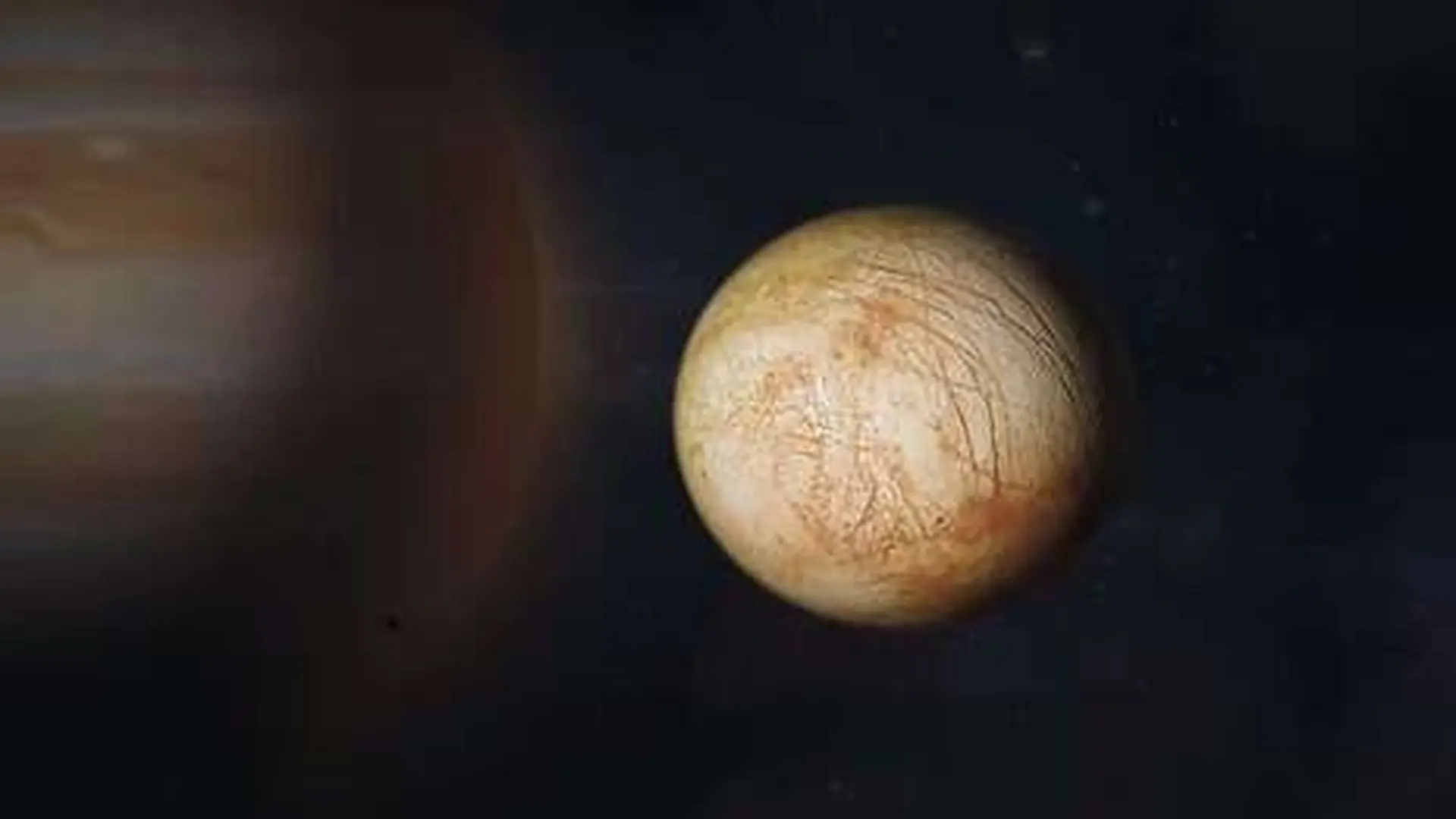
Europa remains a top candidate in the search for extraterrestrial habitability, with its subsurface ocean kept liquid by the constant flexing caused by Jupiter’s powerful gravity.
Previous models suggested that water could ascend through narrow fissures, forming pockets nearer the surface that would be more accessible to orbiting instruments. The latest research, however, indicates that such shallow reservoirs are more likely the result of localized melting events rather than direct oceanic upwelling.
Intense Turbulence Likely Blocks Upward Flow of Ocean Water
In a paper appearing in Nature Astronomy, a team examined the feasibility of liquid water moving upward through structures known as dikes. While these fractures have been likened to magma‑carrying cracks on Earth, the analogy breaks down under Europa’s frigid conditions, where any rising water would shed heat rapidly to the surrounding ice.
Using high‑resolution numerical models, the investigators simulated both laminar and turbulent flow regimes. Even when they omitted convective heat loss—thereby establishing an optimistic upper limit—the volume of water that could travel upward before freezing fell far short of what would be required to sustain the hypothesized shallow lakes and associated surface markings.
When turbulence was introduced, the situation grew more restrictive. Rapid motion forces water to swirl against the icy walls, accelerating heat transfer and causing premature solidification. “This water that’s going to come up, it’s going to be turbulent,” said lead author Ojha. “It will move left and right, up and down, creating a swirling motion.”
As the temperature drops, the fluid can become supercooled, allowing tiny frazil‑ice crystals to nucleate. The study linked to the Nature Astronomy article explains that these crystals can accumulate inside the fracture, throttling flow and eventually sealing the channel. Narrow cracks may freeze within hours, while even broader fissures struggle to transport enough water under turbulent conditions.
To match observed surface features, the models would require fractures that are unrealistically long, overly abundant, or both. Consequently, the authors conclude that direct exchange between the deep ocean and the near‑surface environment is likely limited.
Upcoming Probes Must Pinpoint Origins of Near‑Surface Liquid
These insights reshape expectations for forthcoming exploration missions. NASA’s Europa Clipper, launched on 14 October 2024, will begin its Jupiter‑bound cruise in April 2030 after traveling roughly 1.8 billion miles (2.9 billion km). The spacecraft is slated to execute 49 close flybys, scrutinizing the moon’s ice shell, surface chemistry, geology, and interior structure.
The European Space Agency’s JUICE mission, which lifted off in April 2023, targets arrival at Jupiter in July 2031. Before entering orbit around Ganymede, JUICE will conduct investigations of Europa, Callisto, and Ganymede, gathering complementary data on the icy moons.
Deployment of @NASA’s Europa Clipper spacecraft confirmed pic.twitter.com/pjfU2v7BEg
— SpaceX (@SpaceX) October 14, 2024
A key instrument aboard Europa Clipper, the ice‑penetrating radar, aims to locate any shallow liquid bodies, measuring their depth, geometry, and potential links to deeper layers. While detecting a radar signature consistent with liquid water would be noteworthy, the signal alone cannot confirm a connection to the global ocean.
Researchers at Rutgers University suggest that near‑surface reservoirs could arise from localized heating due to tidal flexure, friction, or other internal processes within the ice shell. This distinction matters for chemical analyses: water sourced from the ocean might carry dissolved salts, minerals, or organic molecules that reflect the moon’s interior, whereas meltwater generated in situ would primarily echo local conditions.
“Our work suggests that Europa’s ice shell may be a stronger barrier between the ocean and the surface than previously assumed,” Ojha noted, emphasizing the need for upcoming missions to differentiate between ocean‑derived and locally formed liquids.
This article has been fact checked for accuracy, with information verified against reputable sources. Learn more about us and our editorial process.
Last reviewed on .
Article history
- Latest version
Reference(s)
- “https://twitter.com/SpaceX/status/1845874986193723732/video/1.” <https://t.co/pjfU2v7BEg>.
Cite this page:
- Posted by Bilal Abbasi