Milky Way Black Hole May Be Tapping Into Its Own Rotation to Fire High-Energy Particles
A new study suggests our galaxy’s black hole, Sagittarius A*, may accelerate particles to extreme PeV energies by tapping into its own rotational power.
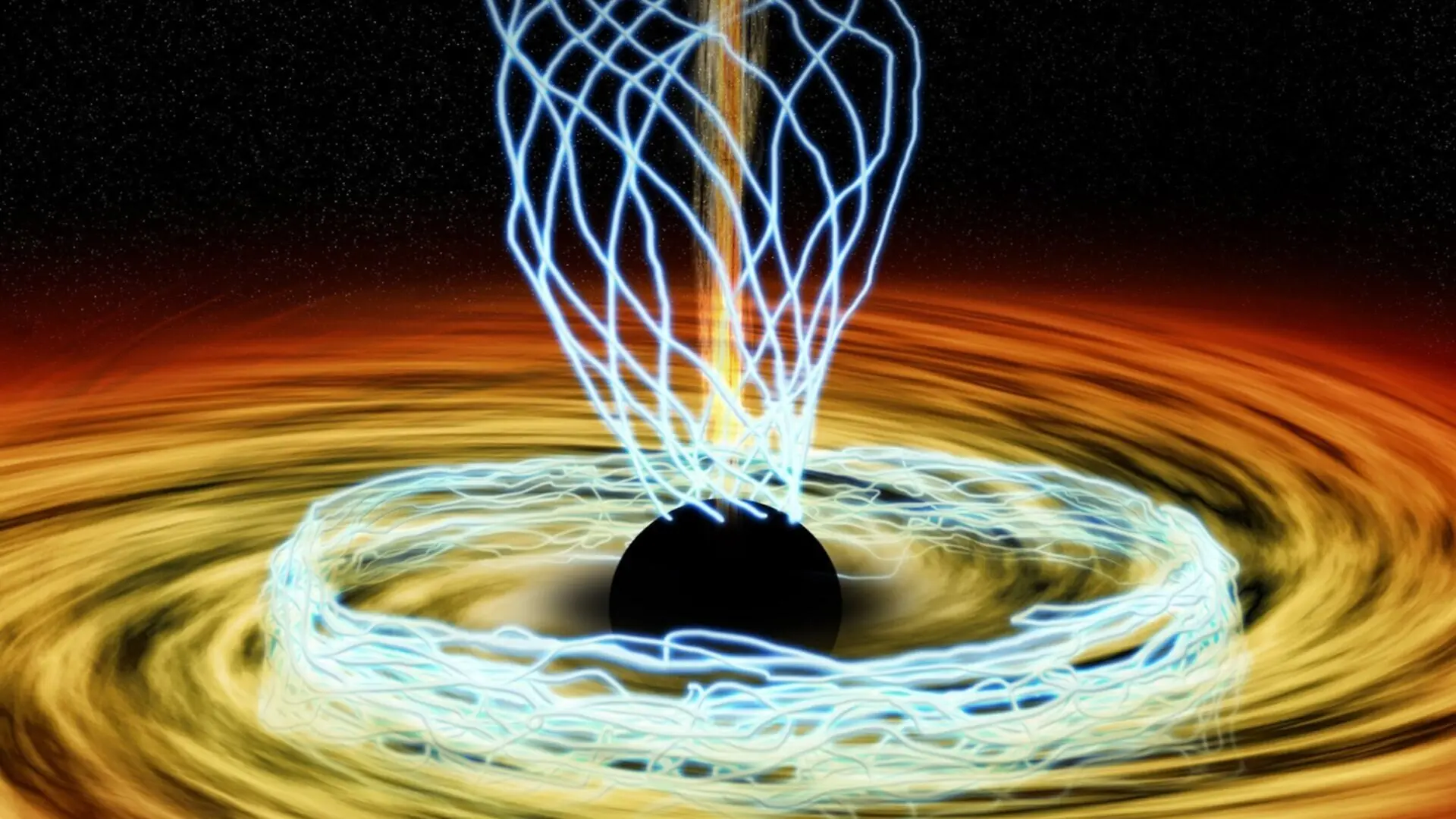
New theoretical research suggests that the supermassive black hole at the center of our galaxy, Sagittarius A*, may be functioning as a natural particle accelerator by harvesting its own rotational energy. A study recently shared via an arXiv preprint details how this process could propel particles to extreme energies, potentially leaving behind a signature detectable by modern telescopes.
Extracting Power from Spacetime
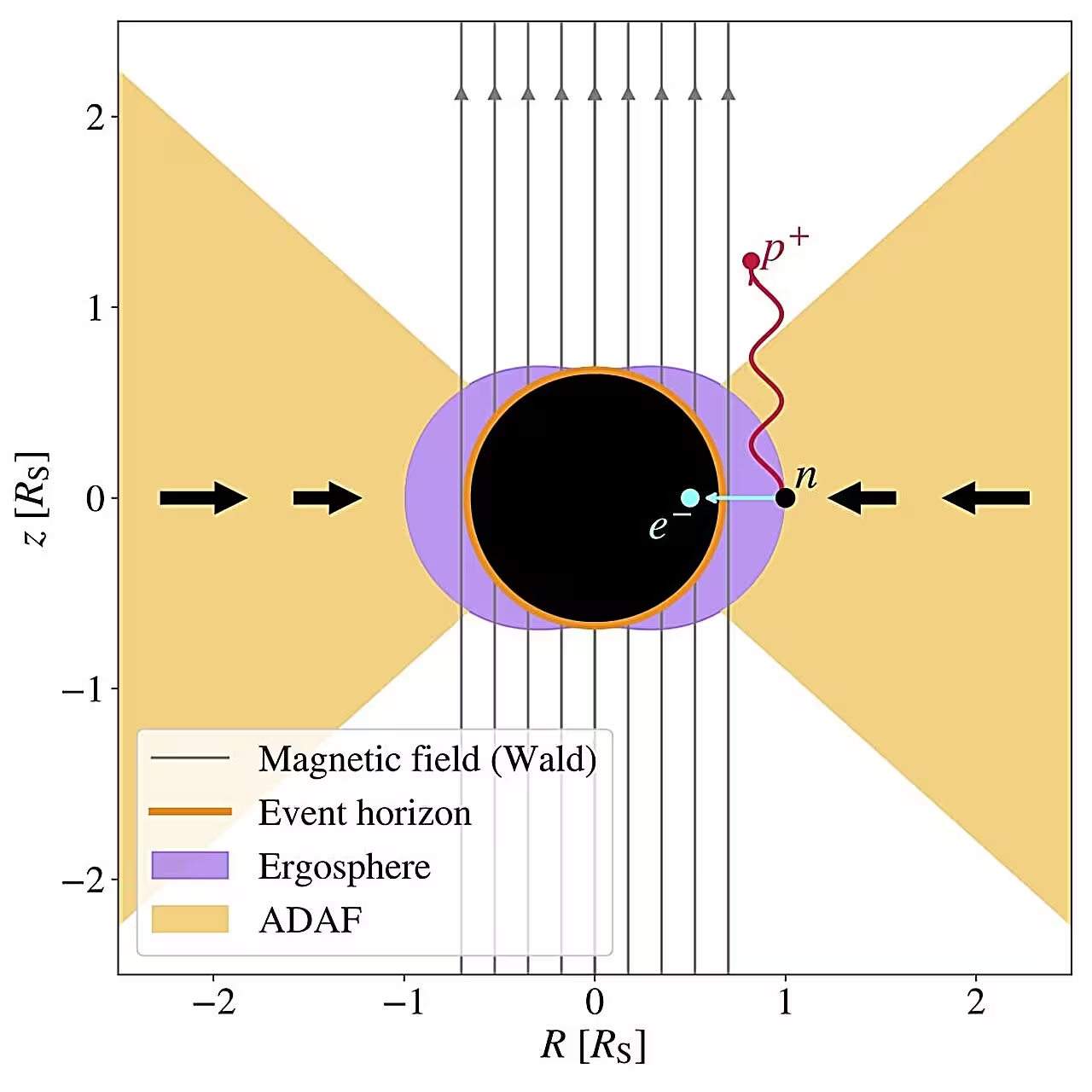
The concept hinges on the Penrose process, a mechanism proposed by physicist Roger Penrose in 1969. It suggests that a rotating black hole possesses an ergosphere—a region just outside the event horizon where the intense gravity of the black hole forces spacetime itself to rotate. Within this zone, objects are dragged along by the black hole’s spin, creating conditions where energy can theoretically be siphoned away.
If a particle enters this region and splits, one fragment can fall into the black hole with negative energy, relative to an outside observer, while the other gains enough momentum to escape. This exchange essentially acts as a theft of the black hole’s rotational energy, transferring it to the outward-bound particle.
The Role of Neutrons in Cosmic Acceleration
While the original Penrose process focused on mechanical splitting, this new model, as noted by Universe Today, centers on the natural decay of neutrons. Near the event horizon, a lone neutron can decay into a proton, an electron, and an antineutrino. Because protons and electrons carry an electric charge, they are susceptible to the magnetic fields that permeate the Galactic Center. This configuration, known as the magnetic Penrose process, significantly boosts the efficiency of the energy transfer.
Researchers calculate that this interaction could accelerate protons to petaelectronvolt (PeV) energies—roughly one quadrillion electronvolts. This is a thousand times more energetic than the protons accelerated within the Large Hadron Collider, effectively turning Sagittarius A* into a massive, natural PeVatron.
Searching for Evidence in the Skies
Confirming this theory requires identifying specific radiation patterns. As these supercharged protons travel away from the black hole, they inevitably strike gas and dust, triggering a cascade of secondary particles that emit high-energy gamma rays. By mapping the spectrum of these rays, astronomers hope to distinguish the unique fingerprint of the Penrose process from other, more conventional sources of radiation near the galaxy’s core.
Furthermore, the decay of neutrons also releases neutrinos. Because these particles are notoriously difficult to stop, they could provide a clear, “clean” signal that travels directly from the heart of the ergosphere to detectors on Earth. Using multimessenger astronomy—the practice of combining gamma-ray and neutrino data—scientists believe they could isolate the precise signatures required to confirm the theory.
Future Observational Hurdles
While the math is compelling, current technology faces significant limitations. The signatures expected from this process are faint, requiring higher precision than existing arrays can provide. Success will likely depend on the next generation of instruments, such as advanced iterations of the High-Altitude Water Cherenkov Observatory (HAWC) and upgrades to the IceCube Neutrino Observatory in Antarctica.
If these future detectors can align their findings, it would represent a landmark achievement in high-energy astrophysics, providing the first physical evidence of a process that has lived primarily in the equations of general relativity for over half a century.
This article has been fact checked for accuracy, with information verified against reputable sources. Learn more about us and our editorial process.
Last reviewed on .
Article history
- Latest version
Reference(s)
- Cermeño, Marina. “Sgr A* as a Galactic PeVatron: Multimessenger Signatures of the Magnetic Penrose Process.” arXiv.org <https://arxiv.org/abs/2609.04051>.
- Koberlein, Brian. “Neutrons, Rotating Black Holes, and a Galactic PeVatron at the Center of the Milky Way.”, October 5, 2026 Universe Today <https://www.universetoday.com/articles/neutrons-rotating-black-holes-and-a-galactic-pevatron-at-the-center-of-the-milky-way>.
Cite this page:
- Posted by Aisha Ahmed