From Schrödinger’s Cat to LIGO: How Quantum Physics Became Our Most Powerful Tool
From Schrödinger’s cat to LIGO, discover how a century of quantum physics transformed abstract, strange theories into the technologies powering our world.
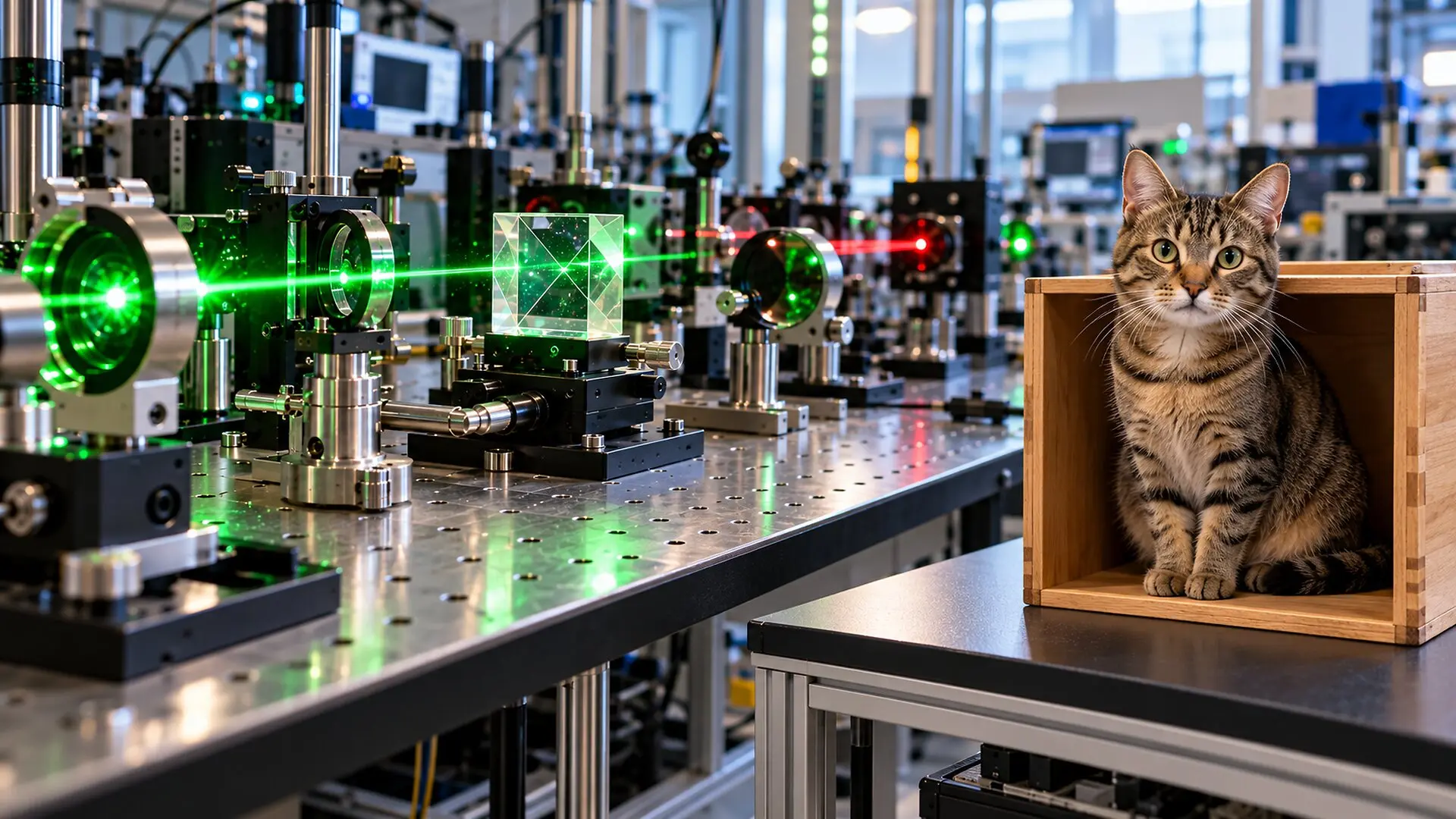
A century of quantum mechanics has transformed the field from a collection of abstract, counterintuitive theories into the bedrock of modern technology. From the early intellectual sparring over the behavior of subatomic particles to the high-precision detection of cosmic ripples, the transition of quantum theory into practical engineering represents one of the most significant shifts in the history of science.
In a comprehensive perspective recently published in Science, physicists Marlan Scully and William Unruh map this evolution. By charting the journey from Erwin Schrödinger’s famous thought experiment to the sophisticated laser systems utilized by the Laser Interferometer Gravitational-Wave Observatory (LIGO), the authors provide a clear-eyed assessment of what quantum mechanics has achieved—and where the boundaries of our current understanding remain.

The Evolution of Quantum Theory
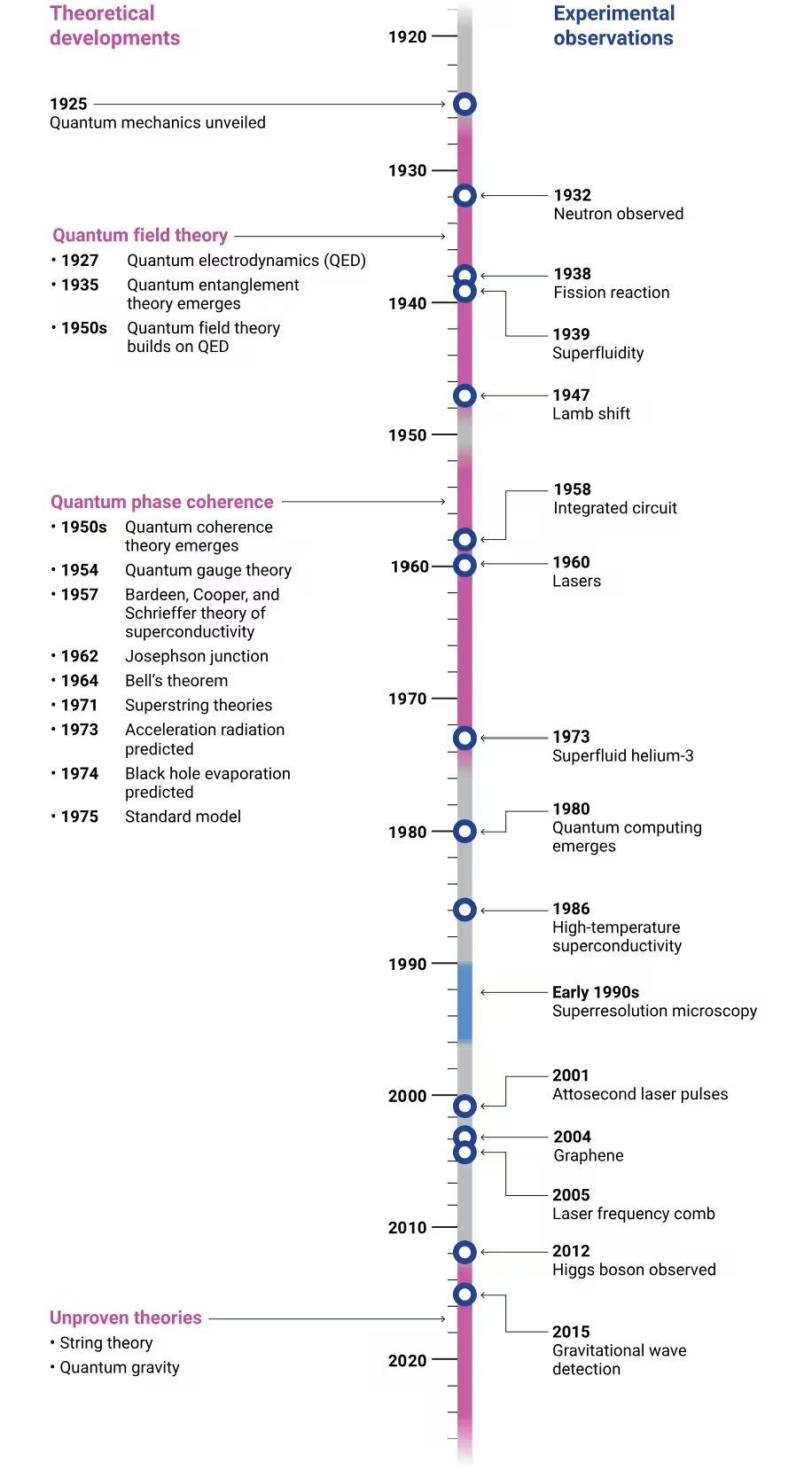
The 1920s served as the crucible for quantum mechanics, defined by the competing but mathematically equivalent approaches of Werner Heisenberg and Erwin Schrödinger. While Heisenberg’s matrix mechanics focused on physical operators, Schrödinger’s wave mechanics provided a framework that resonated more broadly across the physical sciences. Over time, these theories merged into a robust description of nature, eventually finding unity with special relativity through quantum field theory—a milestone underscored by the experimental verification of the Lamb shift in 1947.
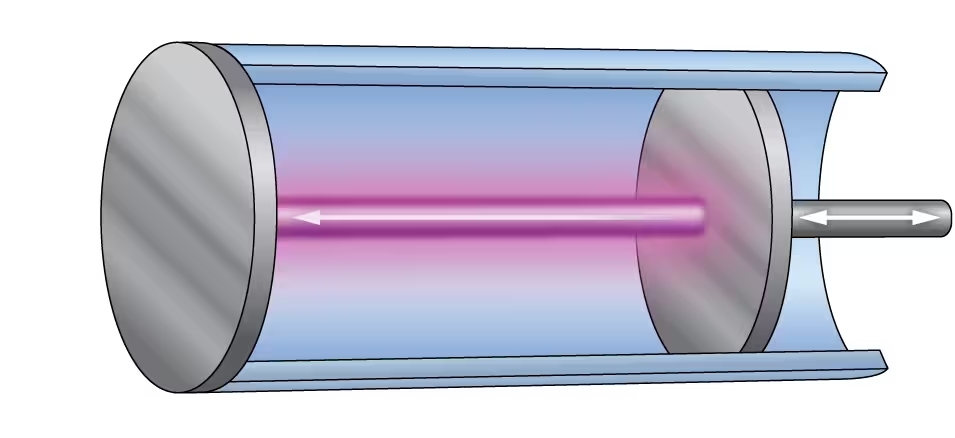
Central to this progress is the concept of quantum coherence, which involves maintaining a stable phase relationship between quantum states. Unlike entanglement, which describes complex correlations, coherence allows scientists to manipulate waves to reinforce or cancel one another. This principle underpins the development of the laser, a technology that once faced significant skepticism but has since become essential to fields ranging from precision medicine to fundamental physics.
Bridging Measurement and Innovation
Today, the practical application of quantum optics is perhaps best exemplified by LIGO. To detect the faint gravitational waves passing through Earth, researchers utilize “squeezed light,” a technique that redistributes quantum uncertainty to reduce noise within the detector. While this does not resolve uncertainty entirely, it provides the sensitivity required to observe the distant, violent collisions of massive objects in space.
Other areas of research remain in a state of maturation. Quantum computing, for instance, offers the promise of exponential speedups for specific algorithms, yet realizing this potential hinges on overcoming the fragility of quantum information and managing error rates. Similarly, while “quantum biology” and “quantum thermodynamics” are active areas of inquiry, they are largely in the research phase. For example, quantum heat engines—systems that convert energy within a controlled cavity—demonstrate that coherence can change the efficiency limits of traditional thermal engines, though these are not yet practical solutions for energy generation.
The Road Ahead
Despite a century of progress, fundamental questions persist. The most significant of these is the integration of quantum mechanics with gravity. While theoretical frameworks like string theory attempt to bridge this gap, a unified, experimentally validated theory remains elusive. The scientific community continues to explore the intersections of quantum physics and the macroscopic world, treating these mysteries not as barriers, but as the next frontier for discovery.
Ultimately, the history of quantum mechanics is a testament to the power of fundamental research. By mastering the behavior of light and matter at the smallest scales, humanity has unlocked a century of innovation, leaving the door wide open for whatever technological leaps may follow.

This article has been fact checked for accuracy, with information verified against reputable sources. Learn more about us and our editorial process.
Last reviewed on .
Article history
- Latest version
Reference(s)
- Scully, Marlan O.., et al. “One hundred years of quantum mechanics.” Science, vol. 390, no. 6777, December 4, 2025, pp. 998-1000. American Association for the Advancement of Science (AAAS), doi: 10.1126/science.ady6092. <https://www.science.org/doi/10.1126/science.ady6092>.
Cite this page:
- Posted by Aisha Ahmed