Disease Models Reveal Why High Infection Burden Does Not Mean High Outbreak Risk
A new mathematical framework applied to three Chinese cities shows that the age groups most vulnerable to an epidemic are not always the ones most likely to start it.

When an infectious disease tears through a population, the age groups suffering the highest long-term infection toll are not necessarily the ones most likely to spark the initial outbreak. Researchers modeling transmission dynamics across three major Chinese cities found a surprising disconnect between an age bracket’s ultimate epidemic burden and its power to trigger widespread contagion. The study is available on the arXiv preprint server and outlines a dual-framework mathematical model to evaluate early-stage risks alongside long-term outcomes.
How Demographic Contact Data Reshapes Disease Modeling
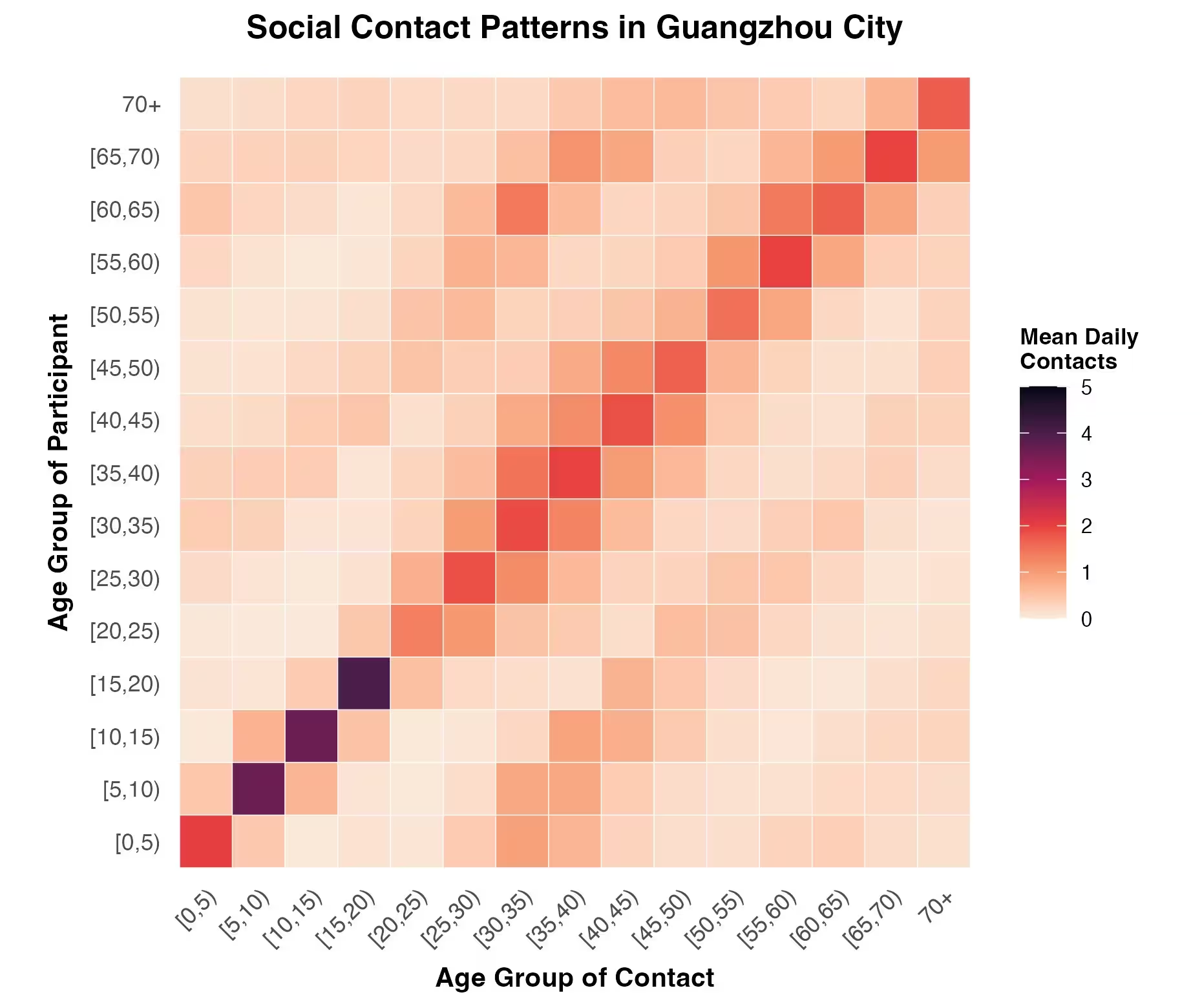
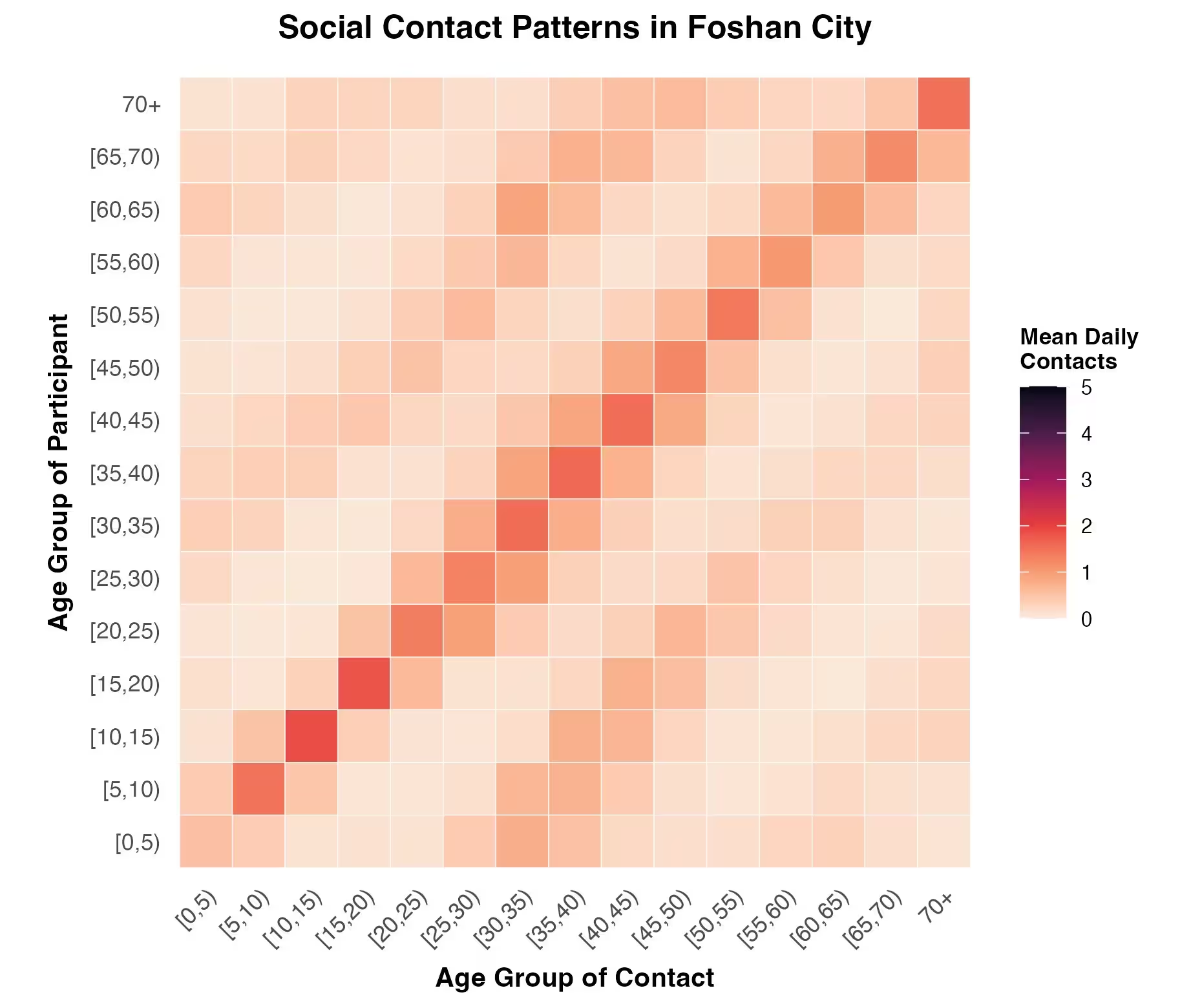
Led by Sicong Zhang, Mingyuan Wu, Jian Yang, Jianpeng Xiao, and Fan Bai, the research team sought to resolve a long-standing question in epidemiology. Standard compartmental models often assume uniform mixing, meaning every person in a population interacts with everyone else at the same rate. However, real-world social contact patterns are highly structured by age, driven by schools, workplaces, and families. To capture these nuances, the authors incorporated empirical age-stratified contact matrices derived from social contact surveys conducted in Guangzhou, Foshan, and Zhuhai, three key urban centers within China’s Guangdong-Hong Kong-Macao Greater Bay Area (GBA).
The total population sizes analyzed across these urban districts reached approximately 18.68 million in Guangzhou, 9.5 million in Foshan, and 2.54 million in Zhuhai. By combining a deterministic susceptible-exposed-infected-recovered or SEIR model with a stochastic Continuous-time Markov chain or CTMC model, the authors mapped out both the final attack rates and the early-stage outbreak-trigger probabilities across 15 stratified age cohorts ranging from zero to over seventy years old.
Why COVID-19 and Hand, Foot, and Mouth Disease Tell Different Stories
To test their mathematical frameworks, the researchers simulated two distinct disease scenarios representing COVID-19 and hand, foot, and mouth disease or HFMD. For the COVID-19 simulations, assuming a basic reproduction number of 2.5, the final attack rates rose monotonically from young children up to the 60 to 65 age group before dipping slightly in the oldest cohort. The population-weighted attack rates reached 82.8 percent in Guangzhou, 84.1 percent in Foshan, and 83.2 percent in Zhuhai, all falling below the 89.3 percent rate predicted by a traditional homogeneous mixing model. This indicates that ignoring contact heterogeneity leads to a systematic overestimation of overall public health burden.
In contrast, the HFMD simulations revealed striking divergences between long-term burden and outbreak risk, particularly among the youngest citizens. For HFMD, children under five years old suffered the highest final attack rates across all three cities, hitting 85.3 percent in Guangzhou, 90.0 percent in Foshan, and 87.5 percent in Zhuhai. This high vulnerability is driven by elevated susceptibility and dense physical interactions in daycare environments. Yet, when evaluating the probability of an initial infection triggering a major outbreak, the under-five cohort did not consistently rank first across every city. While they ranked first in Guangzhou due to intense within-group assortative mixing, they ranked ninth in Foshan and sixth in Zhuhai.
What These Findings Mean for Public Health Surveillance
The authors note that these discrepancies stem from the complex interplay between age-specific contact structures, relative susceptibility, and varying lengths of infectious periods. For respiratory pathogens like COVID-19, the rankings of final attack rates and outbreak-trigger probabilities showed high alignment, showing that burden-targeted and trigger-targeted surveillance strategies can coincide. For childhood infections like HFMD, however, identifying who bears the brunt of an epidemic requires a completely different lens than identifying who is most likely to light the fuse.
The team acknowledges several limitations in their current models, including the exclusion of explicit distinctions between symptomatic and asymptomatic infections, as well as the reliance on social contact data collected roughly a decade prior to the study. Shifts in post-pandemic mixing behavior mean future public health interventions will benefit from updated contact surveys. Nevertheless, the findings highlight the value of deploying complementary epidemiological indicators when designing age-specific surveillance and preparedness strategies.
The study was posted to the arXiv preprint server on November 15, 2026.
This article has been fact checked for accuracy, with information verified against reputable sources. Learn more about us and our editorial process.
Last reviewed on .
Article history
- Latest version
Reference(s)
- Zhang, Sicong. “Indication of demographic and epidemiological data on early-stage risks and long-term epidemic burden.” arXiv.org <http://arxiv.org/abs/2611.19854v1>.
Cite this page:
- Posted by Linda Wilson