Amateur Fossil Hunters Unearth 400 470‑Million‑Year‑Old Creatures Near Ancient South Pole
Southern France rocks reveal rare fossils that preserve normally lost soft tissues, offering scientists a detailed glimpse into ancient life.
Scientists have catalogued close to four hundred fossils that date back roughly 470 million years, many of which retain exceptionally fine soft‑tissue details. The assemblage, dubbed the Cabrières Biota, offers a snapshot of a thriving marine community that once existed at high southern latitudes.
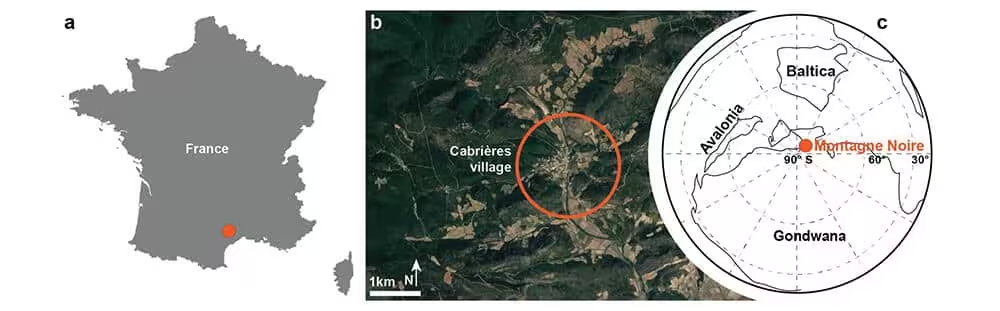
The specimens were recovered from the Montagne Noire range in France’s Hérault department by longtime fossil enthusiasts Eric Monceret and Sylvie Monceret‑Goujon. While typical finds consisted of shells and other hard parts, their fieldwork also revealed specimens that preserve remnants of digestive tracts and external cuticles.
A collaborative team that includes researchers from the University of Lausanne, the French National Centre for Scientific Research and several international partners examined the material. Their results, appearing in Nature Ecology & Evolution, rank the Cabrières site among the most species‑rich Lower Ordovician deposits known.
Uncommon Soft‑Tissue Preservation Sheds Light on Early Marine Fauna
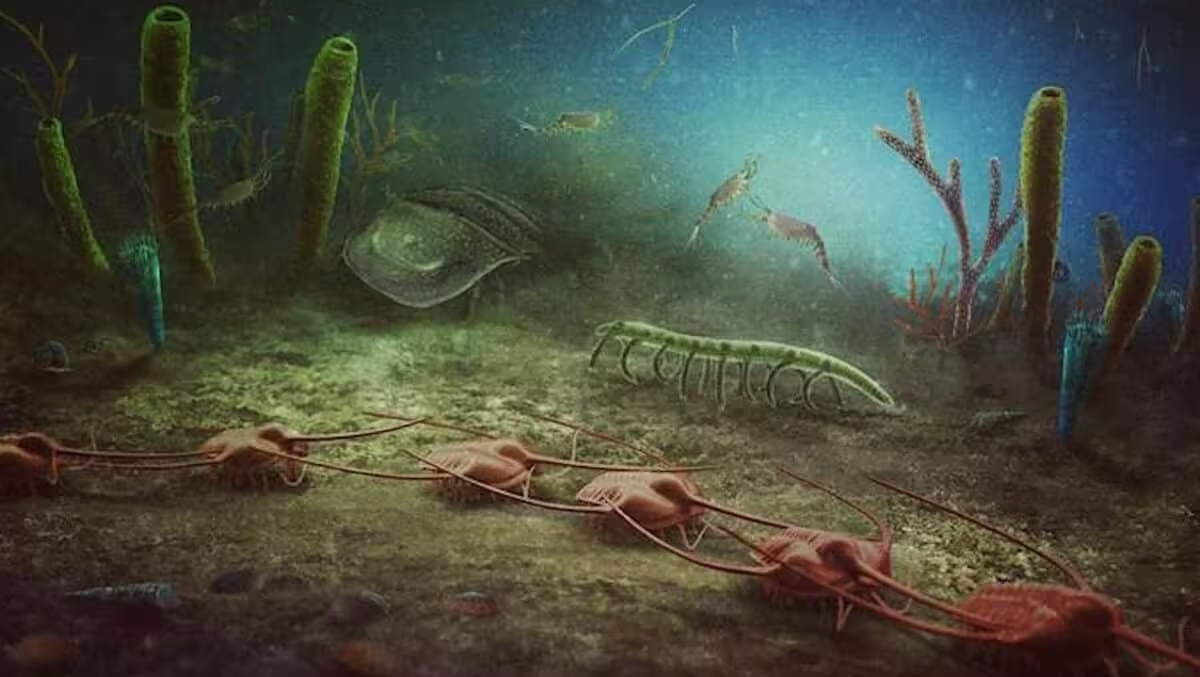
Hard shells dominate most fossil records, but the retention of soft parts at Cabrières is unusually rare. The deposit contains representatives of arthropods—relatives of modern shrimps and millipedes—alongside cnidarians such as early jellyfish and coral‑like forms. Abundant algae and sponge remains further enrich the ecological picture.
The latest study documents a broad spectrum of taxa, including arthropods, cnidarians, brachiopods, gastropods, algae and sponges. Notable examples are a trilobite assigned to the genus Ampyx, gastropods associated with tube‑like structures likely belonging to Sphenothallus, and a hyolith that appears to retain internal organ impressions. Articulated brachiopods were also observed attached to a possible leptomitid sponge.
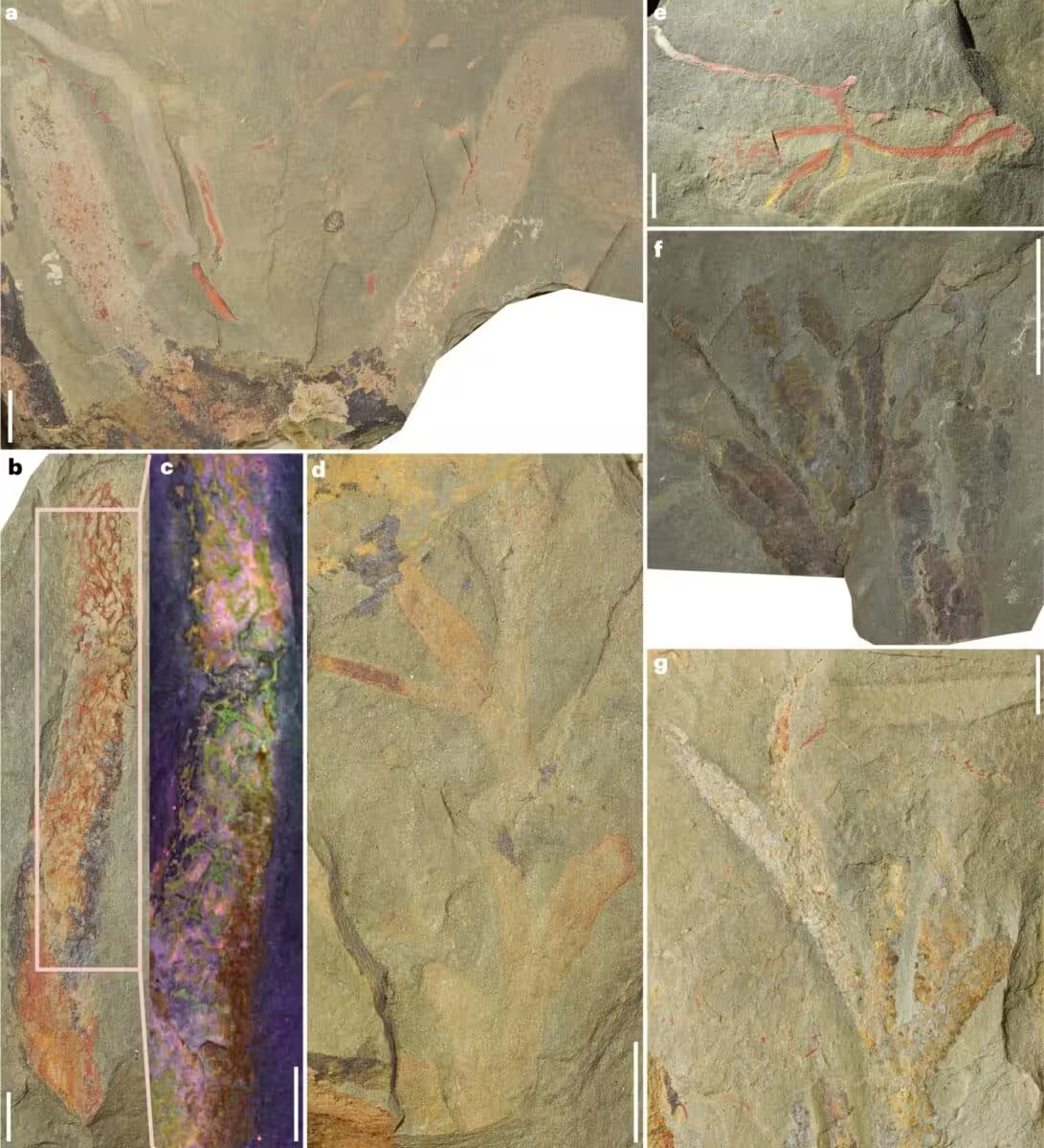
The assemblage shows affinities with the famed Fezouata Formation, another Ordovician lagerstätte known for its diverse fauna.
“Alongside archaic arthropods such as trilobites, brachiopods, cnidarians and gastropod mollusks, all of which are also found in the Fezouata geological formation, the Cabrières Biota stands out for its abundance of large sponges and branching algae,” said Christophe Dupichaud, a doctoral researcher at LGL‑TPE who took part in the site’s latest field study in October 2023, in a statement.
Ordovician Life Thrived Near the Ancient South Pole
When these organisms lived, the terrain that is now southern France occupied a position close to the South Pole. Consequently, the Cabrières assemblage offers a rare glimpse of one of the southernmost marine ecosystems documented from the Ordovician.
Researchers propose that the cool, high‑latitude waters acted as a sanctuary for species seeking to avoid the intense warming that affected equatorial regions.
“At this time of intense global warming, animals were indeed living in high latitude refugia, escaping extreme equatorial temperatures,” explained Farid Saleh, a researcher at the University of Lausanne and first author of the study.
Co‑author Jonathan Antcliffe reflected on the broader implications, noting that “the distant past gives us a glimpse of our possible near future.”
Long‑time Hobbyists Unearth a Fossil Treasure
Eric Monceret and Sylvie Monceret‑Goujon have been searching for fossils since their early twenties, turning their hobby into decades‑long field experience.
“We’ve been prospecting and searching for fossils since the age of twenty,” Monceret said. Finding Cabrières was clearly not just another day in the field. “When we came across this amazing biota, we understood the importance of the discovery and went from amazement to excitement,” Monceret‑Goujon recalled.
Planned large‑scale excavations and detailed anatomical analyses aim to reveal additional details about the organisms’ internal structures, ecological relationships and life habits.
This article has been fact checked for accuracy, with information verified against reputable sources. Learn more about us and our editorial process.
Last reviewed on .
Article history
- Latest version
Reference(s)
- Saleh, Farid. “The Cabrières Biota (France) provides insights into Ordovician polar ecosystems - Nature Ecology & Evolution.”, vol. 8, no. 4, pp. 651-662. Nature, doi: 10.1038/s41559-024-02331-w. <https://www.nature.com/articles/s41559-024-02331-w>.
- <https://www.researchgate.net/profile/Christophe-Dupichaud>.
- “En Occitanie, un zoo fossile d'un demi-milliard d'années.”, July 17, 2026 CNRS Le journal <https://lejournal.cnrs.fr/articles/en-occitanie-un-zoo-fossile-dun-demi-milliard-dannees>.
- <https://www.researchgate.net/profile/Farid-Saleh-2>.
Cite this page:
- Posted by Linda Wilson