Math Breakthrough Reveals How Cooperation Survives in Complex Networks
A comprehensive review of evolutionary graph theory highlights how modern analytical tools are finally explaining decades of simulation data.
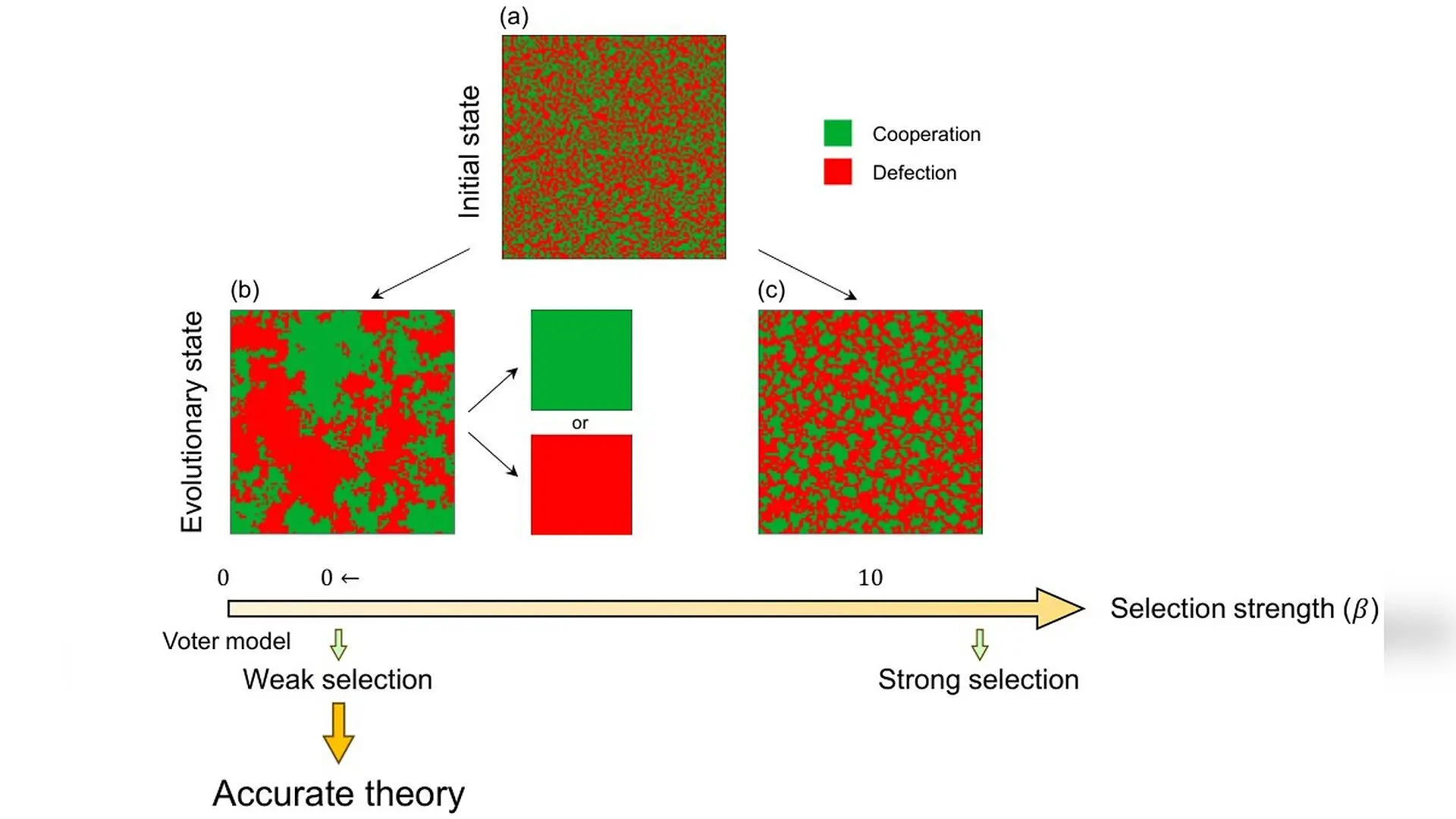
When individuals interact only with their immediate neighbors, self-interested agents can somehow abandon selfish behavior and foster large-scale cooperation. Over the past three decades, researchers have mapped out how this spatial reciprocity works using massive computer simulations, yet explaining the underlying rules through rigorous mathematics has remained an elusive puzzle.
Now, a comprehensive review of recent theoretical breakthroughs published in arXiv outlines how modern analytical frameworks are finally catching up with decades of simulation data. Led by Chaoqian Wang, Xiang Li, and Attila Szolnoki, the review details how mathematical tools can now predict when cooperation will thrive in structured populations without relying entirely on computer models.
Why Cooperation Defies Traditional Logic in Structured Populations
In classical game theory, selfishness always wins. In the classic prisoner’s dilemma, rational individuals pursue personal gains at the expense of the collective good, meaning defection should dominate every time. However, when populations are organized into networks where agents only interact with adjacent neighbors and copy the strategies of successful peers, cooperation can emerge and thrive.
For thirty years, scientists studied these evolutionary games using agent-based simulations, running thousands of virtual interactions to watch how strategies spread. While these simulations are straightforward to set up, they generate complex behaviors whose underlying rules remain difficult to interpret. Mathematical approaches offer a way to find exact analytical solutions, identifying the exact parameter spaces and game payoffs that favor cooperation.
The Power and Limits of Pair Approximation on Networks
Early analytical attempts relied on pair approximation, a method based on ordinary differential equations that tracks pairs of connected individuals rather than isolated agents. This framework successfully derived the celebrated benefit-to-cost rule, which states that for a donation game on a regular network, cooperation thrives if the benefit-to-cost ratio exceeds the number of neighbors an individual has.
However, pair approximation comes with strict limitations. Because the method ignores higher-order information such as second-degree neighbors, it fails when applied to networks with triangle structures, such as clustering coefficients where triangles are common. To solve more complex scenarios, researchers needed a different class of mathematical tools.
How Coalescent Theory Solves Complex Network Dynamics
To move beyond the constraints of pair approximation, recent studies have embraced coalescent theory, an exact mathematical framework based on discrete Markov processes. Given a specific game, initial condition, and network structure, coalescent theory establishes a direct relationship between strategy evolution and network topology. The authors note that while early work focused on regular lattices, recent generalizations allow researchers to analyze arbitrary initial conditions across complex population structures.
Methodologically, applying coalescent theory involves deriving cooperation conditions under neutral drift using coalescent times, substituting specific payoff functions, and solving a system of equations based on the network architecture. The authors categorize future research using this tool into three technical tiers, ranging from applying existing conditions to new network topologies to exploring entirely new payoff functions and strategy dynamics.
The Heavy Computational Price of Exact Analytical Solutions
Despite these powerful analytical advancements, mathematics does not completely replace computer simulations. The authors explain that computing exact solutions involves handling massive matrices, with computational complexity scaling polynomially with population size. Solving coalescent times for populations of roughly one thousand individuals requires high-performance servers because a standard personal laptop runs out of memory.
In contrast, personal laptops easily support agent-based simulations of large populations containing over one hundred thousand individuals. Consequently, the authors suggest that mathematical theories serve as a crucial complementary tool rather than a total replacement, helping researchers understand which classes of models can be predicted analytically while leaving highly complex scenarios to computer simulations.
The study was posted to the arXiv preprint server on October 26, 2026.
This article has been fact checked for accuracy, with information verified against reputable sources. Learn more about us and our editorial process.
Last reviewed on .
Article history
- Latest version
Reference(s)
- Wang, Chaoqian., et al. “The mathematical journey of spatial reciprocity.” Europhysics Letters, vol. 156, no. 6, October 22, 2026, pp. 61002 IOP Publishing, doi: 10.1209/0295-5075/aea248. <https://doi.org/10.1209/0295-5075/aea248>.
Cite this page:
- Posted by Omar Mirza