Mysterious Radio Signal Detected Near Distant Star System But Scientists Are Skeptical
Machine learning has identified a mysterious radio signal from the K2-155 planetary system, highlighting the need for rigorous analysis in SETI research.

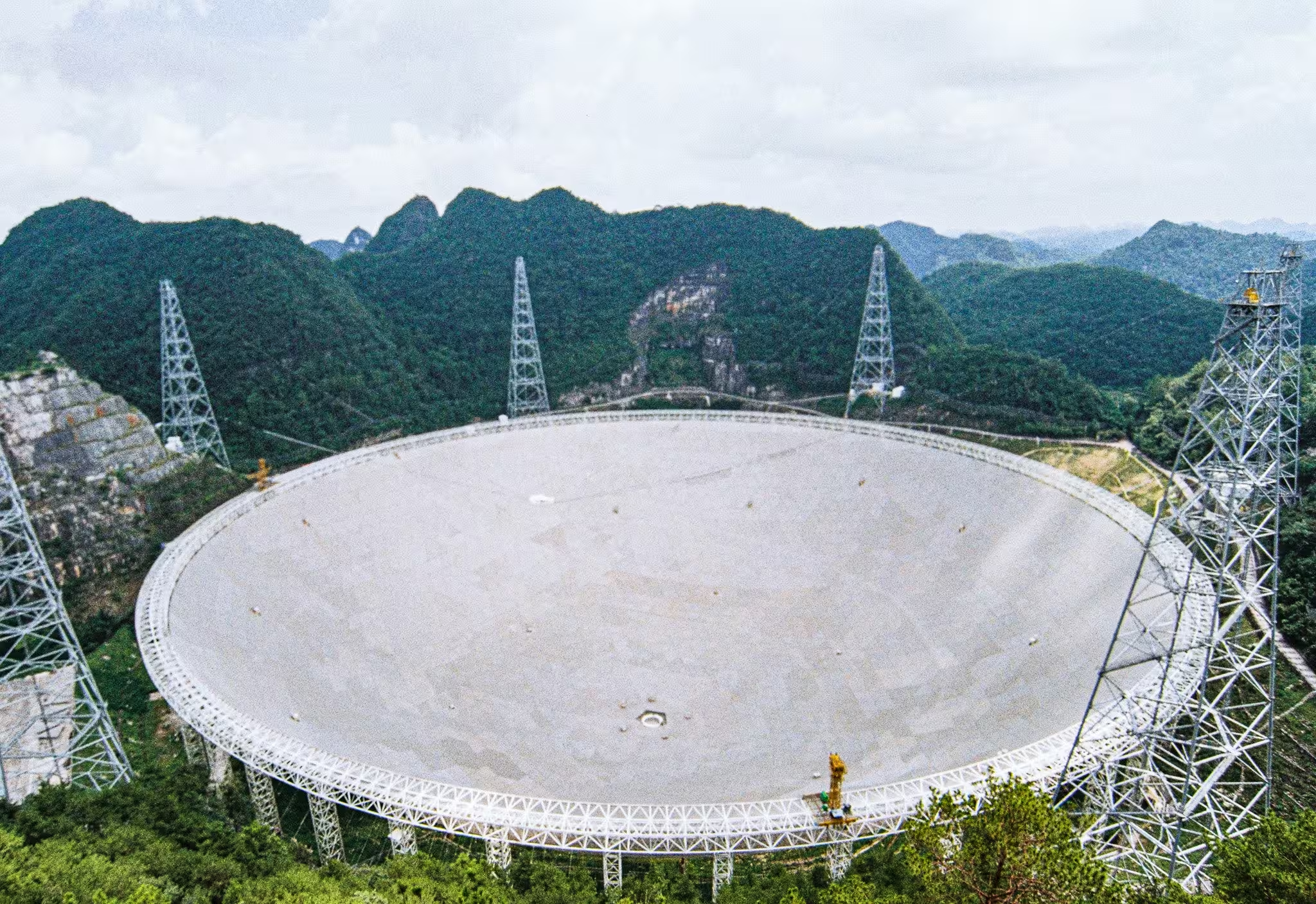
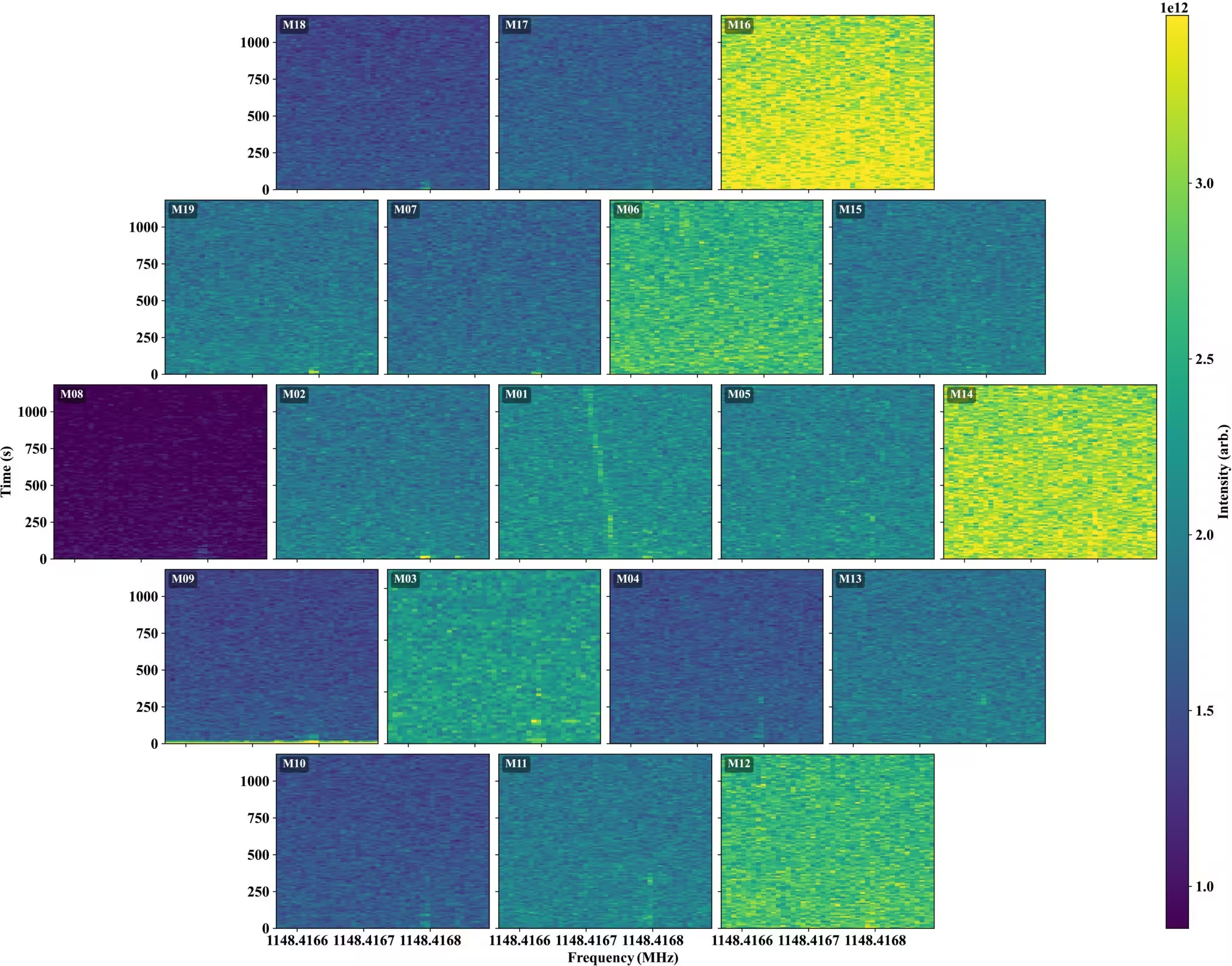
Astronomers analyzing data from China’s Five-hundred-meter Aperture Spherical Radio Telescope (FAST) have identified a peculiar, narrow-band radio signal originating from the direction of K2-155, a star system located approximately 238 light-years from Earth. While the signal exhibited characteristics typically associated with artificial transmissions—such as a specific, narrow frequency and a gradual Doppler drift—researchers emphasize that it is almost certainly a product of terrestrial interference rather than an interstellar broadcast.
New Machine-Learning Approach Filters Cosmic Noise
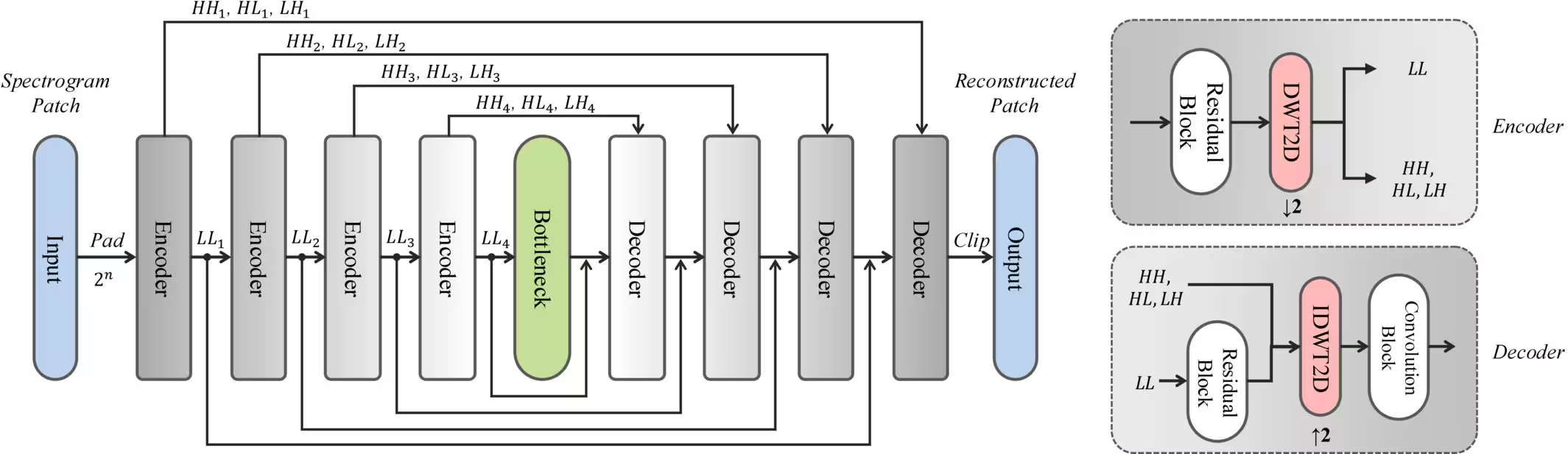
The investigation, published in The Astronomical Journal, was led by Zi-Qi Li of Beijing Normal University. The primary goal was to test a new machine-learning framework designed to sift through massive radio datasets for potential technosignatures. By utilizing a technique called Multiscale Wavelet Net (MSWNet), the team successfully reduced a daunting volume of raw data into a manageable list of signals for human verification.
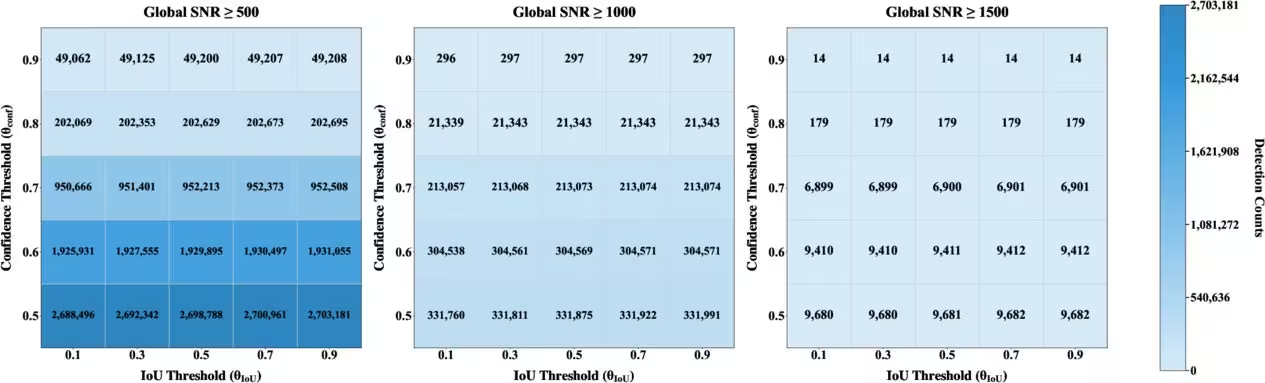
During the screening process, the algorithm processed 139,127 initial detections across 33 exoplanet systems. After applying multi-beam filtering—a technique where FAST compares signals across its 19 simultaneous beams to distinguish between local interference and cosmic sources—only a handful of candidates remained. The signal linked to K2-155, dubbed NBS 260108, was the most notable to emerge from this refined dataset.
Clues Suggest Earthly Origins
Despite its intriguing appearance, the signal failed to pass rigorous follow-up checks. Astronomers noted that the transmission was detected in only one of the telescope’s two polarization channels. Such an imbalance is a hallmark of human-generated signals or instrumental glitches rather than a natural or extraterrestrial source.
Furthermore, similar, recurring signals were detected toward other stars during the same observation session. The presence of these patterns across different targets strongly suggests a local origin. While the team considered various potential sources, including satellites and aviation navigation systems, they could not point to one specific culprit. Consequently, the signal remains unclassified, though it is currently treated as a low-priority candidate for technosignatures.
Advancing the Hunt for Technosignatures
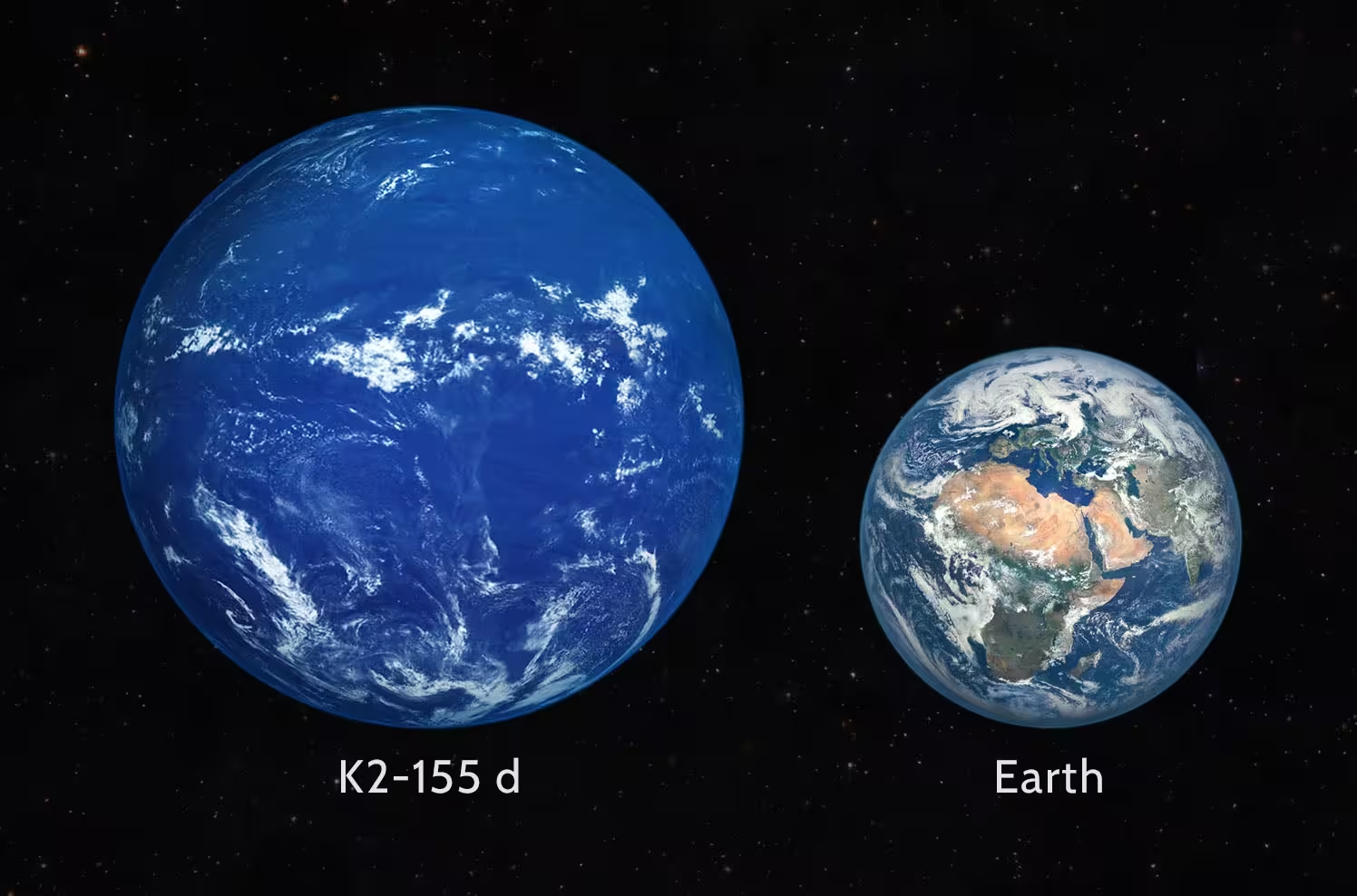
The K2-155 system is of particular interest to astronomers because it hosts three super-Earths, including one that resides near the star’s habitable zone. However, researchers warn that this proximity does not imply the presence of water or life, nor does it elevate the probability of an artificial signal coming from that direction.
The study serves as a proof-of-concept for the MSWNet method, demonstrating that automated pipelines are essential for modern SETI efforts. As radio observatories collect ever-increasing amounts of data, the ability to rapidly distinguish between cosmic potential and the noise of our own technological civilization will remain a cornerstone of space exploration.
Moving forward, the team aims to incorporate raw voltage data from future observations. This would allow for a more granular physical analysis of potential candidates, providing a definitive verification process that goes beyond simple image-based pattern recognition.
For further reading on radio signal detection and verification, explore these peer-reviewed references:
- Conducting high-frequency radio SETI searches using ALMA: An overview of high-frequency technosignature detection. (Monthly Notices of the Royal Astronomical Society, 2025)
- A deep-learning search for technosignatures from 820 nearby stars: Insights into automated signal processing. (Nature Astronomy, 2023)
- Sensitive Multibeam Targeted SETI Observations toward 33 Exoplanet Systems with FAST: The foundational study for the FAST observation campaign. (The Astronomical Journal, 2022)
- Analysis of the Breakthrough Listen signal of interest blc1 with a technosignature verification framework: A comprehensive look at how interference can mimic potential signals. (Nature Astronomy, 2021)
- K2-155: A Bright Metal-poor M Dwarf with Three Transiting Super-Earths: Background on the planetary architecture of the K2-155 system. (The Astronomical Journal, 2018)
This article has been fact checked for accuracy, with information verified against reputable sources. Learn more about us and our editorial process.
Last reviewed on .
Article history
- Latest version
Reference(s)
- Li, Zi-Qi., et al. “A Wavelet-integrated Search Pipeline for Narrowband Technosignatures in FAST Observations of 33 Exoplanet Systems.” The Astronomical Journal, vol. 172, no. 3, August 27, 2026, pp. 180 American Astronomical Society, doi: 10.3847/1538-3881/ae8f34. <https://iopscience.iop.org/article/10.3847/1538-3881/ae8f34>.
- Mason, Louisa A., et al. “Conducting high-frequency radio SETI searches using ALMA.” Monthly Notices of the Royal Astronomical Society, vol. 536, no. 3, December 10, 2024, pp. 2127-2134. Oxford University Press (OUP), doi: 10.1093/mnras/stae2714. <https://doi.org/10.1093/mnras/stae2714>.
- Ma, Peter Xiangyuan., et al. “A deep-learning search for technosignatures from 820 nearby stars.” Nature Astronomy, January 30, 2023 Springer Science and Business Media LLC, doi: 10.1038/s41550-022-01872-z. <https://doi.org/10.1038/s41550-022-01872-z>.
- Tao, Zhen-Zhao., et al. “Sensitive Multibeam Targeted SETI Observations toward 33 Exoplanet Systems with FAST.” The Astronomical Journal, vol. 164, no. 4, September 27, 2022, pp. 160 American Astronomical Society, doi: 10.3847/1538-3881/ac8bd5. <https://doi.org/10.3847/1538-3881/ac8bd5?utm_source=chatgpt.com>.
- Sheikh, Sofia Z.., et al. “Analysis of the Breakthrough Listen signal of interest blc1 with a technosignature verification framework.” Nature Astronomy, vol. 5, no. 11, October 25, 2021, pp. 1153-1162. Springer Science and Business Media LLC, doi: 10.1038/s41550-021-01508-8. <https://doi.org/10.1038/s41550-021-01508-8>.
- Hirano, Teruyuki., et al. “K2-155: A Bright Metal-poor M Dwarf with Three Transiting Super-Earths.” The Astronomical Journal, vol. 155, no. 3, February 23, 2018, pp. 124 American Astronomical Society, doi: 10.3847/1538-3881/aaaa6e. <https://doi.org/10.3847/1538-3881/aaaa6e>.
Cite this page:
- Posted by Aisha Ahmed