Invisible Laser Pulses Turn Plastic Discs Into Working Speakers
New experiments reveal how modulated light striking a membrane can generate clear speech and acoustic waves without conventional electromagnetic drivers.
Invisible laser pulses can transform an ordinary plastic disc into a working loudspeaker, bypassing the need for bulky magnets and copper coils inside the ear canal. Scientists have demonstrated that shining modulated light onto a thin, light-absorbing membrane creates precise physical vibrations that reproduce clear speech and pure musical tones without touching the ear’s delicate structures.
How Light Generates Audible Sound Waves Inside the Ear
When light hits matter, it deposits tiny amounts of energy that rapidly convert into heat and mechanical motion. Researchers Florian Denk, Christin Grill, Anke Leichtle, Hendrik Husstedt, and Ralf Brinkmann published in PLOS One an investigation into how this optoacoustic phenomenon can be harnessed to stimulate human hearing. Instead of relying on conventional electromagnetic drivers that push air through a sealed ear canal, light-based stimulation relies on rapid thermal expansion to generate acoustic pressures.
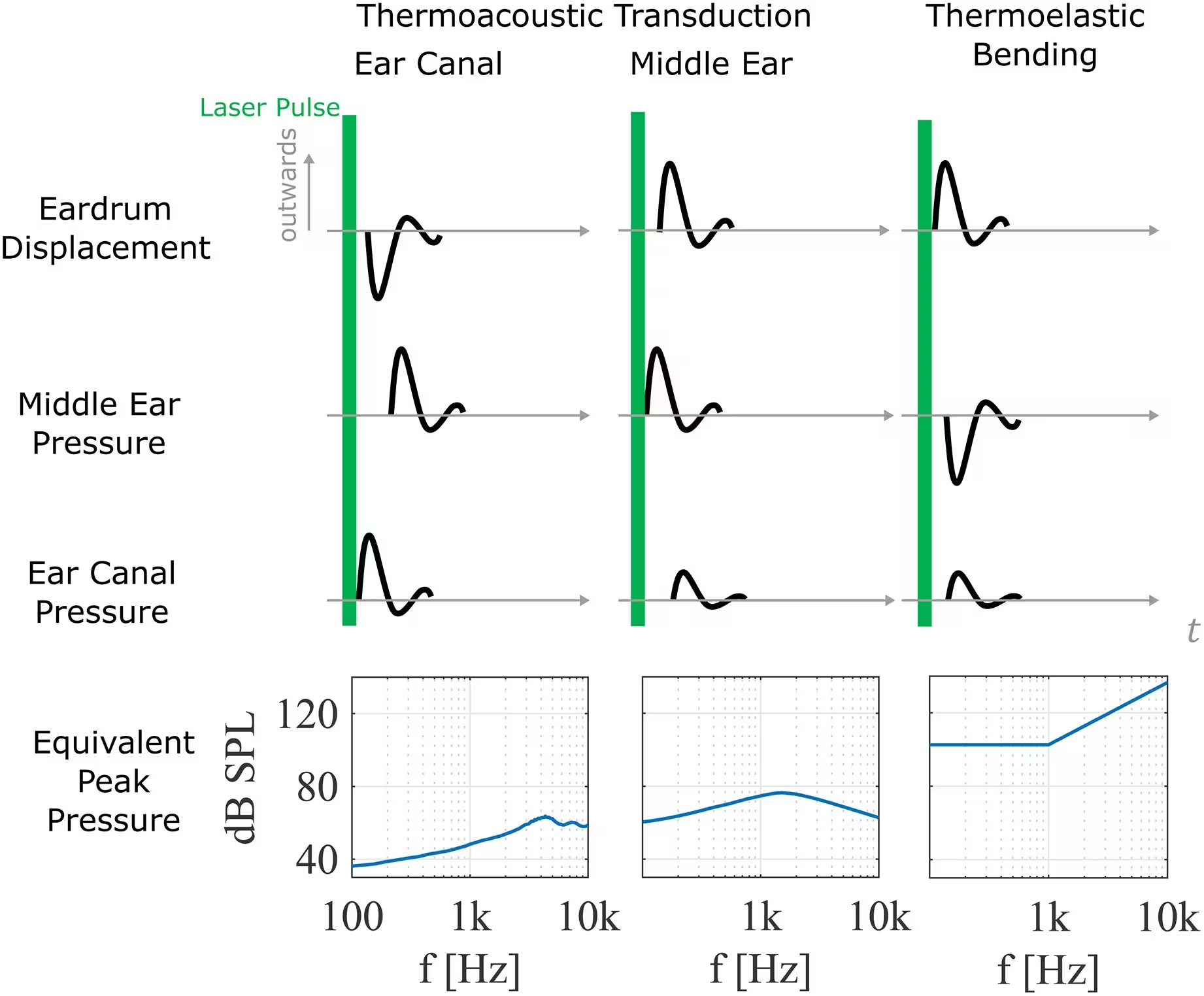
The team evaluated several theoretical mechanisms, including radiation pressure, thermoacoustic air volume expansion, and thermoelastic bending. Their calculations and laboratory experiments revealed that direct radiation pressure and simple thickness expansion create forces far too weak to be useful. However, thermoelastic bending and thermoacoustic air expansion emerged as highly efficient pathways for producing audible sound waves.
Testing Artificial Eardrums in Laboratory Phantoms
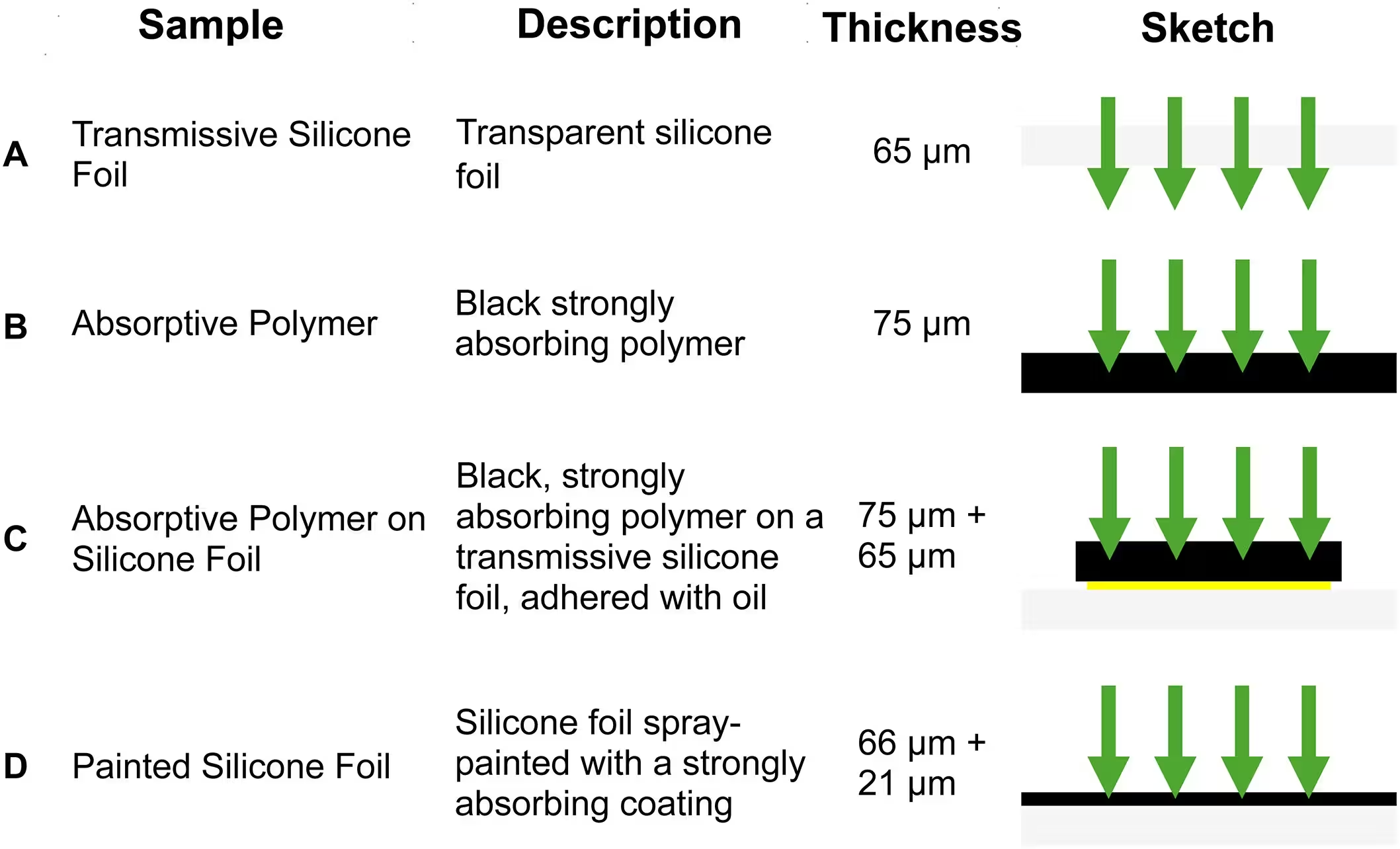
To measure these tiny mechanical reactions, the investigators constructed four distinct artificial eardrum phantoms using a small cylindrical chamber filled with air to mimic the middle ear. These models included a transparent silicone foil, an absorptive polymer disc, a silicone foil coated with a black absorbing paint, and a hybrid combination pairing the polymer disc with the silicone membrane.
Using phase-sensitive optical coherence tomography, a high-resolution laser imaging technique, the team tracked sub-nanometer surface movements synchronized with 50-nanosecond green laser pulses. The painted silicone foil produced the largest physical displacements, exceeding 700 nanometers. Meanwhile, the absorptive polymer generated clean acoustic responses driven by thermoelastic bending, where thermal gradients across the material thickness cause it to curl outward and inward like a bimetallic strip.
Translating Pulses Into Clear Speech and Music
To test whether these light-induced vibrations could carry complex audio signals, the researchers applied an amplitude-modulated laser pulse train running at a repetition rate of 10 kHz. Operating at an average optical power of 25 milliwatts, the system successfully reproduced sinusoidal tones and a recorded speech sample stating, “This is sound made from light.”
The resulting acoustic output achieved equivalent sound pressure levels between 60 and 80 decibels for pure tones, and roughly 42 decibels for the speech sample. While these levels demonstrate that intelligible audio transmission is entirely feasible, the authors note that efficiency must improve by at least 40 decibels to match the output of modern commercial hearing aids while keeping optical power safely below tissue-heating limits.
The research was published in PLOS One on November 18, 2026.
This article has been fact checked for accuracy, with information verified against reputable sources. Learn more about us and our editorial process.
Last reviewed on .
Article history
- Latest version
Reference(s)
- Denk, Florian., et al. “How to hear light—Exploring mechanisms for light-based stimulation of the outer ear.” PLOS One, vol. 21, no. 11, November 18, 2026, pp. e0361459 Public Library of Science (PLoS), doi: 10.1371/journal.pone.0361459. <https://doi.org/10.1371/journal.pone.0361459>.
Cite this page:
- Posted by Bilal Abbasi