Sunflower Crisis in Tanzania Revealed Through New Agricultural Simulation Model
Computer simulations of 1,952 farming households reveal that chemical fertilizers boost peak sunflower harvests but carry hidden risks of failure.

A staggering 87 percent of smallholder sunflower farms in Tanzania operate with local seeds and zero fertilizer, leading to widespread harvest failures where more than half of crops yield under 1 metric ton per hectare. Researchers examining national agricultural census data have uncovered the profound production risks facing East Africa’s vital edible oil sector, which currently battles a massive annual supply deficit of roughly 320,000 metric tons against a domestic demand of up to 570,000 metric tons.
To evaluate how different farming inputs change these odds, agricultural economists turned to computer simulations that generate thousands of possible harvest outcomes based on real-world variability. The study was published in PLOS One on November 18, 2026, offering a detailed look at how weather, soil nutrition, and seed selection collide on small farms.
How Six Different Farming Systems Stack Up Against Drought and Poor Soil
Led by researchers Ibrahim L. Kadigi and Lekumok Kironyi, the team analyzed data from the 2019/20 National Sample Census of Agriculture. They divided the country’s sunflower growers into six distinct management categories. These ranged from the most common baseline of local seeds with no fertilizer up to advanced combinations of improved seed varieties paired with organic manure or inorganic chemical nutrients.
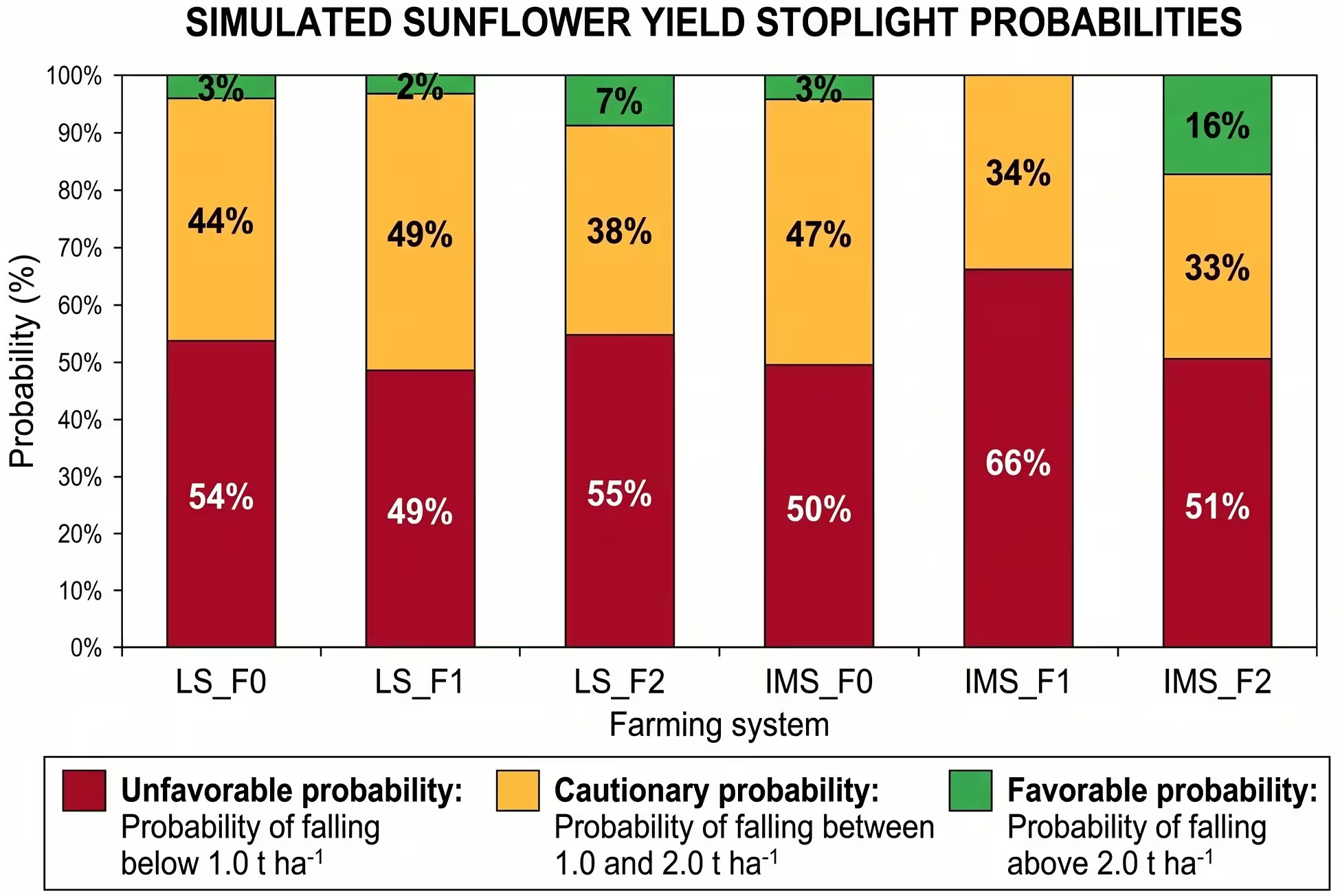
By running a specialized simulation technique known as a Monte Carlo model, the authors projected 500 potential yield variations for each of the six setups. This approach captures the full spectrum of agricultural risk rather than relying on simple averages that can hide catastrophic crop failures. The analysis set two benchmarks for success and failure, marking 1 ton per hectare as a low-productivity red zone and 2 tons per hectare as an optimistic green zone.
The Hidden Catch Behind High-Yield Input Combinations
The numbers revealed that pairing improved seeds with inorganic fertilizers offered the highest peak performance, pushing average simulated yields to 1.138 metric tons per hectare and raising the chance of breaking the 2-ton ceiling to 16 percent. However, this high-input approach also introduced immense volatility, carrying a 51 percent probability that harvests would still drop below the 1-ton danger mark.
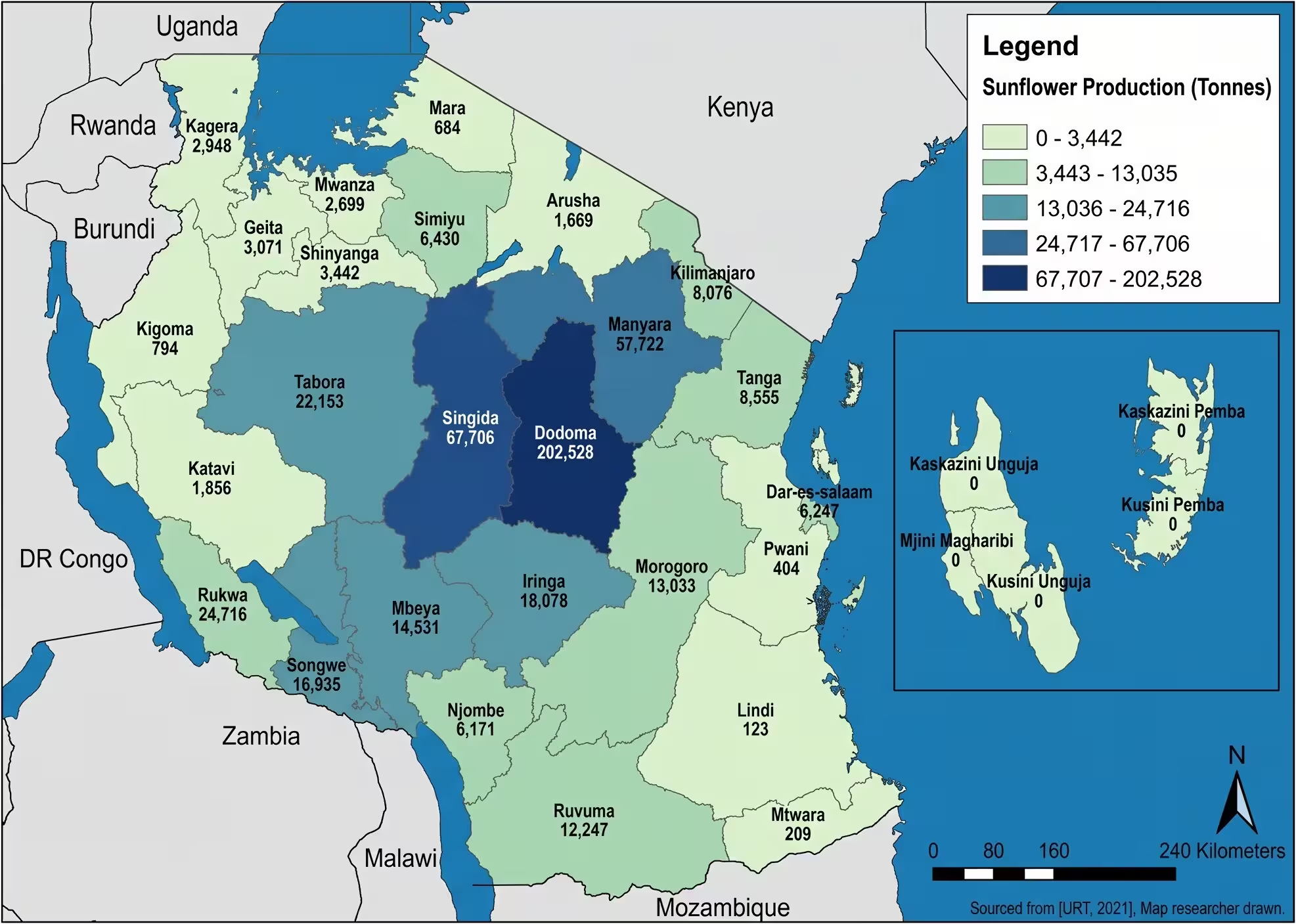
Meanwhile, using organic fertilizers alongside local seeds yielded an average of 1.046 tons per hectare, performing almost identically to the unfertilized local seed baseline. The team noted that organic amendments improve long-term soil health and moisture retention, but their slow nutrient release may fail to meet immediate crop demands during critical growth windows in semi-arid regions like Dodoma and Singida.
Why Simple Government Recommendations Fall Short for Farmers
The authors emphasize that simply pushing farmers to adopt a single technology will not solve Tanzania’s edible oil shortage. Because rainfall patterns, soil compositions, and financial resources vary wildly across regions, a blanket fertilizer policy risks plunging vulnerable smallholders into debt if weather shocks ruin their crops.
Future agricultural strategies must look beyond average yields and focus on integrated soil management, localized extension services, and financial safety nets like crop insurance. Only by combining high-yielding seeds with balanced nutrients and robust risk management can smallholders reliably bridge the country’s vegetable oil gap.
The research was published in PLOS One on November 18, 2026.
This article has been fact checked for accuracy, with information verified against reputable sources. Learn more about us and our editorial process.
Last reviewed on .
Article history
- Latest version
Reference(s)
- Kadigi, Ibrahim L.., et al. “A Multivariate Empirical (MVE) simulation approach to modeling sunflower yield risk and productivity under alternative farming practices in Tanzania.” PLOS One, vol. 21, no. 11, November 18, 2026, pp. e0363039 Public Library of Science (PLoS), doi: 10.1371/journal.pone.0363039. <https://doi.org/10.1371/journal.pone.0363039>.
Cite this page:
- Posted by Michael Ellison