New Mathematical Framework Tracks Invisible Air Turbulence Across Atmosphere
Researchers replace rigid weather formulas with a flexible model that links optical turbulence directly to shifting surface heat fluxes and atmospheric stability.

Invisible atmospheric turbulence blurs distant stars and distorts laser communications, but researchers have created a flexible mathematical hierarchy to model these optical distortions with unprecedented precision. By tying turbulence calculations directly to shifting weather patterns rather than relying on fixed altitude guesses, the new approach captures how invisible air layers move and change.
Light traveling through the air encounters random fluctuations in air density and temperature, collectively known as optical turbulence. These fluctuations ruin astronomical images and disrupt satellite laser links, making accurate forecasting essential. For decades, scientists relied heavily on the classic Hufnagel-Valley model, a standard formula that assumes turbulence follows a rigid, smooth curve based mostly on height and wind speed. However, real-world measurements show that the atmosphere is far more dynamic, featuring localized mixing layers, temperature inversions, and shifting boundary conditions that a static formula simply cannot track.
To resolve these discrepancies, a team of researchers developed a regime-dependent parameterization framework. The study, available on the arXiv preprint server, details a composite formulation that divides the atmosphere into distinct overlapping zones. Instead of applying a single universal equation, the authors combined established meteorological equations using smooth transition functions to represent different atmospheric states realistically.
In the lowest part of the atmosphere known as the surface layer, the model calculates optical turbulence using Monin-Obukhov similarity theory, which accounts for surface heat fluxes, friction velocity, and atmospheric stability. This means two different days with identical wind speeds and temperatures can produce completely different turbulence levels depending on how much heat radiates from the ground. Higher up in the atmospheric boundary layer, the framework switches between a strongly convective profile and stable or near-neutral formulations. For the free atmosphere stretching into the upper skies, the authors utilized a dissipation-based closure tied to turbulent kinetic energy and temperature variance.
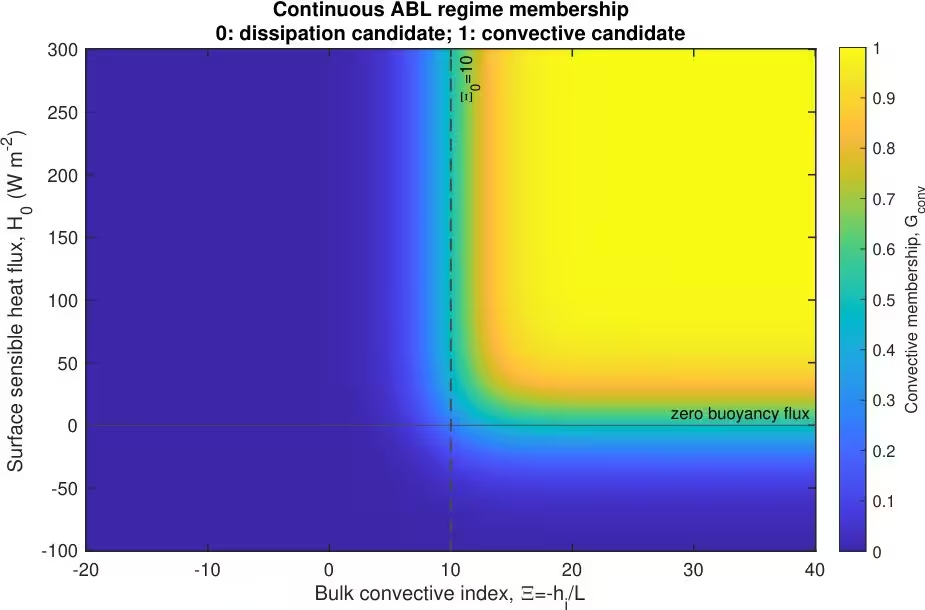
To blend these distinct regions without creating artificial mathematical jumps, the team designed a set of height-dependent local weights that sum to unity. This mathematical construction ensures the profile remains continuous and physically interpretable as the active meteorological description transitions from the ground all the way to the upper atmosphere. The authors tested their framework using synthetic meteorological profiles to evaluate sensitivity to heat fluxes and boundary layer heights.
The resulting calculations demonstrate that meteorological conditioning can shift point turbulence values by orders of magnitude compared to traditional static models. Furthermore, propagation-weighted integrals and simulated scintillation diagnostics showed significant variations, highlighting how mobile turbulent layers change light transport. While the current work establishes mathematical consistency and responsiveness rather than immediate observational proof, it offers a robust foundation for future validation against real-world weather data and vertically resolved turbulence measurements.
The study was posted to the arXiv preprint server on November 17, 2026.
This article has been fact checked for accuracy, with information verified against reputable sources. Learn more about us and our editorial process.
Last reviewed on .
Article history
- Latest version
Reference(s)
- Ata, Yalçın. “A regime dependent parameterization of the refractive-index structure parameter $C_n^2$.” arXiv.org <http://arxiv.org/abs/2611.22641v1>.
Cite this page:
- Posted by Michael Ellison