New Statistical Tool Uncovers Hidden Gene Interactions Behind Diabetes and Hypertension Comorbidity
Researchers introduce a flexible framework that models gene-gene interactions across multiple binary health outcomes, revealing novel genetic crosstalk in biobank data.

A new statistical method called GiMat helps researchers uncover how pairs of genes interact to influence multiple health conditions at the same time. The framework addresses a major bottleneck in genetics research by examining how gene-gene interactions drive complex diseases like type 2 diabetes and hypertension. A study detailing the approach was published in PLOS Computational Biology on November 18, 2026, offering fresh tools to explore the hidden architecture of human disease comorbidity.
Why Traditional Genetic Studies Miss Complex Disease Links
Genome-wide association studies have successfully mapped thousands of genetic variants tied to specific traits. Yet, these single-phenotype analyses often account for only a fraction of overall disease heritability. Scientists suspect that much of this missing heritability stems from gene-gene interactions, where the effect of one genetic variant modifies the impact of another. However, detecting these interactions across multiple binary outcomes, such as having a disease or not having it, remains remarkably difficult because of sparse data matrices and limited statistical power.
To overcome these hurdles, a research team led by Siru Wang, Xuhui Zhu, Yu Li, and Gengjie Jia designed GiMat, which stands for Gene Interaction and Multiple-phenotype Association Test. The method extends multivariate kernel regression to model gene-gene interactions jointly across multiple dichotomous phenotypes. By accommodating both homogeneous and heterogeneous interaction effects, the framework adapts flexibly to different biological scenarios without sacrificing statistical rigor.
How Different Kernel Structures Capture Hidden Genetic Patterns
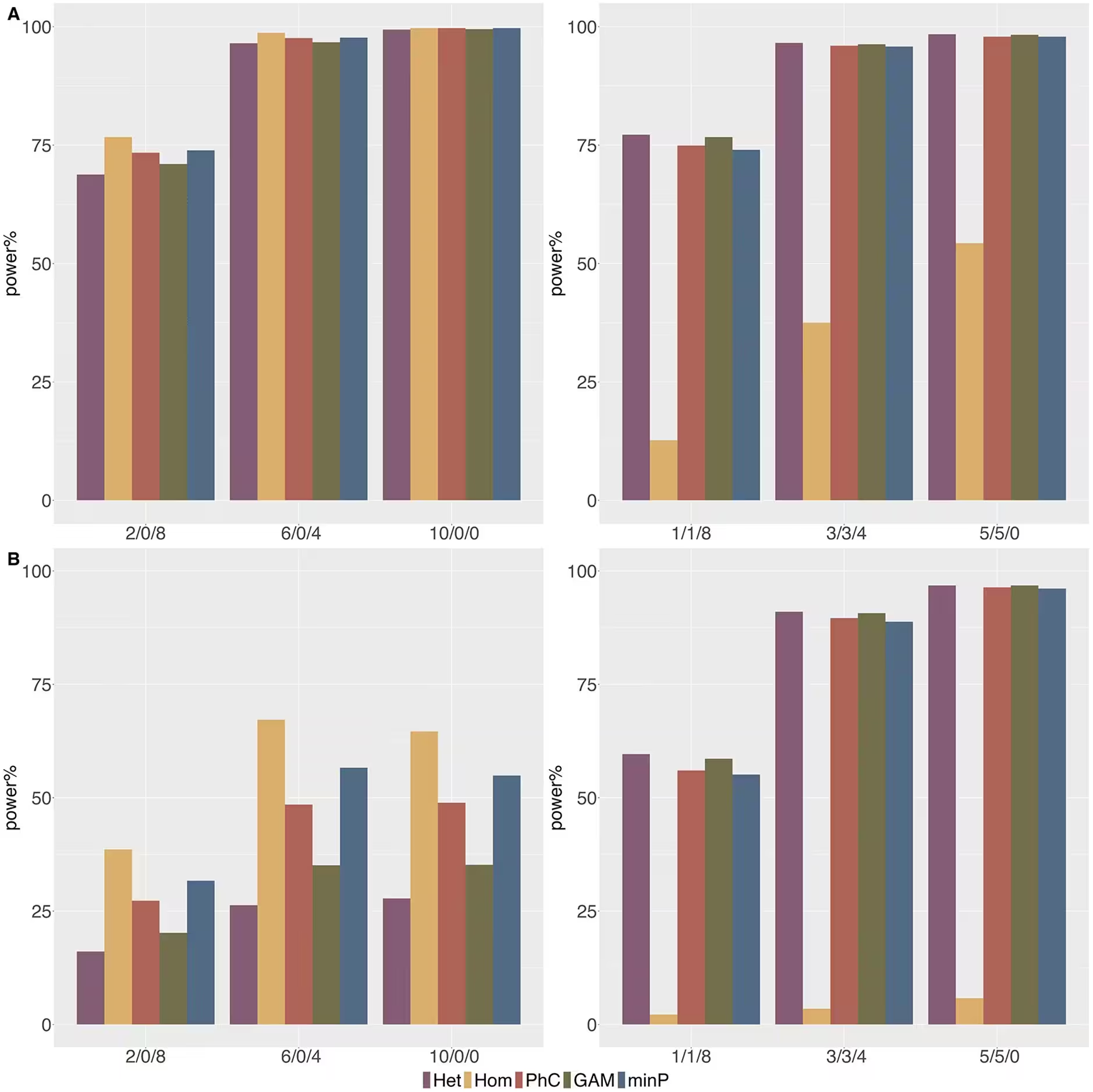
The GiMat framework incorporates several specialized mathematical kernels to test different patterns of genetic interaction. A homogeneous kernel assumes that interaction effects operate in the same direction across all analyzed phenotypes. Conversely, a heterogeneous kernel allows effects to be uncorrelated or even act in opposing directions across different health conditions. A phenotype covariance kernel scales with the residual phenotypic covariance after adjusting for non-genetic covariates.
Because researchers often lack prior knowledge about the true underlying biological structure, GiMat includes an omnibus test using a fast copula-based strategy to compute minimum p-values across all kernel options. Extensive simulation work demonstrated that GiMat maintains conservative control over type I error rates across various disease prevalence levels and phenotype correlations. Furthermore, the framework showed high statistical power to detect interactions even when effect sizes were relatively small, outperforming traditional single-phenotype approaches like BOOST.
Uncovering Novel Gene Pairs Linked to Diabetes and Hypertension
To test the method on real-world data, the authors analyzed genetic information from hundreds of thousands of unrelated White British participants in the UK Biobank. They focused on the comorbidity between type 2 diabetes and hypertension, stratifying patients into subgroups based on the time interval between the two diagnoses. The analysis revealed four significant gene-gene interaction pairs, including SLC30A8-MTHFR, DXO-ZBTB10, INS-RP1L1, and EHMT2-HLA-DQB1.
For instance, the interaction between SLC30A8 and MTHFR showed particularly strong signals when type 2 diabetes onset preceded hypertension by less than five years. SLC30A8 encodes a zinc transporter crucial for insulin secretion, while MTHFR plays a key role in folate metabolism. The statistical findings suggest a biological crosstalk between zinc transport and methionine metabolism, which may help explain why early metabolic dysregulation in diabetes primes hypertensive pathophysiology. Additional validation using tissue co-expression data from the Genotype-Tissue Expression project and protein network databases supported the biological plausibility of these detected links.
Limitations and Next Steps for Precision Medicine
Despite these promising discoveries, the study authors note several limitations that warrant caution. First, the current implementation has not yet been evaluated for rare variant interactions, meaning the findings are primarily restricted to common genetic variants. Second, stringent case-control matching and quality control steps substantially reduce sample sizes, highlighting the need for adaptive sampling strategies in future large-scale biobank analyses.
Statistical interactions alone do not automatically prove direct physical contact between proteins, requiring multi-tiered validation such as functional assays and structural modeling. Nevertheless, the scalability and interpretability of GiMat provide a powerful methodological bridge, offering researchers a robust way to dissect the shared genetic architecture of complex comorbidities and advance precision healthcare.
The research was published in PLOS Computational Biology on November 18, 2026.
This article has been fact checked for accuracy, with information verified against reputable sources. Learn more about us and our editorial process.
Last reviewed on .
Article history
- Latest version
Reference(s)
- Wang, Siru., et al. “A statistical framework to identify gene-gene interactions underlying multiple dichotomous phenotypes from genotype data.” PLOS Computational Biology, vol. 22, no. 11, November 18, 2026, pp. e1014962 Public Library of Science (PLoS), doi: 10.1371/journal.pcbi.1014962. <https://doi.org/10.1371/journal.pcbi.1014962>.
Cite this page:
- Posted by Faisal Qureshi