Giant Hornet Brain Chemistry Reveals Surprising Parallel With Social Bees
Chemistry

Giant Hornet Brain Chemistry Reveals Surprising Parallel With Social Bees

New research on Vespa mandarinia shows that caste-specific brain dopamine levels converge across independent insect lineages.
By Bilal Abbasi
Published:
Email this Article
Giant Hornet Brain Chemistry Reveals Surprising Parallel With Social Bees
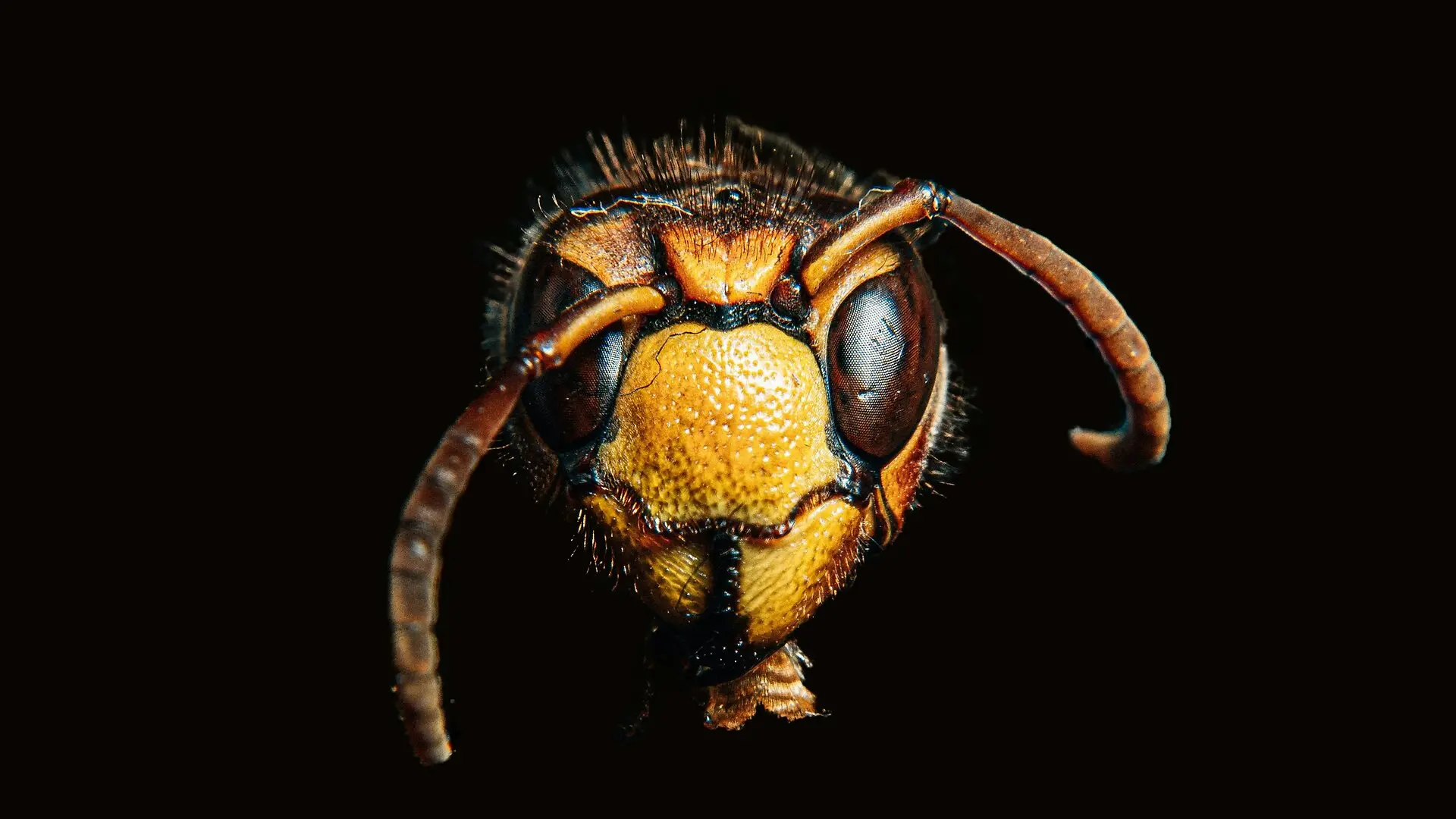
Photo by Max Muselmann on Unsplash

Newly emerged giant hornet gynes carry significantly higher brain dopamine levels than workers of the same age, revealing a striking chemical parallel with advanced eusocial bees. Researchers tracked brain chemistry, lipid reserves, and ovarian growth across multiple life stages in Vespa mandarinia to uncover how neuroactive chemicals regulate caste-specific behaviors.

Measuring Brain Chemistry Across Hornet Life Stages

To understand the physiological drivers behind complex social structures, the authors analyzed concentrations of biogenic amines in female giant hornets collected from wild colonies and laboratory settings in Japan. The study, published in PLOS One, focused on catecholamines like dopamine, phenolamines such as tyramine, and indolamines including serotonin. These chemical messengers act as neurotransmitters, neuromodulators, and neurohormones in insects.

The team measured physical traits, including thoracic width as a marker of body size and ovariole numbers to gauge reproductive capacity. They also dissected specific brain regions, such as the optic lobes responsible for visual processing, the antennal lobes handling scent, the central brain region integrating sensory data, and the suboesophageal ganglion controlling feeding. Lipid storage in the abdomen and maximum oocyte lengths were quantified to map physiological shifts from emergence through hibernation to colony founding.

Dopamine Distinguishes Castes From the Moment of Emergence

The analyses showed that newly emerged gynes, which are reproductive females destined to become queens, possessed significantly higher levels of dopamine and its precursors in the whole brain than newly emerged workers. This pattern matches trends observed in honey bees and bumble bees, suggesting an evolutionary convergence in brain chemistry among highly eusocial insects. In contrast, workers displayed significantly higher levels of serotonin-related substances at emergence than gynes did.
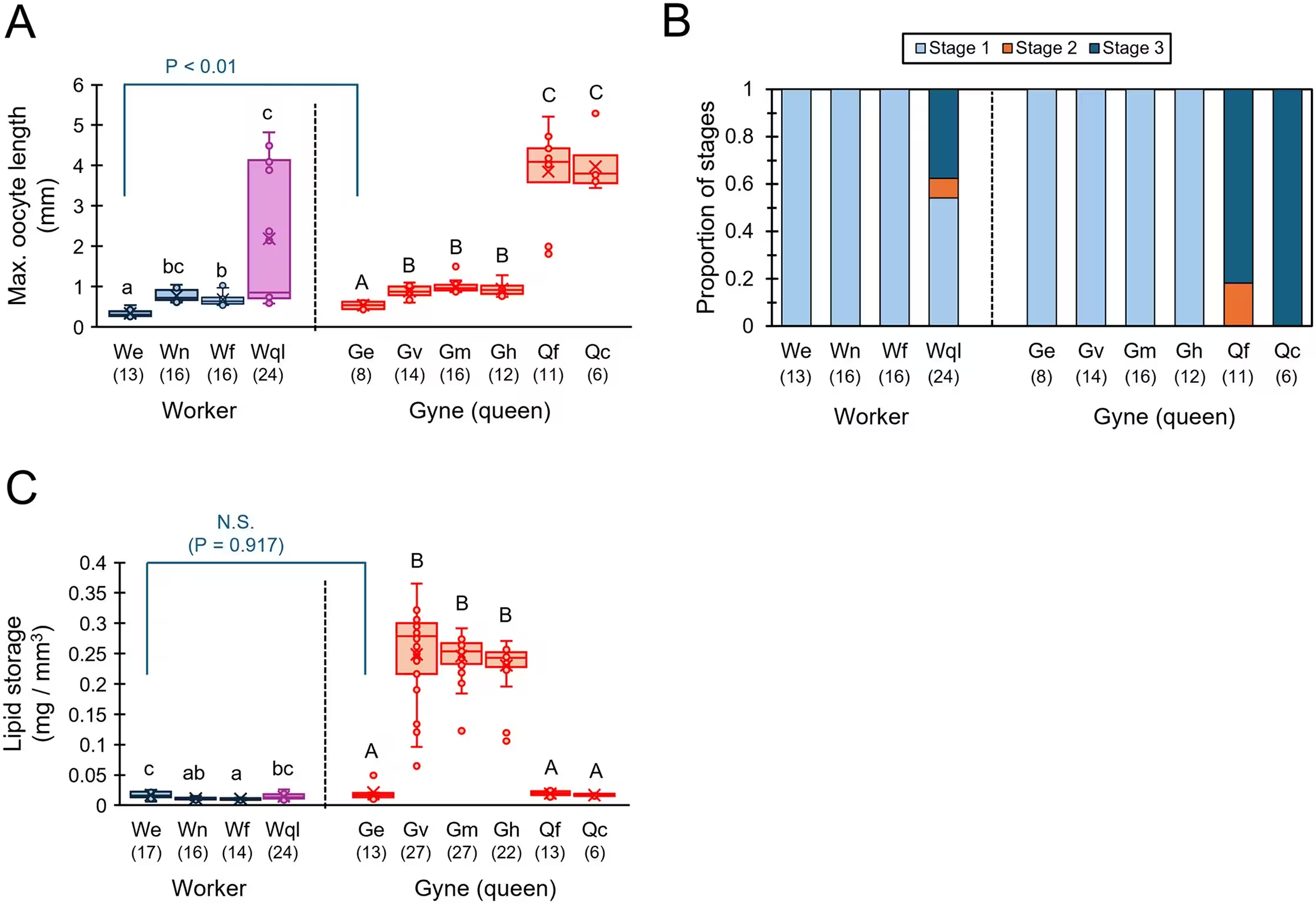
Fig 1: Maximum oocyte lengths in the ovarioles (A), ovarian developmental stages (B) and lipid storage in the abdomen (C) in females across different life stages in Vespa mandarinia. Numbers in parentheses indicate sample size. The different letters above the boxes (small and large capitals) indicate the statistical differences among groups by the Steel-Dwass multiple comparison test (P < 0.05) in workers and gynes (queens), respectively. The caste differences of newly emerged individuals (We vs. Ge) were assessed using the Mann-Whitney U test (letters in blue). Box and whisker plots display the median (the line inside the box), the first and third quartiles (the upper and lower outlines of the box), the minimum and maximum values (the whiskers). The mean value is indicated by a “X” inside the box. Newly emerged worker, We; nurse, Wn; forager, Wf; queenless worker, Wql; newly emerged gyne, Ge; virgin gyne, Gv; mated gyne, Gm; hibernating gyne, Gh; founding queen, Qf; colony queen, Qc.
Maximum oocyte lengths in the ovarioles (A), ovarian developmental stages (B) and lipid storage in the abdomen (C) in females across different life stages in Vespa mandarinia. Numbers in parentheses indicate sample size. The different letters above the boxes (small and large capitals) indicate the statistical differences among groups by the Steel-Dwass multiple comparison test (P < 0.05) in workers and gynes (queens), respectively. The caste differences of newly emerged individuals (We vs. Ge) were assessed using the Mann-Whitney U test (letters in blue). Box and whisker plots display the median (the line inside the box), the first and third quartiles (the upper and lower outlines of the box), the minimum and maximum values (the whiskers). The mean value is indicated by a “X” inside the box. Newly emerged worker, We; nurse, Wn; forager, Wf; queenless worker, Wql; newly emerged gyne, Ge; virgin gyne, Gv; mated gyne, Gm; hibernating gyne, Gh; founding queen, Qf; colony queen, Qc. Credit: Ken Sasaki et al. / PLOS One

Body size measurements confirmed clear morphological divides, with gynes exhibiting an average thoracic width of 11.24 millimeters compared to 8.05 millimeters for workers. Gynes also possessed slightly more ovarioles than workers, averaging 10.8 tubes per ovary versus 10.3. However, physiological traits showed high plasticity across life stages.

Plestic Shifts in Fat Storage and Egg Development

Abdominal lipid storage varied widely depending on the life stage, peaking in virgin, mated, and hibernating gynes as a critical energy reserve for surviving winter. Newly emerged gynes stored fewer lipids, and active founding or colony queens showed depleted fat stores after investing heavily in egg production. Oocyte lengths remained small in newly emerged gynes but grew significantly in founding and colony queens.
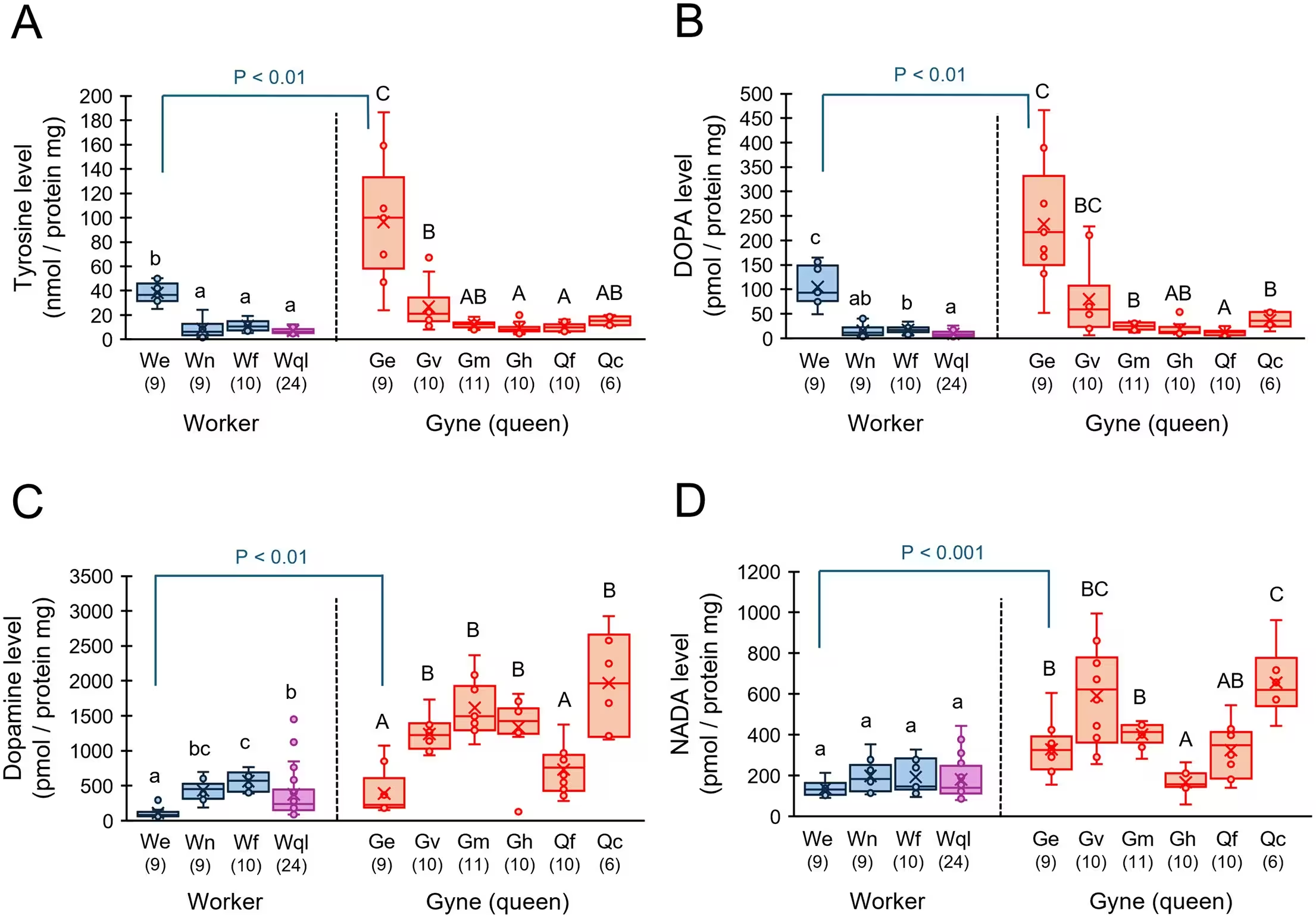
Fig 2: Levels of dopamine-related substances in the whole brain of females at different life stages in V. mandarinia. The numbers in parentheses indicate the sample size. The different letters above the boxes (small and large capitals) indicate the statistical differences among groups by the Steel-Dwass multiple comparison test (P < 0.05) in workers and gynes (queens), respectively. Caste differences at emergence (We vs. Ge) were assessed by using the Mann-Whitney U test (letters in blue). Box and whisker plots display the median (the line inside the box), the first and third quartiles (the upper and lower outlines of the box), the minimum and maximum values (the whiskers). The mean value is indicated by a “X” inside the box. Newly emerged worker, We; nurse, Wn; forager, Wf; queenless worker, Wql; newly emerged gyne, Ge; virgin gyne, Gv; mated gyne, Gm; hibernating gyne, Gh; founding queen, Qf; colony queen, Qc.
Levels of dopamine-related substances in the whole brain of females at different life stages in V. mandarinia. The numbers in parentheses indicate the sample size. The different letters above the boxes (small and large capitals) indicate the statistical differences among groups by the Steel-Dwass multiple comparison test (P < 0.05) in workers and gynes (queens), respectively. Caste differences at emergence (We vs. Ge) were assessed by using the Mann-Whitney U test (letters in blue). Box and whisker plots display the median (the line inside the box), the first and third quartiles (the upper and lower outlines of the box), the minimum and maximum values (the whiskers). The mean value is indicated by a “X” inside the box. Newly emerged worker, We; nurse, Wn; forager, Wf; queenless worker, Wql; newly emerged gyne, Ge; virgin gyne, Gv; mated gyne, Gm; hibernating gyne, Gh; founding queen, Qf; colony queen, Qc. Credit: Ken Sasaki et al. / PLOS One

When researchers evaluated queenless workers, they observed that some individuals developed active ovaries within 10 days. In these queenless workers, maximum oocyte length correlated positively with dopamine and its precursors, indicating that catecholamine pathways can be upregulated when social hierarchies collapse. However, normal gynes in the study did not exhibit this direct link between dopamine and egg maturation.

Regional Brain Variations and Future Directions

Sub-compartment analyses of the hornet brain showed that elevated dopamine in gynes localized primarily to the antennal lobes, central brain, and suboesophageal ganglion, while optic lobes showed no caste differences at emergence. Meanwhile, tyramine levels in the optic lobes increased gradually as gynes transitioned from emergence toward hibernation in cold, dark environments.

The authors note that while these measurements highlight distinct neurochemical signatures associated with specific tasks and life stages, further functional experiments are necessary to confirm how these brain chemicals directly alter insect behavior. The findings establish that despite independent evolutionary origins, highly eusocial hornets and bees share underlying neurochemical strategies for organizing colony labor.

The research was published in PLOS One on November 18, 2026.

Fact Checked

This article has been fact checked for accuracy, with information verified against reputable sources. Learn more about us and our editorial process.

Last reviewed on .

Article history

  • Latest version

Cite this page:

Abbasi, Bilal. “Giant Hornet Brain Chemistry Reveals Surprising Parallel With Social Bees.” BioScience. BioScience ISSN 2521-5760, 18 November 2026. <https://www.bioscience.com.pk/en/subject/chemistry/caste-specific-dynamics-of-brain-biogenic-amine-levels-and-physiological-states-through-the-life-cycle-in-the-giant-hornet-vespa-mandarinia>. Abbasi, B. (2026, November 18). “Giant Hornet Brain Chemistry Reveals Surprising Parallel With Social Bees.” BioScience. ISSN 2521-5760. Retrieved November 18, 2026 from https://www.bioscience.com.pk/en/subject/chemistry/caste-specific-dynamics-of-brain-biogenic-amine-levels-and-physiological-states-through-the-life-cycle-in-the-giant-hornet-vespa-mandarinia Abbasi, Bilal. “Giant Hornet Brain Chemistry Reveals Surprising Parallel With Social Bees.” BioScience. ISSN 2521-5760. https://www.bioscience.com.pk/en/subject/chemistry/caste-specific-dynamics-of-brain-biogenic-amine-levels-and-physiological-states-through-the-life-cycle-in-the-giant-hornet-vespa-mandarinia (accessed November 18, 2026).
End of the article